Story maps · Grades 11–12
Tess of the d'Urbervilles: A Story Map
The PDF is one tabloid page (11 × 17 in). On letter paper, choose “Fit to page.”
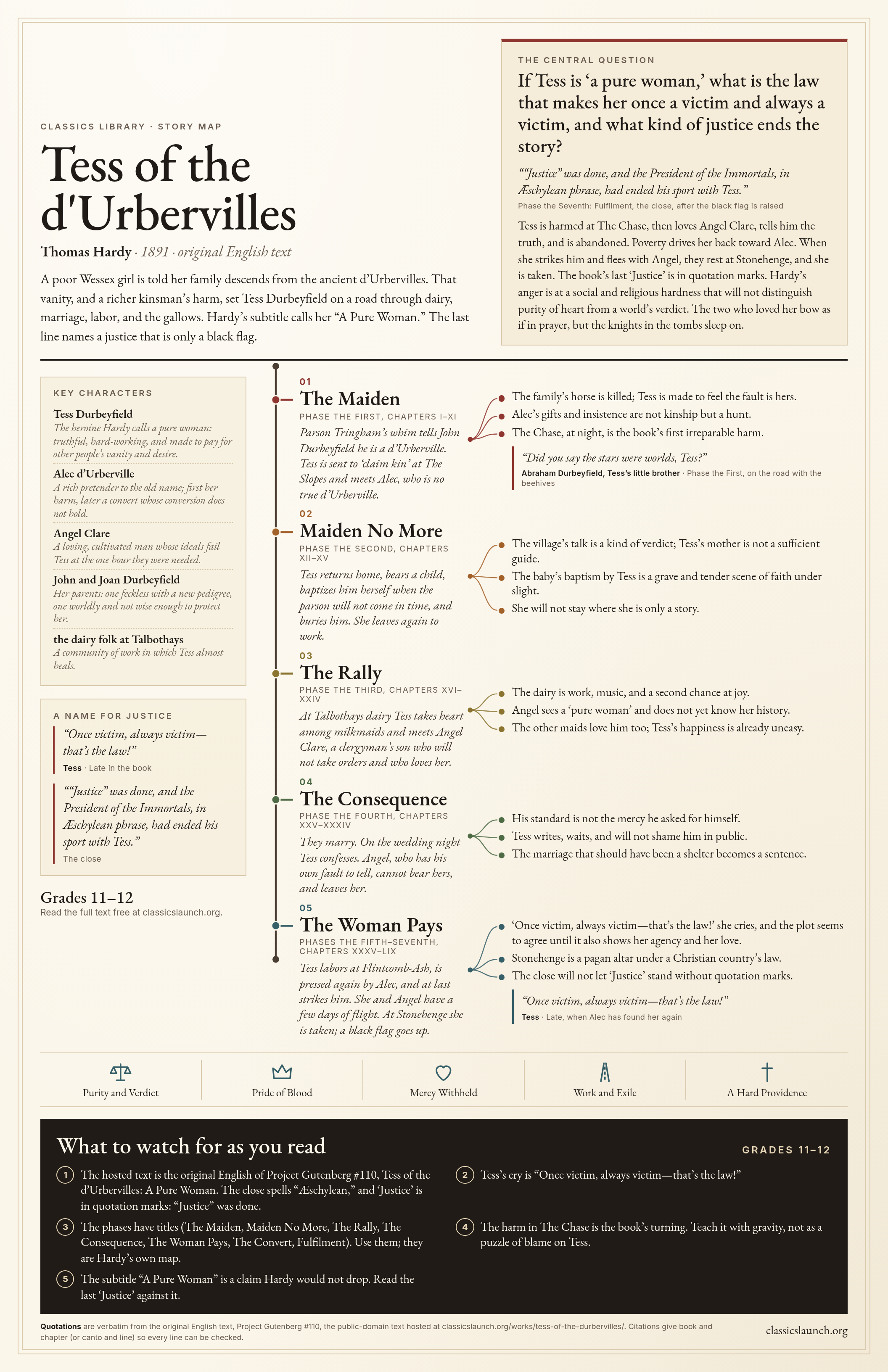
A poor Wessex girl is told her family descends from the ancient d’Urbervilles. That vanity, and a richer kinsman’s harm, set Tess Durbeyfield on a road through dairy, marriage, labor, and the gallows. Hardy’s subtitle calls her “A Pure Woman.” The last line names a justice that is only a black flag.
The central question
If Tess is ‘a pure woman,’ what is the law that makes her once a victim and always a victim, and what kind of justice ends the story?
““Justice” was done, and the President of the Immortals, in Æschylean phrase, had ended his sport with Tess.”
Tess is harmed at The Chase, then loves Angel Clare, tells him the truth, and is abandoned. Poverty drives her back toward Alec. When she strikes him and flees with Angel, they rest at Stonehenge, and she is taken. The book’s last ‘Justice’ is in quotation marks. Hardy’s anger is at a social and religious hardness that will not distinguish purity of heart from a world’s verdict. The two who loved her bow as if in prayer, but the knights in the tombs sleep on.
- 01
The Maiden
Phase the First, Chapters I–XI
Parson Tringham’s whim tells John Durbeyfield he is a d’Urberville. Tess is sent to ‘claim kin’ at The Slopes and meets Alec, who is no true d’Urberville.
- The family’s horse is killed; Tess is made to feel the fault is hers.
- Alec’s gifts and insistence are not kinship but a hunt.
- The Chase, at night, is the book’s first irreparable harm.
“Did you say the stars were worlds, Tess?”
- 02
Maiden No More
Phase the Second, Chapters XII–XV
Tess returns home, bears a child, baptizes him herself when the parson will not come in time, and buries him. She leaves again to work.
- The village’s talk is a kind of verdict; Tess’s mother is not a sufficient guide.
- The baby’s baptism by Tess is a grave and tender scene of faith under slight.
- She will not stay where she is only a story.
- 03
The Rally
Phase the Third, Chapters XVI–XXIV
At Talbothays dairy Tess takes heart among milkmaids and meets Angel Clare, a clergyman’s son who will not take orders and who loves her.
- The dairy is work, music, and a second chance at joy.
- Angel sees a ‘pure woman’ and does not yet know her history.
- The other maids love him too; Tess’s happiness is already uneasy.
- 04
The Consequence
Phase the Fourth, Chapters XXV–XXXIV
They marry. On the wedding night Tess confesses. Angel, who has his own fault to tell, cannot bear hers, and leaves her.
- His standard is not the mercy he asked for himself.
- Tess writes, waits, and will not shame him in public.
- The marriage that should have been a shelter becomes a sentence.
- 05
The Woman Pays
Phases the Fifth–Seventh, Chapters XXXV–LIX
Tess labors at Flintcomb-Ash, is pressed again by Alec, and at last strikes him. She and Angel have a few days of flight. At Stonehenge she is taken; a black flag goes up.
- ‘Once victim, always victim—that’s the law!’ she cries, and the plot seems to agree until it also shows her agency and her love.
- Stonehenge is a pagan altar under a Christian country’s law.
- The close will not let ‘Justice’ stand without quotation marks.
“Once victim, always victim—that’s the law!”
- Purity and Verdict
- Pride of Blood
- Mercy Withheld
- Work and Exile
- A Hard Providence
What to watch for as you read
Grades 11–12- The hosted text is the original English of Project Gutenberg #110, Tess of the d’Urbervilles: A Pure Woman. The close spells “Æschylean,” and ‘Justice’ is in quotation marks: “Justice” was done.
- Tess’s cry is “Once victim, always victim—that’s the law!”
- The phases have titles (The Maiden, Maiden No More, The Rally, The Consequence, The Woman Pays, The Convert, Fulfilment). Use them; they are Hardy’s own map.
- The harm in The Chase is the book’s turning. Teach it with gravity, not as a puzzle of blame on Tess.
- The subtitle “A Pure Woman” is a claim Hardy would not drop. Read the last ‘Justice’ against it.
Every quotation is word for word from the original English text hosted in this library and is checked against that text each time the site is built. Citations give book and chapter (or canto and line).