Story maps · Grades 9–12
The Age of Alexander: Nine Greek Lives: A Story Map
The PDF is one tabloid page (11 × 17 in). On letter paper, choose “Fit to page.”
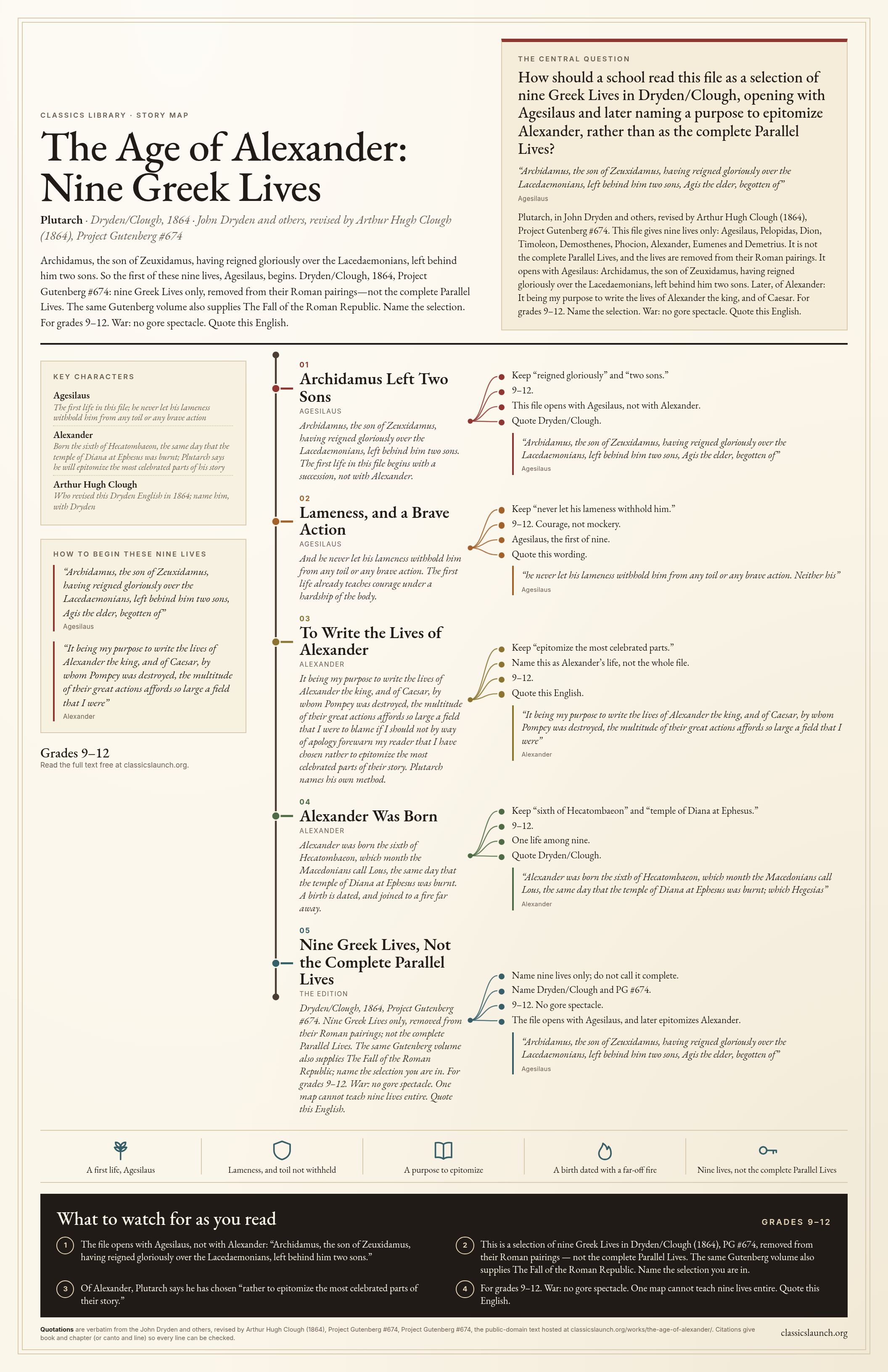
Archidamus, the son of Zeuxidamus, having reigned gloriously over the Lacedaemonians, left behind him two sons. So the first of these nine lives, Agesilaus, begins. Dryden/Clough, 1864, Project Gutenberg #674: nine Greek Lives only, removed from their Roman pairings—not the complete Parallel Lives. The same Gutenberg volume also supplies The Fall of the Roman Republic. Name the selection. For grades 9–12. War: no gore spectacle. Quote this English.
The central question
How should a school read this file as a selection of nine Greek Lives in Dryden/Clough, opening with Agesilaus and later naming a purpose to epitomize Alexander, rather than as the complete Parallel Lives?
“Archidamus, the son of Zeuxidamus, having reigned gloriously over the Lacedaemonians, left behind him two sons, Agis the elder, begotten of”
Plutarch, in John Dryden and others, revised by Arthur Hugh Clough (1864), Project Gutenberg #674. This file gives nine lives only: Agesilaus, Pelopidas, Dion, Timoleon, Demosthenes, Phocion, Alexander, Eumenes and Demetrius. It is not the complete Parallel Lives, and the lives are removed from their Roman pairings. It opens with Agesilaus: Archidamus, the son of Zeuxidamus, having reigned gloriously over the Lacedaemonians, left behind him two sons. Later, of Alexander: It being my purpose to write the lives of Alexander the king, and of Caesar. For grades 9–12. Name the selection. War: no gore spectacle. Quote this English.
- 01
Archidamus Left Two Sons
Agesilaus
Archidamus, the son of Zeuxidamus, having reigned gloriously over the Lacedaemonians, left behind him two sons. The first life in this file begins with a succession, not with Alexander.
- Keep “reigned gloriously” and “two sons.”
- 9–12.
- This file opens with Agesilaus, not with Alexander.
- Quote Dryden/Clough.
“Archidamus, the son of Zeuxidamus, having reigned gloriously over the Lacedaemonians, left behind him two sons, Agis the elder, begotten of”
- 02
Lameness, and a Brave Action
Agesilaus
And he never let his lameness withhold him from any toil or any brave action. The first life already teaches courage under a hardship of the body.
- Keep “never let his lameness withhold him.”
- 9–12. Courage, not mockery.
- Agesilaus, the first of nine.
- Quote this wording.
“he never let his lameness withhold him from any toil or any brave action. Neither his”
- 03
To Write the Lives of Alexander
Alexander
It being my purpose to write the lives of Alexander the king, and of Caesar, by whom Pompey was destroyed, the multitude of their great actions affords so large a field that I were to blame if I should not by way of apology forewarn my reader that I have chosen rather to epitomize the most celebrated parts of their story. Plutarch names his own method.
- Keep “epitomize the most celebrated parts.”
- Name this as Alexander’s life, not the whole file.
- 9–12.
- Quote this English.
“It being my purpose to write the lives of Alexander the king, and of Caesar, by whom Pompey was destroyed, the multitude of their great actions affords so large a field that I were”
- 04
Alexander Was Born
Alexander
Alexander was born the sixth of Hecatombaeon, which month the Macedonians call Lous, the same day that the temple of Diana at Ephesus was burnt. A birth is dated, and joined to a fire far away.
- Keep “sixth of Hecatombaeon” and “temple of Diana at Ephesus.”
- 9–12.
- One life among nine.
- Quote Dryden/Clough.
“Alexander was born the sixth of Hecatombaeon, which month the Macedonians call Lous, the same day that the temple of Diana at Ephesus was burnt; which Hegesias”
- 05
Nine Greek Lives, Not the Complete Parallel Lives
The edition
Dryden/Clough, 1864, Project Gutenberg #674. Nine Greek Lives only, removed from their Roman pairings; not the complete Parallel Lives. The same Gutenberg volume also supplies The Fall of the Roman Republic; name the selection you are in. For grades 9–12. War: no gore spectacle. One map cannot teach nine lives entire. Quote this English.
- Name nine lives only; do not call it complete.
- Name Dryden/Clough and PG #674.
- 9–12. No gore spectacle.
- The file opens with Agesilaus, and later epitomizes Alexander.
“Archidamus, the son of Zeuxidamus, having reigned gloriously over the Lacedaemonians, left behind him two sons, Agis the elder, begotten of”
- A first life, Agesilaus
- Lameness, and toil not withheld
- A purpose to epitomize
- A birth dated with a far-off fire
- Nine lives, not the complete Parallel Lives
What to watch for as you read
Grades 9–12- The file opens with Agesilaus, not with Alexander: “Archidamus, the son of Zeuxidamus, having reigned gloriously over the Lacedaemonians, left behind him two sons.”
- This is a selection of nine Greek Lives in Dryden/Clough (1864), PG #674, removed from their Roman pairings — not the complete Parallel Lives. The same Gutenberg volume also supplies The Fall of the Roman Republic. Name the selection you are in.
- Of Alexander, Plutarch says he has chosen “rather to epitomize the most celebrated parts of their story.”
- For grades 9–12. War: no gore spectacle. One map cannot teach nine lives entire. Quote this English.
Every quotation is word for word from the John Dryden and others, revised by Arthur Hugh Clough (1864), Project Gutenberg #674 hosted in this library and is checked against that text each time the site is built. Citations give book and chapter (or canto and line).