Story maps · Grades 9–12
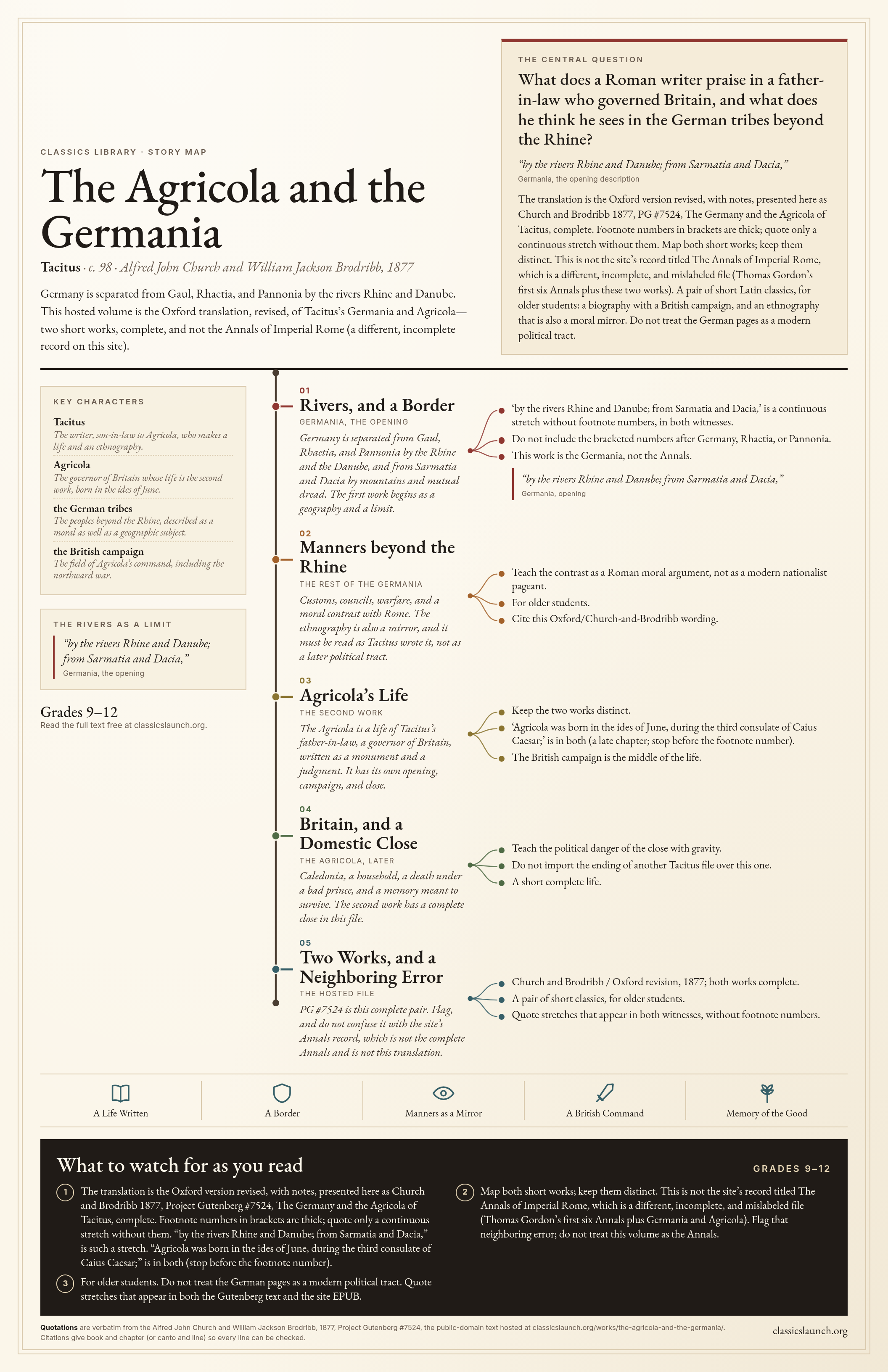
The Agricola and the Germania: A Story Map
The PDF is one tabloid page (11 × 17 in). On letter paper, choose “Fit to page.”
Germany is separated from Gaul, Rhaetia, and Pannonia by the rivers Rhine and Danube. This hosted volume is the Oxford translation, revised, of Tacitus’s Germania and Agricola—two short works, complete, and not the Annals of Imperial Rome (a different, incomplete record on this site).
The central question
What does a Roman writer praise in a father-in-law who governed Britain, and what does he think he sees in the German tribes beyond the Rhine?
“by the rivers Rhine and Danube; from Sarmatia and Dacia,”
The translation is the Oxford version revised, with notes, presented here as Church and Brodribb 1877, PG #7524, The Germany and the Agricola of Tacitus, complete. Footnote numbers in brackets are thick; quote only a continuous stretch without them. Map both short works; keep them distinct. This is not the site’s record titled The Annals of Imperial Rome, which is a different, incomplete, and mislabeled file (Thomas Gordon’s first six Annals plus these two works). A pair of short Latin classics, for older students: a biography with a British campaign, and an ethnography that is also a moral mirror. Do not treat the German pages as a modern political tract.
- 01
Rivers, and a Border
Germania, the opening
Germany is separated from Gaul, Rhaetia, and Pannonia by the Rhine and the Danube, and from Sarmatia and Dacia by mountains and mutual dread. The first work begins as a geography and a limit.
- ‘by the rivers Rhine and Danube; from Sarmatia and Dacia,’ is a continuous stretch without footnote numbers, in both witnesses.
- Do not include the bracketed numbers after Germany, Rhaetia, or Pannonia.
- This work is the Germania, not the Annals.
“by the rivers Rhine and Danube; from Sarmatia and Dacia,”
- 02
Manners beyond the Rhine
The rest of the Germania
Customs, councils, warfare, and a moral contrast with Rome. The ethnography is also a mirror, and it must be read as Tacitus wrote it, not as a later political tract.
- Teach the contrast as a Roman moral argument, not as a modern nationalist pageant.
- For older students.
- Cite this Oxford/Church-and-Brodribb wording.
- 03
Agricola’s Life
The second work
The Agricola is a life of Tacitus’s father-in-law, a governor of Britain, written as a monument and a judgment. It has its own opening, campaign, and close.
- Keep the two works distinct.
- ‘Agricola was born in the ides of June, during the third consulate of Caius Caesar;’ is in both (a late chapter; stop before the footnote number).
- The British campaign is the middle of the life.
- 04
Britain, and a Domestic Close
The Agricola, later
Caledonia, a household, a death under a bad prince, and a memory meant to survive. The second work has a complete close in this file.
- Teach the political danger of the close with gravity.
- Do not import the ending of another Tacitus file over this one.
- A short complete life.
- 05
Two Works, and a Neighboring Error
The hosted file
PG #7524 is this complete pair. Flag, and do not confuse it with the site’s Annals record, which is not the complete Annals and is not this translation.
- Church and Brodribb / Oxford revision, 1877; both works complete.
- A pair of short classics, for older students.
- Quote stretches that appear in both witnesses, without footnote numbers.
- A Life Written
- A Border
- Manners as a Mirror
- A British Command
- Memory of the Good
What to watch for as you read
Grades 9–12- The translation is the Oxford version revised, with notes, presented here as Church and Brodribb 1877, Project Gutenberg #7524, The Germany and the Agricola of Tacitus, complete. Footnote numbers in brackets are thick; quote only a continuous stretch without them. “by the rivers Rhine and Danube; from Sarmatia and Dacia,” is such a stretch. “Agricola was born in the ides of June, during the third consulate of Caius Caesar;” is in both (stop before the footnote number).
- Map both short works; keep them distinct. This is not the site’s record titled The Annals of Imperial Rome, which is a different, incomplete, and mislabeled file (Thomas Gordon’s first six Annals plus Germania and Agricola). Flag that neighboring error; do not treat this volume as the Annals.
- For older students. Do not treat the German pages as a modern political tract. Quote stretches that appear in both the Gutenberg text and the site EPUB.
Every quotation is word for word from the Alfred John Church and William Jackson Brodribb, 1877 hosted in this library and is checked against that text each time the site is built. Citations give book and chapter (or canto and line).