Story maps · Grades 11–12
The Annals of Imperial Rome: A Story Map
The PDF is one tabloid page (11 × 17 in). On letter paper, choose “Fit to page.”
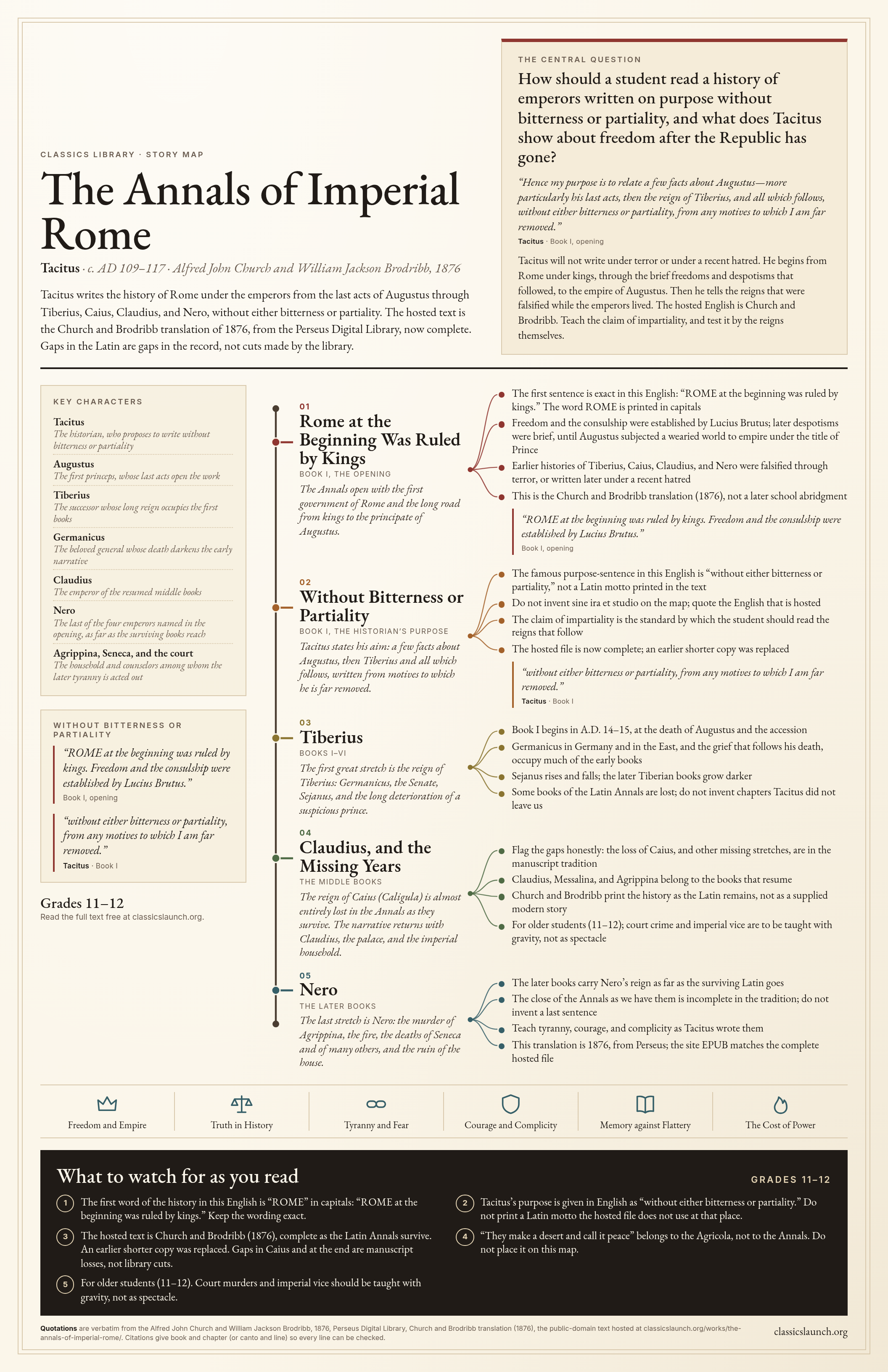
Tacitus writes the history of Rome under the emperors from the last acts of Augustus through Tiberius, Caius, Claudius, and Nero, without either bitterness or partiality. The hosted text is the Church and Brodribb translation of 1876, from the Perseus Digital Library, now complete. Gaps in the Latin are gaps in the record, not cuts made by the library.
The central question
How should a student read a history of emperors written on purpose without bitterness or partiality, and what does Tacitus show about freedom after the Republic has gone?
“Hence my purpose is to relate a few facts about Augustus—more particularly his last acts, then the reign of Tiberius, and all which follows, without either bitterness or partiality, from any motives to which I am far removed.”
Tacitus will not write under terror or under a recent hatred. He begins from Rome under kings, through the brief freedoms and despotisms that followed, to the empire of Augustus. Then he tells the reigns that were falsified while the emperors lived. The hosted English is Church and Brodribb. Teach the claim of impartiality, and test it by the reigns themselves.
- 01
Rome at the Beginning Was Ruled by Kings
Book I, the opening
The Annals open with the first government of Rome and the long road from kings to the principate of Augustus.
- The first sentence is exact in this English: “ROME at the beginning was ruled by kings.” The word ROME is printed in capitals
- Freedom and the consulship were established by Lucius Brutus; later despotisms were brief, until Augustus subjected a wearied world to empire under the title of Prince
- Earlier histories of Tiberius, Caius, Claudius, and Nero were falsified through terror, or written later under a recent hatred
- This is the Church and Brodribb translation (1876), not a later school abridgment
“ROME at the beginning was ruled by kings. Freedom and the consulship were established by Lucius Brutus.”
- 02
Without Bitterness or Partiality
Book I, the historian’s purpose
Tacitus states his aim: a few facts about Augustus, then Tiberius and all which follows, written from motives to which he is far removed.
- The famous purpose-sentence in this English is “without either bitterness or partiality,” not a Latin motto printed in the text
- Do not invent sine ira et studio on the map; quote the English that is hosted
- The claim of impartiality is the standard by which the student should read the reigns that follow
- The hosted file is now complete; an earlier shorter copy was replaced
“without either bitterness or partiality, from any motives to which I am far removed.”
- 03
Tiberius
Books I–VI
The first great stretch is the reign of Tiberius: Germanicus, the Senate, Sejanus, and the long deterioration of a suspicious prince.
- Book I begins in A.D. 14–15, at the death of Augustus and the accession
- Germanicus in Germany and in the East, and the grief that follows his death, occupy much of the early books
- Sejanus rises and falls; the later Tiberian books grow darker
- Some books of the Latin Annals are lost; do not invent chapters Tacitus did not leave us
- 04
Claudius, and the Missing Years
The middle books
The reign of Caius (Caligula) is almost entirely lost in the Annals as they survive. The narrative returns with Claudius, the palace, and the imperial household.
- Flag the gaps honestly: the loss of Caius, and other missing stretches, are in the manuscript tradition
- Claudius, Messalina, and Agrippina belong to the books that resume
- Church and Brodribb print the history as the Latin remains, not as a supplied modern story
- For older students (11–12); court crime and imperial vice are to be taught with gravity, not as spectacle
- 05
Nero
The later books
The last stretch is Nero: the murder of Agrippina, the fire, the deaths of Seneca and of many others, and the ruin of the house.
- The later books carry Nero’s reign as far as the surviving Latin goes
- The close of the Annals as we have them is incomplete in the tradition; do not invent a last sentence
- Teach tyranny, courage, and complicity as Tacitus wrote them
- This translation is 1876, from Perseus; the site EPUB matches the complete hosted file
- Freedom and Empire
- Truth in History
- Tyranny and Fear
- Courage and Complicity
- Memory against Flattery
- The Cost of Power
What to watch for as you read
Grades 11–12- The first word of the history in this English is “ROME” in capitals: “ROME at the beginning was ruled by kings.” Keep the wording exact.
- Tacitus’s purpose is given in English as “without either bitterness or partiality.” Do not print a Latin motto the hosted file does not use at that place.
- The hosted text is Church and Brodribb (1876), complete as the Latin Annals survive. An earlier shorter copy was replaced. Gaps in Caius and at the end are manuscript losses, not library cuts.
- “They make a desert and call it peace” belongs to the Agricola, not to the Annals. Do not place it on this map.
- For older students (11–12). Court murders and imperial vice should be taught with gravity, not as spectacle.
Every quotation is word for word from the Alfred John Church and William Jackson Brodribb, 1876 hosted in this library and is checked against that text each time the site is built. Citations give book and chapter (or canto and line).