Story maps · Grades 11–12
The Call of Cthulhu and Other Weird Stories: A Story Map
The PDF is one tabloid page (11 × 17 in). On letter paper, choose “Fit to page.”
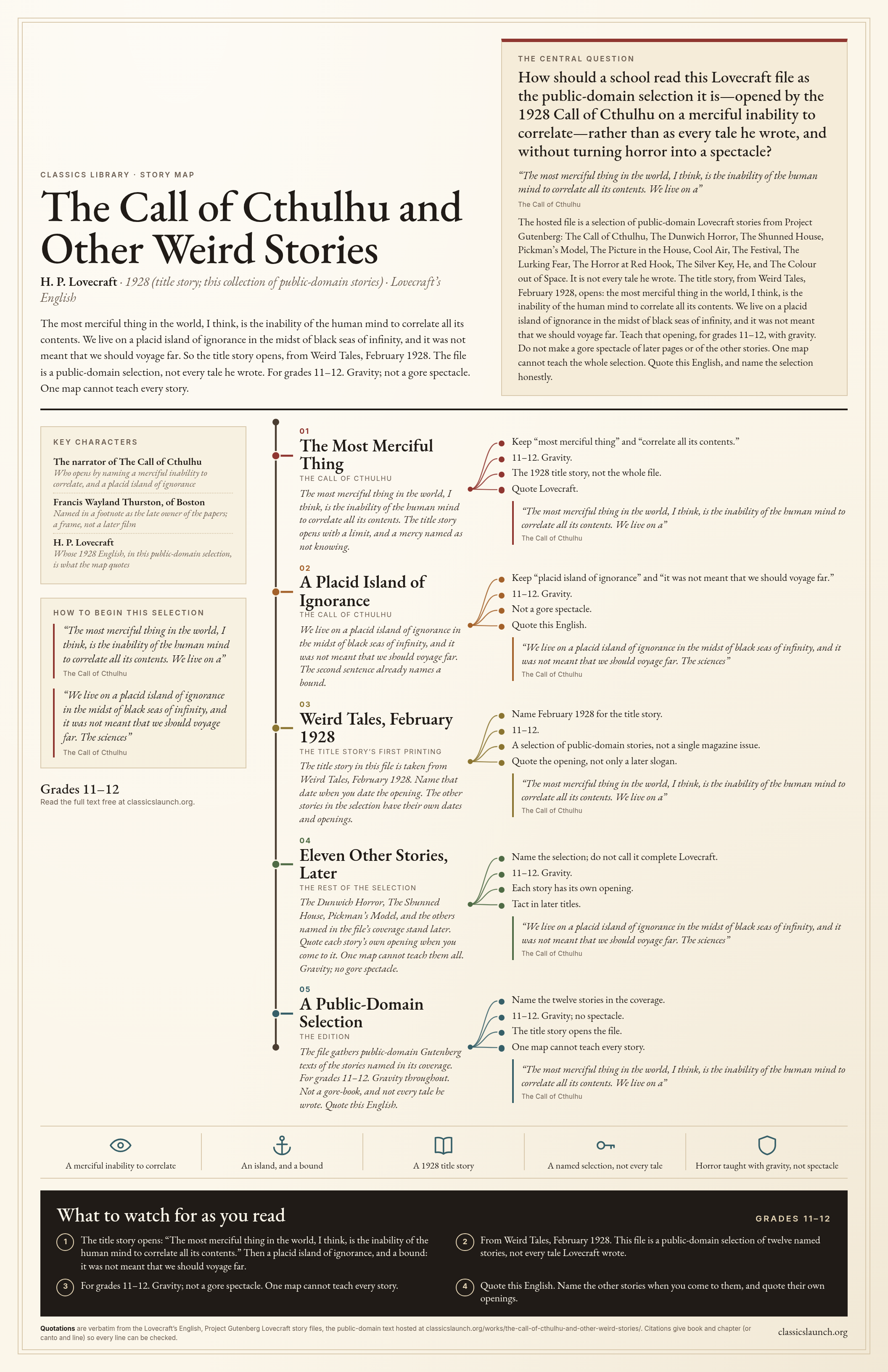
The most merciful thing in the world, I think, is the inability of the human mind to correlate all its contents. We live on a placid island of ignorance in the midst of black seas of infinity, and it was not meant that we should voyage far. So the title story opens, from Weird Tales, February 1928. The file is a public-domain selection, not every tale he wrote. For grades 11–12. Gravity; not a gore spectacle. One map cannot teach every story.
The central question
How should a school read this Lovecraft file as the public-domain selection it is—opened by the 1928 Call of Cthulhu on a merciful inability to correlate—rather than as every tale he wrote, and without turning horror into a spectacle?
“The most merciful thing in the world, I think, is the inability of the human mind to correlate all its contents. We live on a”
The hosted file is a selection of public-domain Lovecraft stories from Project Gutenberg: The Call of Cthulhu, The Dunwich Horror, The Shunned House, Pickman’s Model, The Picture in the House, Cool Air, The Festival, The Lurking Fear, The Horror at Red Hook, The Silver Key, He, and The Colour out of Space. It is not every tale he wrote. The title story, from Weird Tales, February 1928, opens: the most merciful thing in the world, I think, is the inability of the human mind to correlate all its contents. We live on a placid island of ignorance in the midst of black seas of infinity, and it was not meant that we should voyage far. Teach that opening, for grades 11–12, with gravity. Do not make a gore spectacle of later pages or of the other stories. One map cannot teach the whole selection. Quote this English, and name the selection honestly.
- 01
The Most Merciful Thing
The Call of Cthulhu
The most merciful thing in the world, I think, is the inability of the human mind to correlate all its contents. The title story opens with a limit, and a mercy named as not knowing.
- Keep “most merciful thing” and “correlate all its contents.”
- 11–12. Gravity.
- The 1928 title story, not the whole file.
- Quote Lovecraft.
“The most merciful thing in the world, I think, is the inability of the human mind to correlate all its contents. We live on a”
- 02
A Placid Island of Ignorance
The Call of Cthulhu
We live on a placid island of ignorance in the midst of black seas of infinity, and it was not meant that we should voyage far. The second sentence already names a bound.
- Keep “placid island of ignorance” and “it was not meant that we should voyage far.”
- 11–12. Gravity.
- Not a gore spectacle.
- Quote this English.
“We live on a placid island of ignorance in the midst of black seas of infinity, and it was not meant that we should voyage far. The sciences”
- 03
Weird Tales, February 1928
The title story’s first printing
The title story in this file is taken from Weird Tales, February 1928. Name that date when you date the opening. The other stories in the selection have their own dates and openings.
- Name February 1928 for the title story.
- 11–12.
- A selection of public-domain stories, not a single magazine issue.
- Quote the opening, not only a later slogan.
“The most merciful thing in the world, I think, is the inability of the human mind to correlate all its contents. We live on a”
- 04
Eleven Other Stories, Later
The rest of the selection
The Dunwich Horror, The Shunned House, Pickman’s Model, and the others named in the file’s coverage stand later. Quote each story’s own opening when you come to it. One map cannot teach them all. Gravity; no gore spectacle.
- Name the selection; do not call it complete Lovecraft.
- 11–12. Gravity.
- Each story has its own opening.
- Tact in later titles.
“We live on a placid island of ignorance in the midst of black seas of infinity, and it was not meant that we should voyage far. The sciences”
- 05
A Public-Domain Selection
The edition
The file gathers public-domain Gutenberg texts of the stories named in its coverage. For grades 11–12. Gravity throughout. Not a gore-book, and not every tale he wrote. Quote this English.
- Name the twelve stories in the coverage.
- 11–12. Gravity; no spectacle.
- The title story opens the file.
- One map cannot teach every story.
“The most merciful thing in the world, I think, is the inability of the human mind to correlate all its contents. We live on a”
- A merciful inability to correlate
- An island, and a bound
- A 1928 title story
- A named selection, not every tale
- Horror taught with gravity, not spectacle
What to watch for as you read
Grades 11–12- The title story opens: “The most merciful thing in the world, I think, is the inability of the human mind to correlate all its contents.” Then a placid island of ignorance, and a bound: it was not meant that we should voyage far.
- From Weird Tales, February 1928. This file is a public-domain selection of twelve named stories, not every tale Lovecraft wrote.
- For grades 11–12. Gravity; not a gore spectacle. One map cannot teach every story.
- Quote this English. Name the other stories when you come to them, and quote their own openings.
Every quotation is word for word from the Lovecraft’s English hosted in this library and is checked against that text each time the site is built. Citations give book and chapter (or canto and line).