Story maps · Grades 10–12
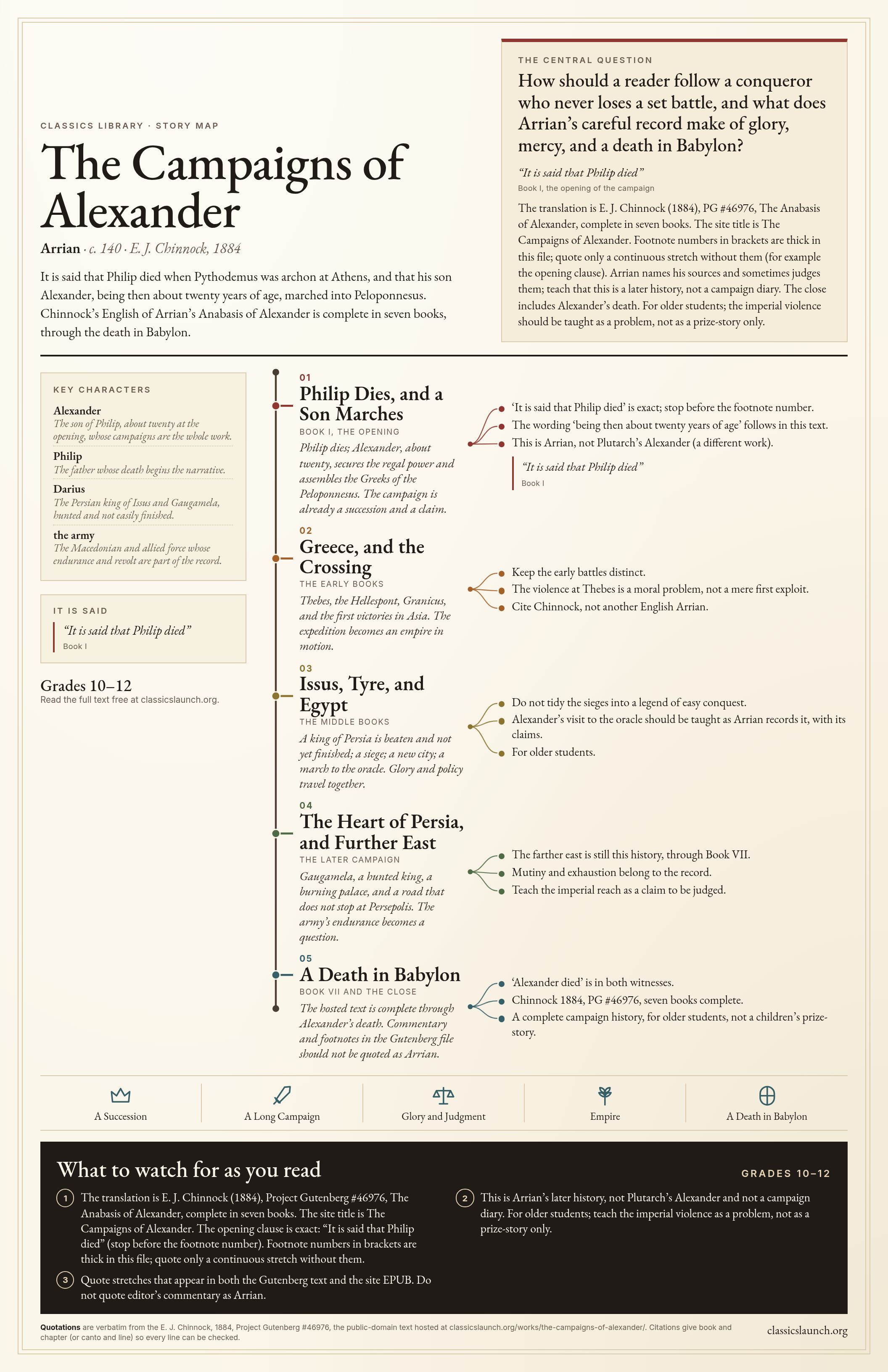
The Campaigns of Alexander: A Story Map
The PDF is one tabloid page (11 × 17 in). On letter paper, choose “Fit to page.”
It is said that Philip died when Pythodemus was archon at Athens, and that his son Alexander, being then about twenty years of age, marched into Peloponnesus. Chinnock’s English of Arrian’s Anabasis of Alexander is complete in seven books, through the death in Babylon.
The central question
How should a reader follow a conqueror who never loses a set battle, and what does Arrian’s careful record make of glory, mercy, and a death in Babylon?
“It is said that Philip died”
The translation is E. J. Chinnock (1884), PG #46976, The Anabasis of Alexander, complete in seven books. The site title is The Campaigns of Alexander. Footnote numbers in brackets are thick in this file; quote only a continuous stretch without them (for example the opening clause). Arrian names his sources and sometimes judges them; teach that this is a later history, not a campaign diary. The close includes Alexander’s death. For older students; the imperial violence should be taught as a problem, not as a prize-story only.
- 01
Philip Dies, and a Son Marches
Book I, the opening
Philip dies; Alexander, about twenty, secures the regal power and assembles the Greeks of the Peloponnesus. The campaign is already a succession and a claim.
- ‘It is said that Philip died’ is exact; stop before the footnote number.
- The wording ‘being then about twenty years of age’ follows in this text.
- This is Arrian, not Plutarch’s Alexander (a different work).
“It is said that Philip died”
- 02
Greece, and the Crossing
The early books
Thebes, the Hellespont, Granicus, and the first victories in Asia. The expedition becomes an empire in motion.
- Keep the early battles distinct.
- The violence at Thebes is a moral problem, not a mere first exploit.
- Cite Chinnock, not another English Arrian.
- 03
Issus, Tyre, and Egypt
The middle books
A king of Persia is beaten and not yet finished; a siege; a new city; a march to the oracle. Glory and policy travel together.
- Do not tidy the sieges into a legend of easy conquest.
- Alexander’s visit to the oracle should be taught as Arrian records it, with its claims.
- For older students.
- 04
The Heart of Persia, and Further East
The later campaign
Gaugamela, a hunted king, a burning palace, and a road that does not stop at Persepolis. The army’s endurance becomes a question.
- The farther east is still this history, through Book VII.
- Mutiny and exhaustion belong to the record.
- Teach the imperial reach as a claim to be judged.
- 05
A Death in Babylon
Book VII and the close
The hosted text is complete through Alexander’s death. Commentary and footnotes in the Gutenberg file should not be quoted as Arrian.
- ‘Alexander died’ is in both witnesses.
- Chinnock 1884, PG #46976, seven books complete.
- A complete campaign history, for older students, not a children’s prize-story.
- A Succession
- A Long Campaign
- Glory and Judgment
- Empire
- A Death in Babylon
What to watch for as you read
Grades 10–12- The translation is E. J. Chinnock (1884), Project Gutenberg #46976, The Anabasis of Alexander, complete in seven books. The site title is The Campaigns of Alexander. The opening clause is exact: “It is said that Philip died” (stop before the footnote number). Footnote numbers in brackets are thick in this file; quote only a continuous stretch without them.
- This is Arrian’s later history, not Plutarch’s Alexander and not a campaign diary. For older students; teach the imperial violence as a problem, not as a prize-story only.
- Quote stretches that appear in both the Gutenberg text and the site EPUB. Do not quote editor’s commentary as Arrian.
Every quotation is word for word from the E. J. Chinnock, 1884 hosted in this library and is checked against that text each time the site is built. Citations give book and chapter (or canto and line).