Story maps · Grades 9–12
The Conquest of Gaul: A Story Map
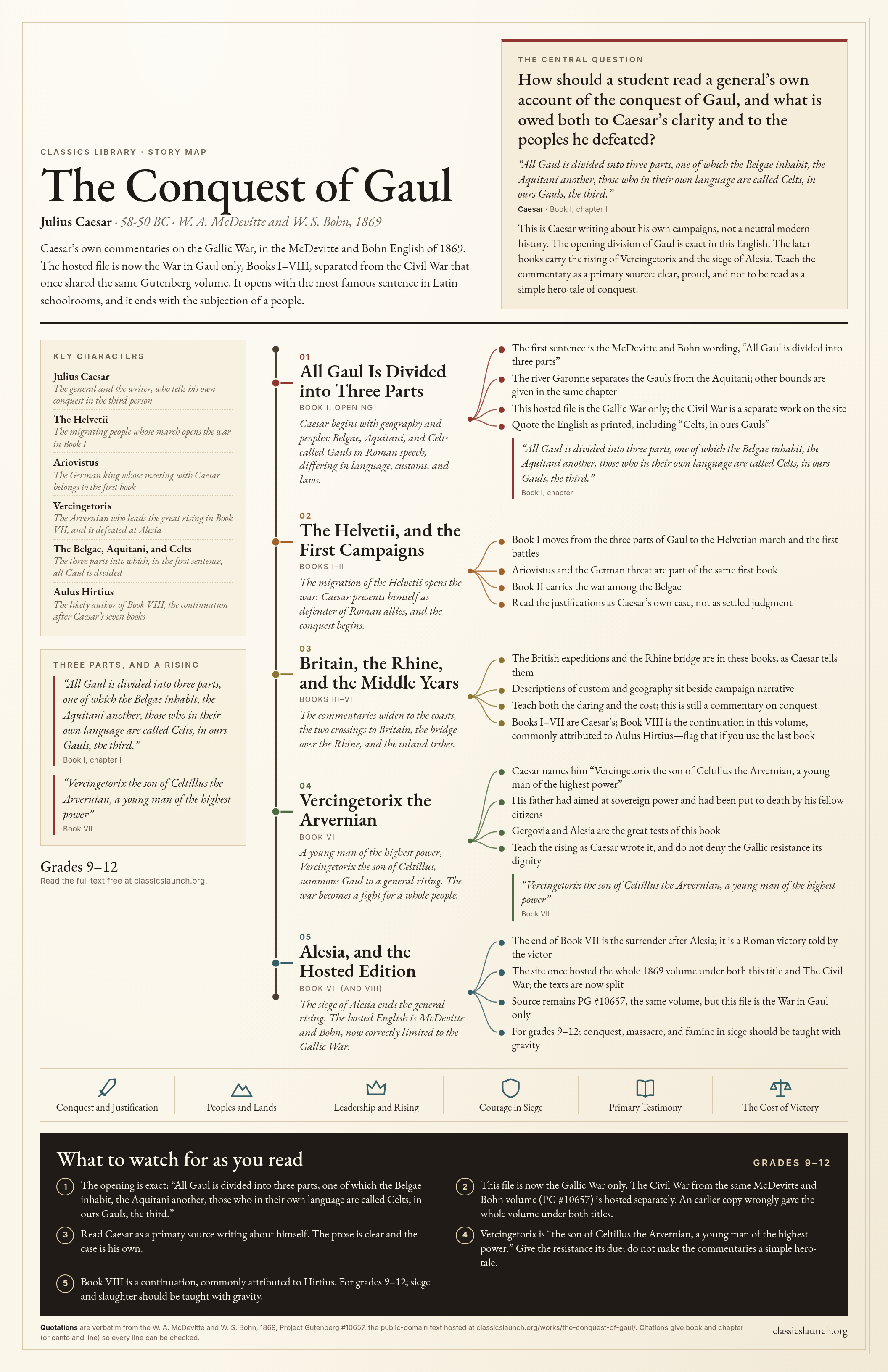
The PDF is one tabloid page (11 × 17 in). On letter paper, choose “Fit to page.”
Caesar’s own commentaries on the Gallic War, in the McDevitte and Bohn English of 1869. The hosted file is now the War in Gaul only, Books I–VIII, separated from the Civil War that once shared the same Gutenberg volume. It opens with the most famous sentence in Latin schoolrooms, and it ends with the subjection of a people.
The central question
How should a student read a general’s own account of the conquest of Gaul, and what is owed both to Caesar’s clarity and to the peoples he defeated?
“All Gaul is divided into three parts, one of which the Belgae inhabit, the Aquitani another, those who in their own language are called Celts, in ours Gauls, the third.”
This is Caesar writing about his own campaigns, not a neutral modern history. The opening division of Gaul is exact in this English. The later books carry the rising of Vercingetorix and the siege of Alesia. Teach the commentary as a primary source: clear, proud, and not to be read as a simple hero-tale of conquest.
- 01
All Gaul Is Divided into Three Parts
Book I, opening
Caesar begins with geography and peoples: Belgae, Aquitani, and Celts called Gauls in Roman speech, differing in language, customs, and laws.
- The first sentence is the McDevitte and Bohn wording, “All Gaul is divided into three parts”
- The river Garonne separates the Gauls from the Aquitani; other bounds are given in the same chapter
- This hosted file is the Gallic War only; the Civil War is a separate work on the site
- Quote the English as printed, including “Celts, in ours Gauls”
“All Gaul is divided into three parts, one of which the Belgae inhabit, the Aquitani another, those who in their own language are called Celts, in ours Gauls, the third.”
- 02
The Helvetii, and the First Campaigns
Books I–II
The migration of the Helvetii opens the war. Caesar presents himself as defender of Roman allies, and the conquest begins.
- Book I moves from the three parts of Gaul to the Helvetian march and the first battles
- Ariovistus and the German threat are part of the same first book
- Book II carries the war among the Belgae
- Read the justifications as Caesar’s own case, not as settled judgment
- 03
Britain, the Rhine, and the Middle Years
Books III–VI
The commentaries widen to the coasts, the two crossings to Britain, the bridge over the Rhine, and the inland tribes.
- The British expeditions and the Rhine bridge are in these books, as Caesar tells them
- Descriptions of custom and geography sit beside campaign narrative
- Teach both the daring and the cost; this is still a commentary on conquest
- Books I–VII are Caesar’s; Book VIII is the continuation in this volume, commonly attributed to Aulus Hirtius—flag that if you use the last book
- 04
Vercingetorix the Arvernian
Book VII
A young man of the highest power, Vercingetorix the son of Celtillus, summons Gaul to a general rising. The war becomes a fight for a whole people.
- Caesar names him “Vercingetorix the son of Celtillus the Arvernian, a young man of the highest power”
- His father had aimed at sovereign power and had been put to death by his fellow citizens
- Gergovia and Alesia are the great tests of this book
- Teach the rising as Caesar wrote it, and do not deny the Gallic resistance its dignity
“Vercingetorix the son of Celtillus the Arvernian, a young man of the highest power”
- 05
Alesia, and the Hosted Edition
Book VII (and VIII)
The siege of Alesia ends the general rising. The hosted English is McDevitte and Bohn, now correctly limited to the Gallic War.
- The end of Book VII is the surrender after Alesia; it is a Roman victory told by the victor
- The site once hosted the whole 1869 volume under both this title and The Civil War; the texts are now split
- Source remains PG #10657, the same volume, but this file is the War in Gaul only
- For grades 9–12; conquest, massacre, and famine in siege should be taught with gravity
- Conquest and Justification
- Peoples and Lands
- Leadership and Rising
- Courage in Siege
- Primary Testimony
- The Cost of Victory
What to watch for as you read
Grades 9–12- The opening is exact: “All Gaul is divided into three parts, one of which the Belgae inhabit, the Aquitani another, those who in their own language are called Celts, in ours Gauls, the third.”
- This file is now the Gallic War only. The Civil War from the same McDevitte and Bohn volume (PG #10657) is hosted separately. An earlier copy wrongly gave the whole volume under both titles.
- Read Caesar as a primary source writing about himself. The prose is clear and the case is his own.
- Vercingetorix is “the son of Celtillus the Arvernian, a young man of the highest power.” Give the resistance its due; do not make the commentaries a simple hero-tale.
- Book VIII is a continuation, commonly attributed to Hirtius. For grades 9–12; siege and slaughter should be taught with gravity.
Every quotation is word for word from the W. A. McDevitte and W. S. Bohn, 1869 hosted in this library and is checked against that text each time the site is built. Citations give book and chapter (or canto and line).