Story maps · Grades 11–12
The Devils: A Story Map
The PDF is one tabloid page (11 × 17 in). On letter paper, choose “Fit to page.”
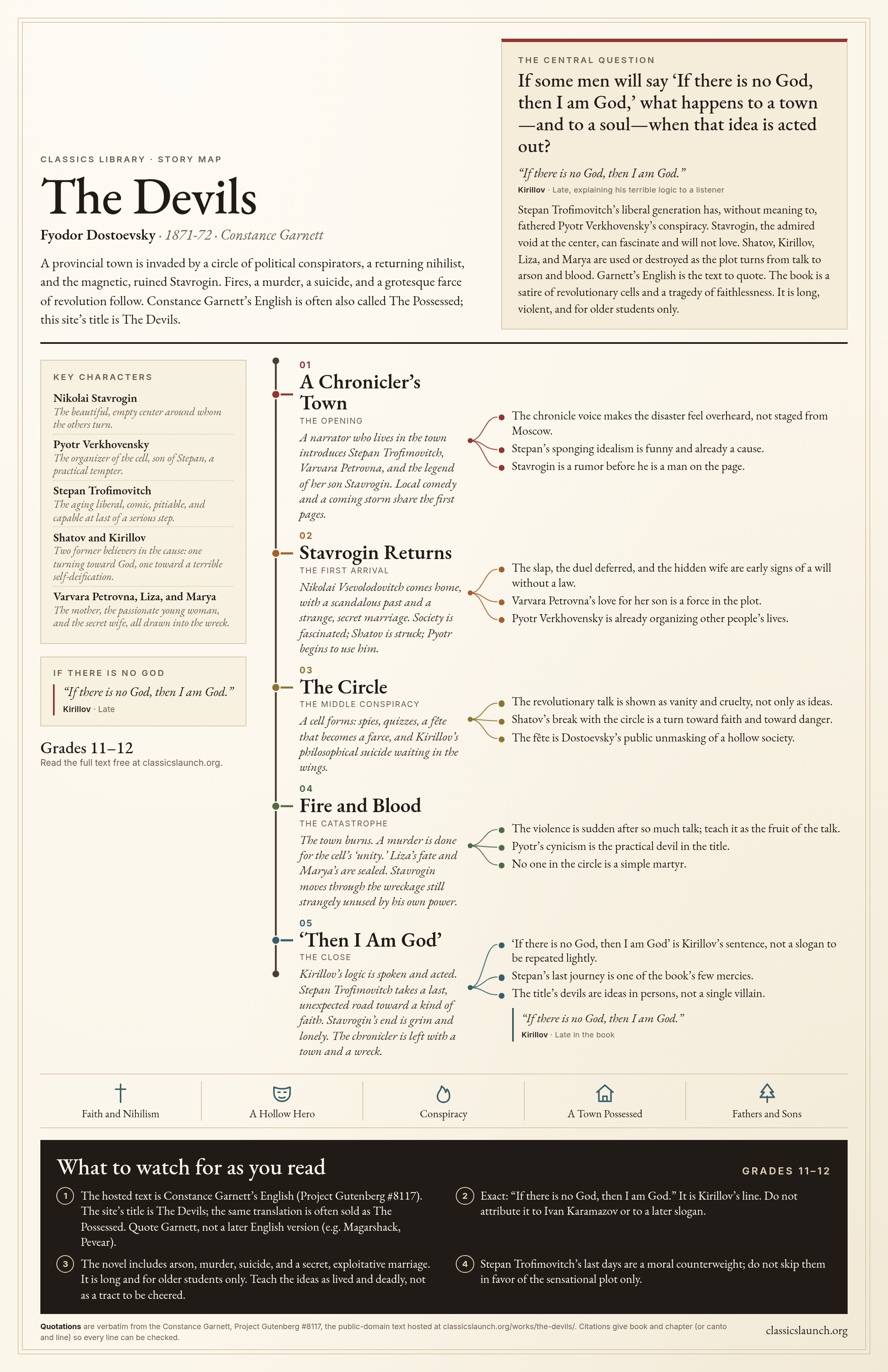
A provincial town is invaded by a circle of political conspirators, a returning nihilist, and the magnetic, ruined Stavrogin. Fires, a murder, a suicide, and a grotesque farce of revolution follow. Constance Garnett’s English is often also called The Possessed; this site’s title is The Devils.
The central question
If some men will say ‘If there is no God, then I am God,’ what happens to a town—and to a soul—when that idea is acted out?
“If there is no God, then I am God.”
Stepan Trofimovitch’s liberal generation has, without meaning to, fathered Pyotr Verkhovensky’s conspiracy. Stavrogin, the admired void at the center, can fascinate and will not love. Shatov, Kirillov, Liza, and Marya are used or destroyed as the plot turns from talk to arson and blood. Garnett’s English is the text to quote. The book is a satire of revolutionary cells and a tragedy of faithlessness. It is long, violent, and for older students only.
- 01
A Chronicler’s Town
The opening
A narrator who lives in the town introduces Stepan Trofimovitch, Varvara Petrovna, and the legend of her son Stavrogin. Local comedy and a coming storm share the first pages.
- The chronicle voice makes the disaster feel overheard, not staged from Moscow.
- Stepan’s sponging idealism is funny and already a cause.
- Stavrogin is a rumor before he is a man on the page.
- 02
Stavrogin Returns
The first arrival
Nikolai Vsevolodovitch comes home, with a scandalous past and a strange, secret marriage. Society is fascinated; Shatov is struck; Pyotr begins to use him.
- The slap, the duel deferred, and the hidden wife are early signs of a will without a law.
- Varvara Petrovna’s love for her son is a force in the plot.
- Pyotr Verkhovensky is already organizing other people’s lives.
- 03
The Circle
The middle conspiracy
A cell forms: spies, quizzes, a fête that becomes a farce, and Kirillov’s philosophical suicide waiting in the wings.
- The revolutionary talk is shown as vanity and cruelty, not only as ideas.
- Shatov’s break with the circle is a turn toward faith and toward danger.
- The fête is Dostoevsky’s public unmasking of a hollow society.
- 04
Fire and Blood
The catastrophe
The town burns. A murder is done for the cell’s ‘unity.’ Liza’s fate and Marya’s are sealed. Stavrogin moves through the wreckage still strangely unused by his own power.
- The violence is sudden after so much talk; teach it as the fruit of the talk.
- Pyotr’s cynicism is the practical devil in the title.
- No one in the circle is a simple martyr.
- 05
‘Then I Am God’
The close
Kirillov’s logic is spoken and acted. Stepan Trofimovitch takes a last, unexpected road toward a kind of faith. Stavrogin’s end is grim and lonely. The chronicler is left with a town and a wreck.
- ‘If there is no God, then I am God’ is Kirillov’s sentence, not a slogan to be repeated lightly.
- Stepan’s last journey is one of the book’s few mercies.
- The title’s devils are ideas in persons, not a single villain.
“If there is no God, then I am God.”
- Faith and Nihilism
- A Hollow Hero
- Conspiracy
- A Town Possessed
- Fathers and Sons
What to watch for as you read
Grades 11–12- The hosted text is Constance Garnett’s English (Project Gutenberg #8117). The site’s title is The Devils; the same translation is often sold as The Possessed. Quote Garnett, not a later English version (e.g. Magarshack, Pevear).
- Exact: “If there is no God, then I am God.” It is Kirillov’s line. Do not attribute it to Ivan Karamazov or to a later slogan.
- The novel includes arson, murder, suicide, and a secret, exploitative marriage. It is long and for older students only. Teach the ideas as lived and deadly, not as a tract to be cheered.
- Stepan Trofimovitch’s last days are a moral counterweight; do not skip them in favor of the sensational plot only.
Every quotation is word for word from the Constance Garnett hosted in this library and is checked against that text each time the site is built. Citations give book and chapter (or canto and line).