Story maps · Grades 11–12
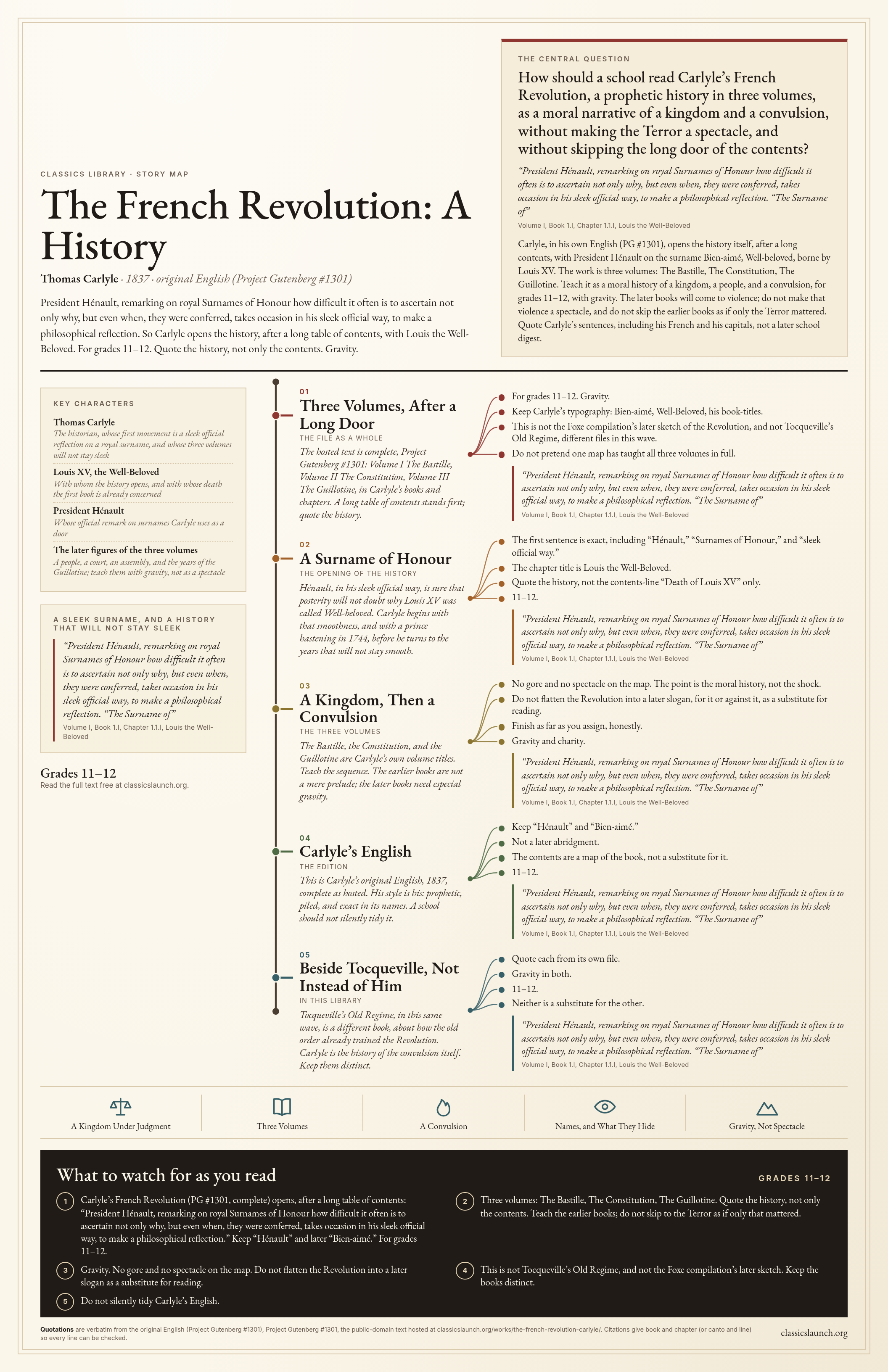
The French Revolution: A History: A Story Map
The PDF is one tabloid page (11 × 17 in). On letter paper, choose “Fit to page.”
President Hénault, remarking on royal Surnames of Honour how difficult it often is to ascertain not only why, but even when, they were conferred, takes occasion in his sleek official way, to make a philosophical reflection. So Carlyle opens the history, after a long table of contents, with Louis the Well-Beloved. For grades 11–12. Quote the history, not only the contents. Gravity.
The central question
How should a school read Carlyle’s French Revolution, a prophetic history in three volumes, as a moral narrative of a kingdom and a convulsion, without making the Terror a spectacle, and without skipping the long door of the contents?
“President Hénault, remarking on royal Surnames of Honour how difficult it often is to ascertain not only why, but even when, they were conferred, takes occasion in his sleek official way, to make a philosophical reflection. “The Surname of”
Carlyle, in his own English (PG #1301), opens the history itself, after a long contents, with President Hénault on the surname Bien-aimé, Well-beloved, borne by Louis XV. The work is three volumes: The Bastille, The Constitution, The Guillotine. Teach it as a moral history of a kingdom, a people, and a convulsion, for grades 11–12, with gravity. The later books will come to violence; do not make that violence a spectacle, and do not skip the earlier books as if only the Terror mattered. Quote Carlyle’s sentences, including his French and his capitals, not a later school digest.
- 01
Three Volumes, After a Long Door
The file as a whole
The hosted text is complete, Project Gutenberg #1301: Volume I The Bastille, Volume II The Constitution, Volume III The Guillotine, in Carlyle’s books and chapters. A long table of contents stands first; quote the history.
- For grades 11–12. Gravity.
- Keep Carlyle’s typography: Bien-aimé, Well-Beloved, his book-titles.
- This is not the Foxe compilation’s later sketch of the Revolution, and not Tocqueville’s Old Regime, different files in this wave.
- Do not pretend one map has taught all three volumes in full.
“President Hénault, remarking on royal Surnames of Honour how difficult it often is to ascertain not only why, but even when, they were conferred, takes occasion in his sleek official way, to make a philosophical reflection. “The Surname of”
- 02
A Surname of Honour
The opening of the history
Hénault, in his sleek official way, is sure that posterity will not doubt why Louis XV was called Well-beloved. Carlyle begins with that smoothness, and with a prince hastening in 1744, before he turns to the years that will not stay smooth.
- The first sentence is exact, including “Hénault,” “Surnames of Honour,” and “sleek official way.”
- The chapter title is Louis the Well-Beloved.
- Quote the history, not the contents-line “Death of Louis XV” only.
- 11–12.
“President Hénault, remarking on royal Surnames of Honour how difficult it often is to ascertain not only why, but even when, they were conferred, takes occasion in his sleek official way, to make a philosophical reflection. “The Surname of”
- 03
A Kingdom, Then a Convulsion
The three volumes
The Bastille, the Constitution, and the Guillotine are Carlyle’s own volume titles. Teach the sequence. The earlier books are not a mere prelude; the later books need especial gravity.
- No gore and no spectacle on the map. The point is the moral history, not the shock.
- Do not flatten the Revolution into a later slogan, for it or against it, as a substitute for reading.
- Finish as far as you assign, honestly.
- Gravity and charity.
“President Hénault, remarking on royal Surnames of Honour how difficult it often is to ascertain not only why, but even when, they were conferred, takes occasion in his sleek official way, to make a philosophical reflection. “The Surname of”
- 04
Carlyle’s English
The edition
This is Carlyle’s original English, 1837, complete as hosted. His style is his: prophetic, piled, and exact in its names. A school should not silently tidy it.
- Keep “Hénault” and “Bien-aimé.”
- Not a later abridgment.
- The contents are a map of the book, not a substitute for it.
- 11–12.
“President Hénault, remarking on royal Surnames of Honour how difficult it often is to ascertain not only why, but even when, they were conferred, takes occasion in his sleek official way, to make a philosophical reflection. “The Surname of”
- 05
Beside Tocqueville, Not Instead of Him
In this library
Tocqueville’s Old Regime, in this same wave, is a different book, about how the old order already trained the Revolution. Carlyle is the history of the convulsion itself. Keep them distinct.
- Quote each from its own file.
- Gravity in both.
- 11–12.
- Neither is a substitute for the other.
“President Hénault, remarking on royal Surnames of Honour how difficult it often is to ascertain not only why, but even when, they were conferred, takes occasion in his sleek official way, to make a philosophical reflection. “The Surname of”
- A Kingdom Under Judgment
- Three Volumes
- A Convulsion
- Names, and What They Hide
- Gravity, Not Spectacle
What to watch for as you read
Grades 11–12- Carlyle’s French Revolution (PG #1301, complete) opens, after a long table of contents: “President Hénault, remarking on royal Surnames of Honour how difficult it often is to ascertain not only why, but even when, they were conferred, takes occasion in his sleek official way, to make a philosophical reflection.” Keep “Hénault” and later “Bien-aimé.” For grades 11–12.
- Three volumes: The Bastille, The Constitution, The Guillotine. Quote the history, not only the contents. Teach the earlier books; do not skip to the Terror as if only that mattered.
- Gravity. No gore and no spectacle on the map. Do not flatten the Revolution into a later slogan as a substitute for reading.
- This is not Tocqueville’s Old Regime, and not the Foxe compilation’s later sketch. Keep the books distinct.
- Do not silently tidy Carlyle’s English.
Every quotation is word for word from the original English (Project Gutenberg #1301) hosted in this library and is checked against that text each time the site is built. Citations give book and chapter (or canto and line).