Story maps · Grades Adult/Advanced
The Golden Ass: A Story Map
The PDF is one tabloid page (11 × 17 in). On letter paper, choose “Fit to page.”
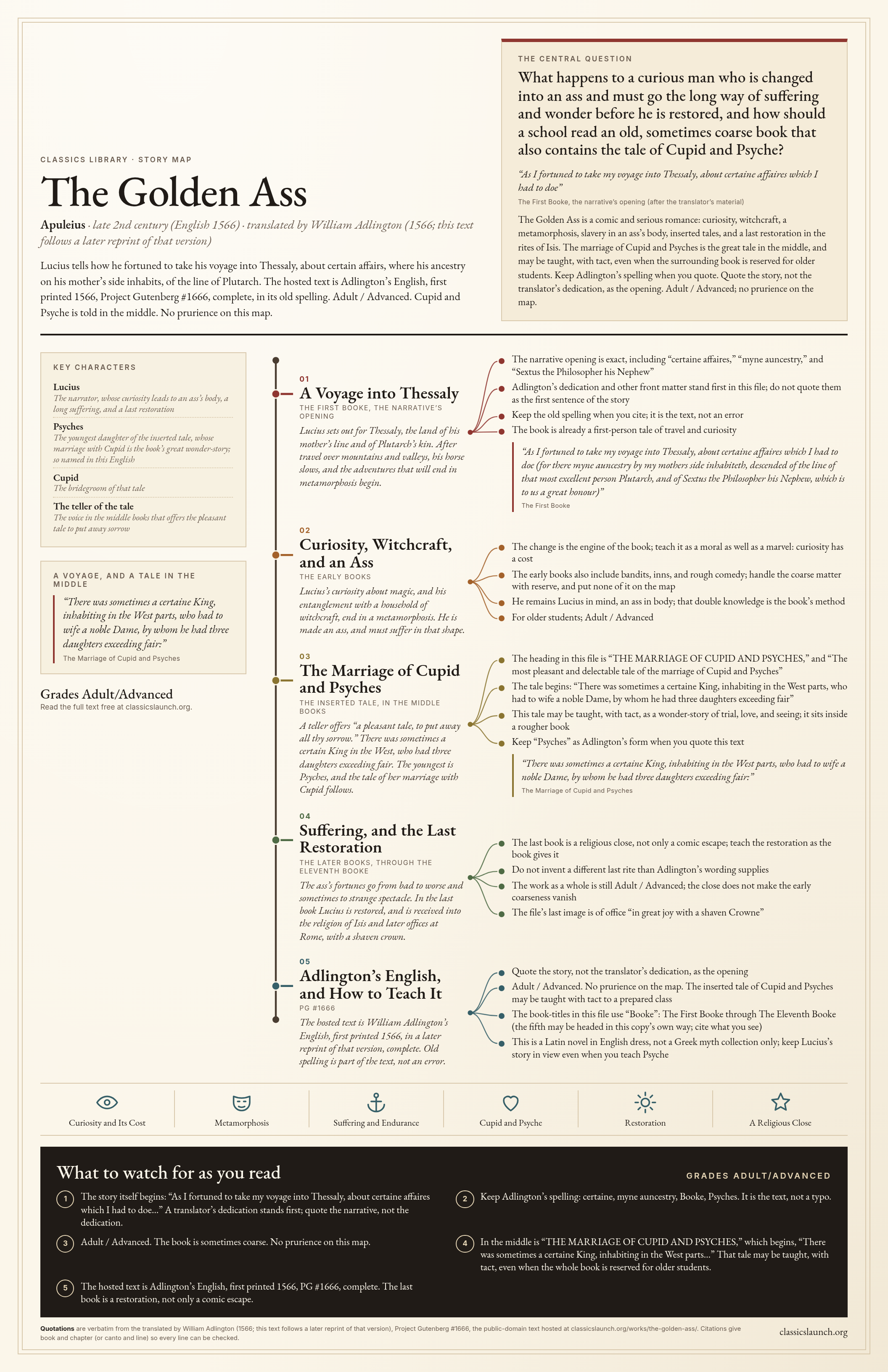
Lucius tells how he fortuned to take his voyage into Thessaly, about certain affairs, where his ancestry on his mother’s side inhabits, of the line of Plutarch. The hosted text is Adlington’s English, first printed 1566, Project Gutenberg #1666, complete, in its old spelling. Adult / Advanced. Cupid and Psyche is told in the middle. No prurience on this map.
The central question
What happens to a curious man who is changed into an ass and must go the long way of suffering and wonder before he is restored, and how should a school read an old, sometimes coarse book that also contains the tale of Cupid and Psyche?
“As I fortuned to take my voyage into Thessaly, about certaine affaires which I had to doe”
The Golden Ass is a comic and serious romance: curiosity, witchcraft, a metamorphosis, slavery in an ass’s body, inserted tales, and a last restoration in the rites of Isis. The marriage of Cupid and Psyches is the great tale in the middle, and may be taught, with tact, even when the surrounding book is reserved for older students. Keep Adlington’s spelling when you quote. Quote the story, not the translator’s dedication, as the opening. Adult / Advanced; no prurience on the map.
- 01
A Voyage into Thessaly
The First Booke, the narrative’s opening
Lucius sets out for Thessaly, the land of his mother’s line and of Plutarch’s kin. After travel over mountains and valleys, his horse slows, and the adventures that will end in metamorphosis begin.
- The narrative opening is exact, including “certaine affaires,” “myne auncestry,” and “Sextus the Philosopher his Nephew”
- Adlington’s dedication and other front matter stand first in this file; do not quote them as the first sentence of the story
- Keep the old spelling when you cite; it is the text, not an error
- The book is already a first-person tale of travel and curiosity
“As I fortuned to take my voyage into Thessaly, about certaine affaires which I had to doe (for there myne auncestry by my mothers side inhabiteth, descended of the line of that most excellent person Plutarch, and of Sextus the Philosopher his Nephew, which is to us a great honour)”
- 02
Curiosity, Witchcraft, and an Ass
The early books
Lucius’s curiosity about magic, and his entanglement with a household of witchcraft, end in a metamorphosis. He is made an ass, and must suffer in that shape.
- The change is the engine of the book; teach it as a moral as well as a marvel: curiosity has a cost
- The early books also include bandits, inns, and rough comedy; handle the coarse matter with reserve, and put none of it on the map
- He remains Lucius in mind, an ass in body; that double knowledge is the book’s method
- For older students; Adult / Advanced
- 03
The Marriage of Cupid and Psyches
The inserted tale, in the middle books
A teller offers “a pleasant tale, to put away all thy sorrow.” There was sometimes a certain King in the West, who had three daughters exceeding fair. The youngest is Psyches, and the tale of her marriage with Cupid follows.
- The heading in this file is “THE MARRIAGE OF CUPID AND PSYCHES,” and “The most pleasant and delectable tale of the marriage of Cupid and Psyches”
- The tale begins: “There was sometimes a certaine King, inhabiting in the West parts, who had to wife a noble Dame, by whom he had three daughters exceeding fair”
- This tale may be taught, with tact, as a wonder-story of trial, love, and seeing; it sits inside a rougher book
- Keep “Psyches” as Adlington’s form when you quote this text
“There was sometimes a certaine King, inhabiting in the West parts, who had to wife a noble Dame, by whom he had three daughters exceeding fair:”
- 04
Suffering, and the Last Restoration
The later books, through The Eleventh Booke
The ass’s fortunes go from bad to worse and sometimes to strange spectacle. In the last book Lucius is restored, and is received into the religion of Isis and later offices at Rome, with a shaven crown.
- The last book is a religious close, not only a comic escape; teach the restoration as the book gives it
- Do not invent a different last rite than Adlington’s wording supplies
- The work as a whole is still Adult / Advanced; the close does not make the early coarseness vanish
- The file’s last image is of office “in great joy with a shaven Crowne”
- 05
Adlington’s English, and How to Teach It
PG #1666
The hosted text is William Adlington’s English, first printed 1566, in a later reprint of that version, complete. Old spelling is part of the text, not an error.
- Quote the story, not the translator’s dedication, as the opening
- Adult / Advanced. No prurience on the map. The inserted tale of Cupid and Psyches may be taught with tact to a prepared class
- The book-titles in this file use “Booke”: The First Booke through The Eleventh Booke (the fifth may be headed in this copy’s own way; cite what you see)
- This is a Latin novel in English dress, not a Greek myth collection only; keep Lucius’s story in view even when you teach Psyche
- Curiosity and Its Cost
- Metamorphosis
- Suffering and Endurance
- Cupid and Psyche
- Restoration
- A Religious Close
What to watch for as you read
Grades Adult/Advanced- The story itself begins: “As I fortuned to take my voyage into Thessaly, about certaine affaires which I had to doe…” A translator’s dedication stands first; quote the narrative, not the dedication.
- Keep Adlington’s spelling: certaine, myne auncestry, Booke, Psyches. It is the text, not a typo.
- Adult / Advanced. The book is sometimes coarse. No prurience on this map.
- In the middle is “THE MARRIAGE OF CUPID AND PSYCHES,” which begins, “There was sometimes a certaine King, inhabiting in the West parts…” That tale may be taught, with tact, even when the whole book is reserved for older students.
- The hosted text is Adlington’s English, first printed 1566, PG #1666, complete. The last book is a restoration, not only a comic escape.
Every quotation is word for word from the translated by William Adlington (1566; this text follows a later reprint of that version) hosted in this library and is checked against that text each time the site is built. Citations give book and chapter (or canto and line).