Story maps · Grades 9–12
The Histories: A Story Map
The PDF is one tabloid page (11 × 17 in). On letter paper, choose “Fit to page.”
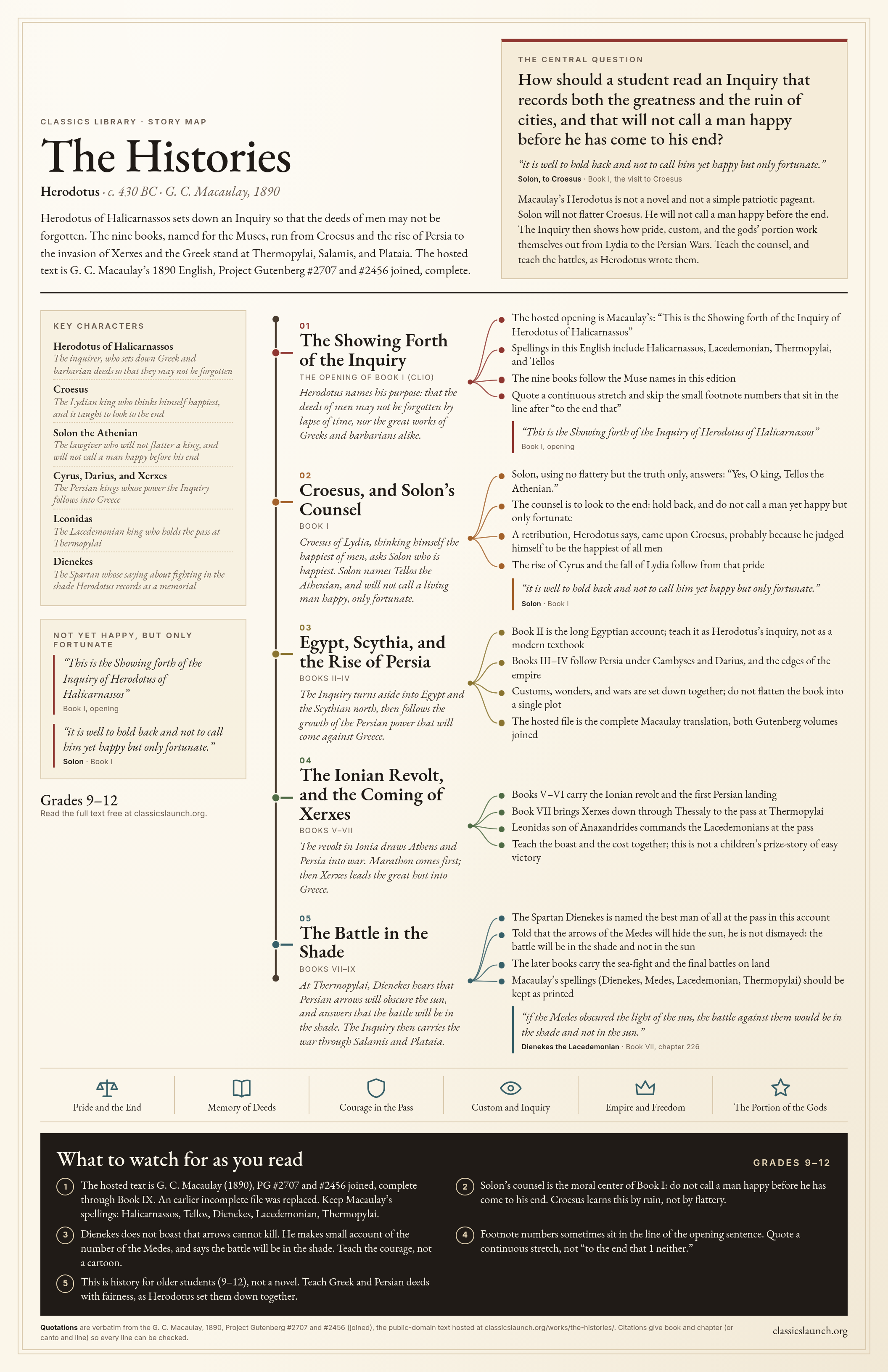
Herodotus of Halicarnassos sets down an Inquiry so that the deeds of men may not be forgotten. The nine books, named for the Muses, run from Croesus and the rise of Persia to the invasion of Xerxes and the Greek stand at Thermopylai, Salamis, and Plataia. The hosted text is G. C. Macaulay’s 1890 English, Project Gutenberg #2707 and #2456 joined, complete.
The central question
How should a student read an Inquiry that records both the greatness and the ruin of cities, and that will not call a man happy before he has come to his end?
“it is well to hold back and not to call him yet happy but only fortunate.”
Macaulay’s Herodotus is not a novel and not a simple patriotic pageant. Solon will not flatter Croesus. He will not call a man happy before the end. The Inquiry then shows how pride, custom, and the gods’ portion work themselves out from Lydia to the Persian Wars. Teach the counsel, and teach the battles, as Herodotus wrote them.
- 01
The Showing Forth of the Inquiry
The opening of Book I (Clio)
Herodotus names his purpose: that the deeds of men may not be forgotten by lapse of time, nor the great works of Greeks and barbarians alike.
- The hosted opening is Macaulay’s: “This is the Showing forth of the Inquiry of Herodotus of Halicarnassos”
- Spellings in this English include Halicarnassos, Lacedemonian, Thermopylai, and Tellos
- The nine books follow the Muse names in this edition
- Quote a continuous stretch and skip the small footnote numbers that sit in the line after “to the end that”
“This is the Showing forth of the Inquiry of Herodotus of Halicarnassos”
- 02
Croesus, and Solon’s Counsel
Book I
Croesus of Lydia, thinking himself the happiest of men, asks Solon who is happiest. Solon names Tellos the Athenian, and will not call a living man happy, only fortunate.
- Solon, using no flattery but the truth only, answers: “Yes, O king, Tellos the Athenian.”
- The counsel is to look to the end: hold back, and do not call a man yet happy but only fortunate
- A retribution, Herodotus says, came upon Croesus, probably because he judged himself to be the happiest of all men
- The rise of Cyrus and the fall of Lydia follow from that pride
“it is well to hold back and not to call him yet happy but only fortunate.”
- 03
Egypt, Scythia, and the Rise of Persia
Books II–IV
The Inquiry turns aside into Egypt and the Scythian north, then follows the growth of the Persian power that will come against Greece.
- Book II is the long Egyptian account; teach it as Herodotus’s inquiry, not as a modern textbook
- Books III–IV follow Persia under Cambyses and Darius, and the edges of the empire
- Customs, wonders, and wars are set down together; do not flatten the book into a single plot
- The hosted file is the complete Macaulay translation, both Gutenberg volumes joined
- 04
The Ionian Revolt, and the Coming of Xerxes
Books V–VII
The revolt in Ionia draws Athens and Persia into war. Marathon comes first; then Xerxes leads the great host into Greece.
- Books V–VI carry the Ionian revolt and the first Persian landing
- Book VII brings Xerxes down through Thessaly to the pass at Thermopylai
- Leonidas son of Anaxandrides commands the Lacedemonians at the pass
- Teach the boast and the cost together; this is not a children’s prize-story of easy victory
- 05
The Battle in the Shade
Books VII–IX
At Thermopylai, Dienekes hears that Persian arrows will obscure the sun, and answers that the battle will be in the shade. The Inquiry then carries the war through Salamis and Plataia.
- The Spartan Dienekes is named the best man of all at the pass in this account
- Told that the arrows of the Medes will hide the sun, he is not dismayed: the battle will be in the shade and not in the sun
- The later books carry the sea-fight and the final battles on land
- Macaulay’s spellings (Dienekes, Medes, Lacedemonian, Thermopylai) should be kept as printed
“if the Medes obscured the light of the sun, the battle against them would be in the shade and not in the sun.”
- Pride and the End
- Memory of Deeds
- Courage in the Pass
- Custom and Inquiry
- Empire and Freedom
- The Portion of the Gods
What to watch for as you read
Grades 9–12- The hosted text is G. C. Macaulay (1890), PG #2707 and #2456 joined, complete through Book IX. An earlier incomplete file was replaced. Keep Macaulay’s spellings: Halicarnassos, Tellos, Dienekes, Lacedemonian, Thermopylai.
- Solon’s counsel is the moral center of Book I: do not call a man happy before he has come to his end. Croesus learns this by ruin, not by flattery.
- Dienekes does not boast that arrows cannot kill. He makes small account of the number of the Medes, and says the battle will be in the shade. Teach the courage, not a cartoon.
- Footnote numbers sometimes sit in the line of the opening sentence. Quote a continuous stretch, not “to the end that 1 neither.”
- This is history for older students (9–12), not a novel. Teach Greek and Persian deeds with fairness, as Herodotus set them down together.
Every quotation is word for word from the G. C. Macaulay, 1890 hosted in this library and is checked against that text each time the site is built. Citations give book and chapter (or canto and line).