Story maps · Grades 10–12
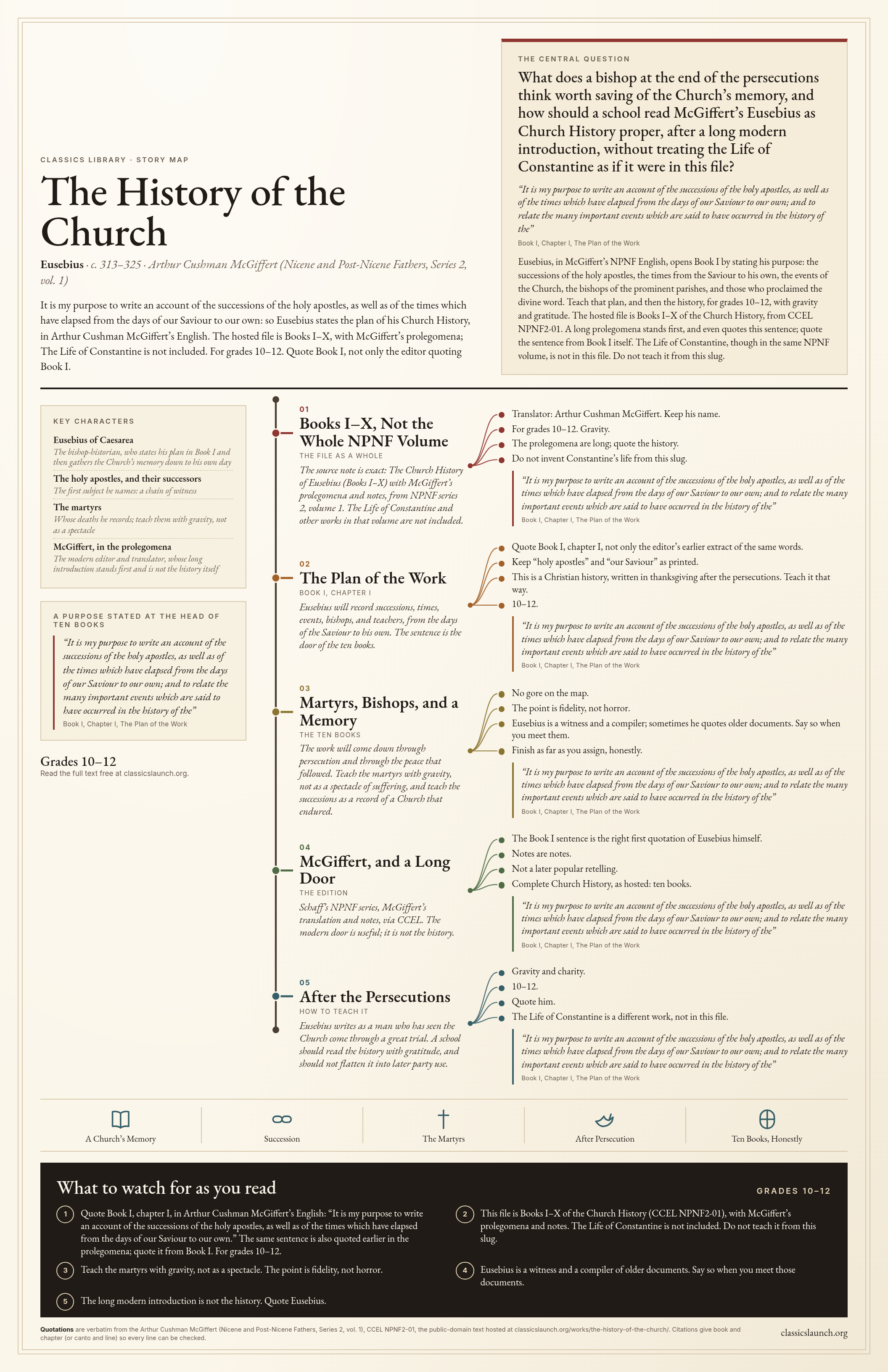
The History of the Church: A Story Map
The PDF is one tabloid page (11 × 17 in). On letter paper, choose “Fit to page.”
It is my purpose to write an account of the successions of the holy apostles, as well as of the times which have elapsed from the days of our Saviour to our own: so Eusebius states the plan of his Church History, in Arthur Cushman McGiffert’s English. The hosted file is Books I–X, with McGiffert’s prolegomena; The Life of Constantine is not included. For grades 10–12. Quote Book I, not only the editor quoting Book I.
The central question
What does a bishop at the end of the persecutions think worth saving of the Church’s memory, and how should a school read McGiffert’s Eusebius as Church History proper, after a long modern introduction, without treating the Life of Constantine as if it were in this file?
“It is my purpose to write an account of the successions of the holy apostles, as well as of the times which have elapsed from the days of our Saviour to our own; and to relate the many important events which are said to have occurred in the history of the”
Eusebius, in McGiffert’s NPNF English, opens Book I by stating his purpose: the successions of the holy apostles, the times from the Saviour to his own, the events of the Church, the bishops of the prominent parishes, and those who proclaimed the divine word. Teach that plan, and then the history, for grades 10–12, with gravity and gratitude. The hosted file is Books I–X of the Church History, from CCEL NPNF2-01. A long prolegomena stands first, and even quotes this sentence; quote the sentence from Book I itself. The Life of Constantine, though in the same NPNF volume, is not in this file. Do not teach it from this slug.
- 01
Books I–X, Not the Whole NPNF Volume
The file as a whole
The source note is exact: The Church History of Eusebius (Books I–X) with McGiffert’s prolegomena and notes, from NPNF series 2, volume 1. The Life of Constantine and other works in that volume are not included.
- Translator: Arthur Cushman McGiffert. Keep his name.
- For grades 10–12. Gravity.
- The prolegomena are long; quote the history.
- Do not invent Constantine’s life from this slug.
“It is my purpose to write an account of the successions of the holy apostles, as well as of the times which have elapsed from the days of our Saviour to our own; and to relate the many important events which are said to have occurred in the history of the”
- 02
The Plan of the Work
Book I, Chapter I
Eusebius will record successions, times, events, bishops, and teachers, from the days of the Saviour to his own. The sentence is the door of the ten books.
- Quote Book I, chapter I, not only the editor’s earlier extract of the same words.
- Keep “holy apostles” and “our Saviour” as printed.
- This is a Christian history, written in thanksgiving after the persecutions. Teach it that way.
- 10–12.
“It is my purpose to write an account of the successions of the holy apostles, as well as of the times which have elapsed from the days of our Saviour to our own; and to relate the many important events which are said to have occurred in the history of the”
- 03
Martyrs, Bishops, and a Memory
The ten books
The work will come down through persecution and through the peace that followed. Teach the martyrs with gravity, not as a spectacle of suffering, and teach the successions as a record of a Church that endured.
- No gore on the map.
- The point is fidelity, not horror.
- Eusebius is a witness and a compiler; sometimes he quotes older documents. Say so when you meet them.
- Finish as far as you assign, honestly.
“It is my purpose to write an account of the successions of the holy apostles, as well as of the times which have elapsed from the days of our Saviour to our own; and to relate the many important events which are said to have occurred in the history of the”
- 04
McGiffert, and a Long Door
The edition
Schaff’s NPNF series, McGiffert’s translation and notes, via CCEL. The modern door is useful; it is not the history.
- The Book I sentence is the right first quotation of Eusebius himself.
- Notes are notes.
- Not a later popular retelling.
- Complete Church History, as hosted: ten books.
“It is my purpose to write an account of the successions of the holy apostles, as well as of the times which have elapsed from the days of our Saviour to our own; and to relate the many important events which are said to have occurred in the history of the”
- 05
After the Persecutions
How to teach it
Eusebius writes as a man who has seen the Church come through a great trial. A school should read the history with gratitude, and should not flatten it into later party use.
- Gravity and charity.
- 10–12.
- Quote him.
- The Life of Constantine is a different work, not in this file.
“It is my purpose to write an account of the successions of the holy apostles, as well as of the times which have elapsed from the days of our Saviour to our own; and to relate the many important events which are said to have occurred in the history of the”
- A Church’s Memory
- Succession
- The Martyrs
- After Persecution
- Ten Books, Honestly
What to watch for as you read
Grades 10–12- Quote Book I, chapter I, in Arthur Cushman McGiffert’s English: “It is my purpose to write an account of the successions of the holy apostles, as well as of the times which have elapsed from the days of our Saviour to our own.” The same sentence is also quoted earlier in the prolegomena; quote it from Book I. For grades 10–12.
- This file is Books I–X of the Church History (CCEL NPNF2-01), with McGiffert’s prolegomena and notes. The Life of Constantine is not included. Do not teach it from this slug.
- Teach the martyrs with gravity, not as a spectacle. The point is fidelity, not horror.
- Eusebius is a witness and a compiler of older documents. Say so when you meet those documents.
- The long modern introduction is not the history. Quote Eusebius.
Every quotation is word for word from the Arthur Cushman McGiffert (Nicene and Post-Nicene Fathers, Series 2, vol. 1) hosted in this library and is checked against that text each time the site is built. Citations give book and chapter (or canto and line).