Story maps · Grades 10–12
The History of the Peloponnesian War: A Story Map
The PDF is one tabloid page (11 × 17 in). On letter paper, choose “Fit to page.”
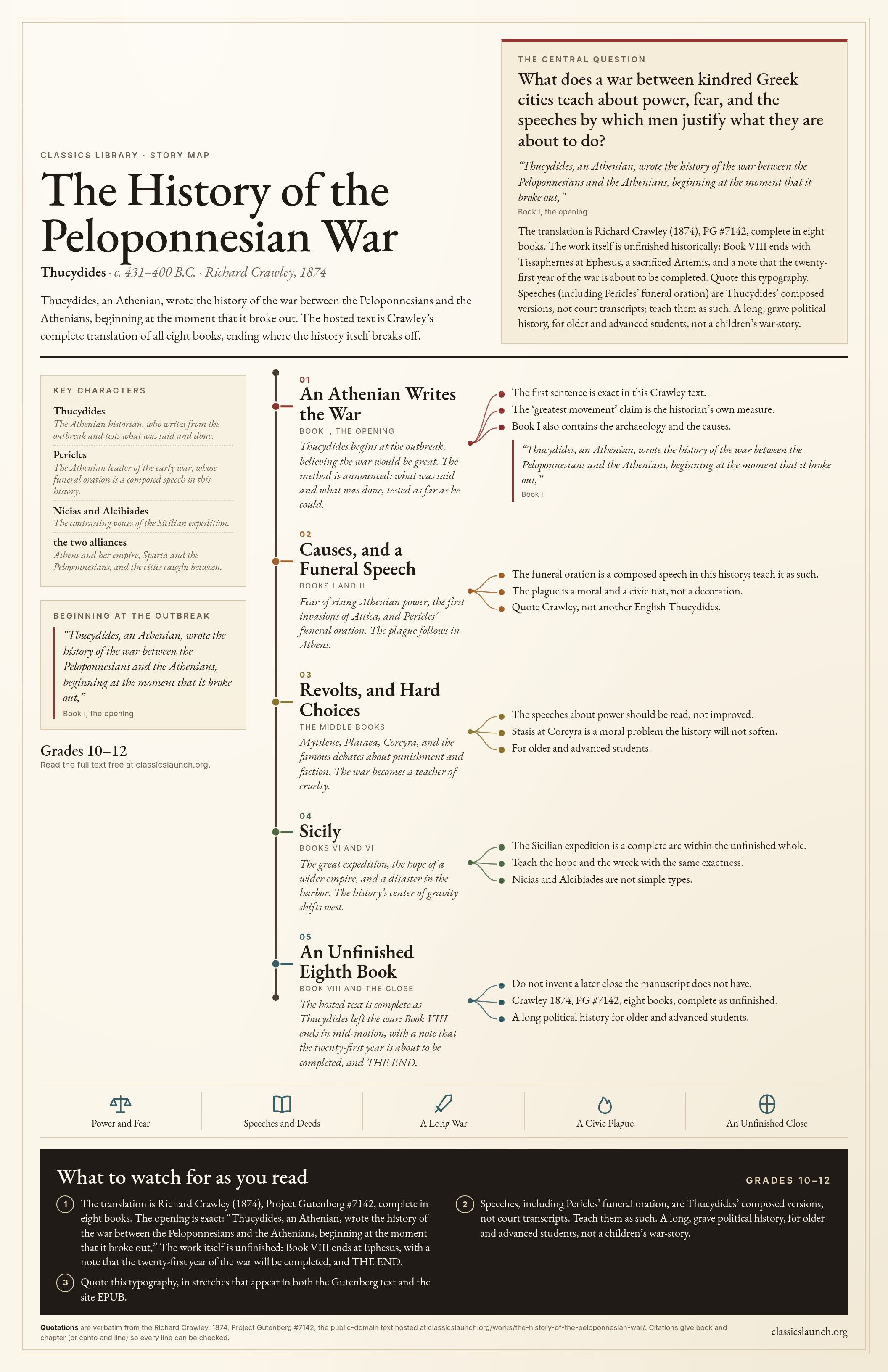
Thucydides, an Athenian, wrote the history of the war between the Peloponnesians and the Athenians, beginning at the moment that it broke out. The hosted text is Crawley’s complete translation of all eight books, ending where the history itself breaks off.
The central question
What does a war between kindred Greek cities teach about power, fear, and the speeches by which men justify what they are about to do?
“Thucydides, an Athenian, wrote the history of the war between the Peloponnesians and the Athenians, beginning at the moment that it broke out,”
The translation is Richard Crawley (1874), PG #7142, complete in eight books. The work itself is unfinished historically: Book VIII ends with Tissaphernes at Ephesus, a sacrificed Artemis, and a note that the twenty-first year of the war is about to be completed. Quote this typography. Speeches (including Pericles’ funeral oration) are Thucydides’ composed versions, not court transcripts; teach them as such. A long, grave political history, for older and advanced students, not a children’s war-story.
- 01
An Athenian Writes the War
Book I, the opening
Thucydides begins at the outbreak, believing the war would be great. The method is announced: what was said and what was done, tested as far as he could.
- The first sentence is exact in this Crawley text.
- The ‘greatest movement’ claim is the historian’s own measure.
- Book I also contains the archaeology and the causes.
“Thucydides, an Athenian, wrote the history of the war between the Peloponnesians and the Athenians, beginning at the moment that it broke out,”
- 02
Causes, and a Funeral Speech
Books I and II
Fear of rising Athenian power, the first invasions of Attica, and Pericles’ funeral oration. The plague follows in Athens.
- The funeral oration is a composed speech in this history; teach it as such.
- The plague is a moral and a civic test, not a decoration.
- Quote Crawley, not another English Thucydides.
- 03
Revolts, and Hard Choices
The middle books
Mytilene, Plataea, Corcyra, and the famous debates about punishment and faction. The war becomes a teacher of cruelty.
- The speeches about power should be read, not improved.
- Stasis at Corcyra is a moral problem the history will not soften.
- For older and advanced students.
- 04
Sicily
Books VI and VII
The great expedition, the hope of a wider empire, and a disaster in the harbor. The history’s center of gravity shifts west.
- The Sicilian expedition is a complete arc within the unfinished whole.
- Teach the hope and the wreck with the same exactness.
- Nicias and Alcibiades are not simple types.
- 05
An Unfinished Eighth Book
Book VIII and the close
The hosted text is complete as Thucydides left the war: Book VIII ends in mid-motion, with a note that the twenty-first year is about to be completed, and THE END.
- Do not invent a later close the manuscript does not have.
- Crawley 1874, PG #7142, eight books, complete as unfinished.
- A long political history for older and advanced students.
- Power and Fear
- Speeches and Deeds
- A Long War
- A Civic Plague
- An Unfinished Close
What to watch for as you read
Grades 10–12- The translation is Richard Crawley (1874), Project Gutenberg #7142, complete in eight books. The opening is exact: “Thucydides, an Athenian, wrote the history of the war between the Peloponnesians and the Athenians, beginning at the moment that it broke out,” The work itself is unfinished: Book VIII ends at Ephesus, with a note that the twenty-first year of the war will be completed, and THE END.
- Speeches, including Pericles’ funeral oration, are Thucydides’ composed versions, not court transcripts. Teach them as such. A long, grave political history, for older and advanced students, not a children’s war-story.
- Quote this typography, in stretches that appear in both the Gutenberg text and the site EPUB.
Every quotation is word for word from the Richard Crawley, 1874 hosted in this library and is checked against that text each time the site is built. Citations give book and chapter (or canto and line).