Story maps · Grades 8–12
The Invisible Man: A Story Map
The PDF is one tabloid page (11 × 17 in). On letter paper, choose “Fit to page.”
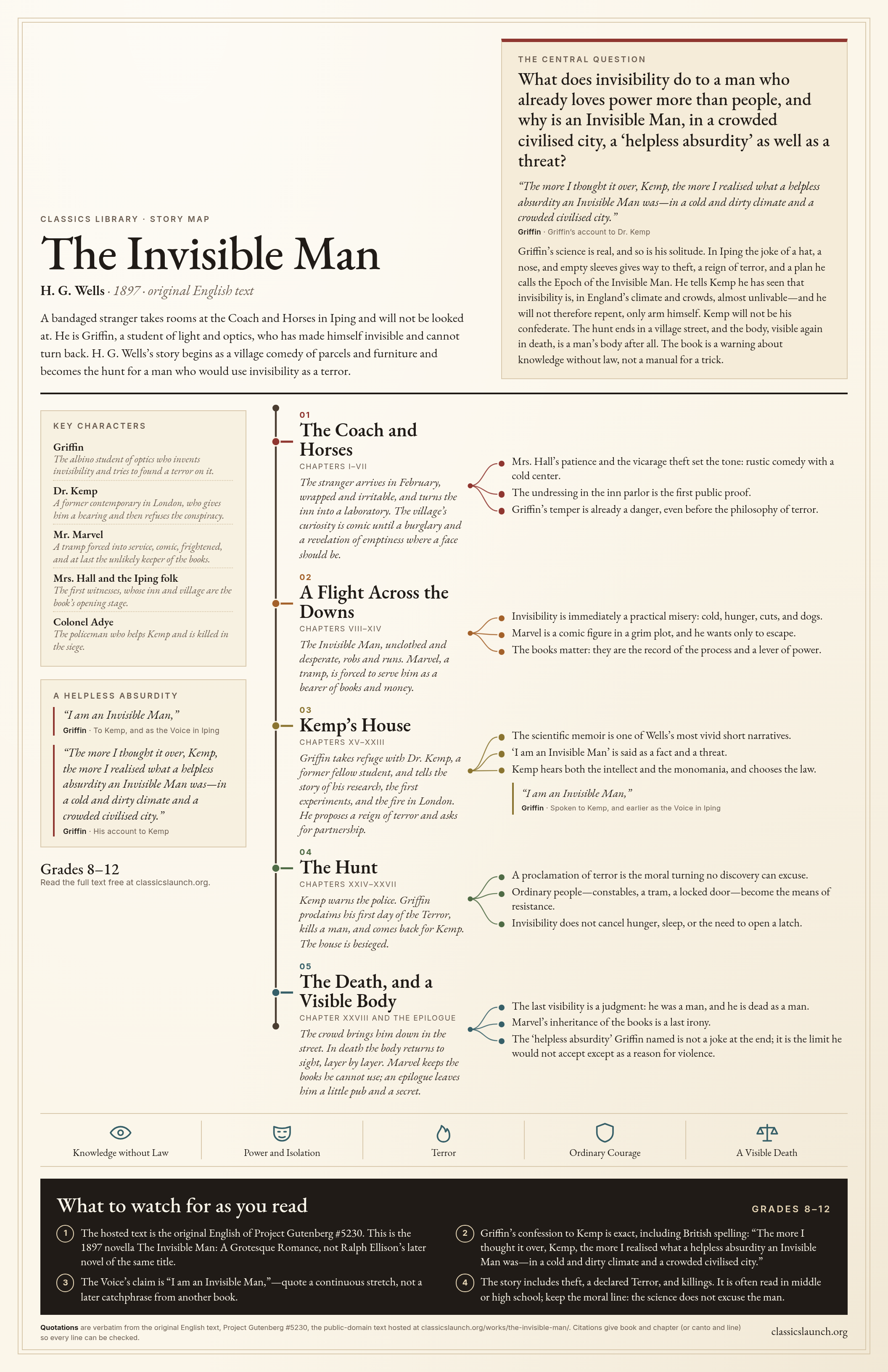
A bandaged stranger takes rooms at the Coach and Horses in Iping and will not be looked at. He is Griffin, a student of light and optics, who has made himself invisible and cannot turn back. H. G. Wells’s story begins as a village comedy of parcels and furniture and becomes the hunt for a man who would use invisibility as a terror.
The central question
What does invisibility do to a man who already loves power more than people, and why is an Invisible Man, in a crowded civilised city, a ‘helpless absurdity’ as well as a threat?
“The more I thought it over, Kemp, the more I realised what a helpless absurdity an Invisible Man was—in a cold and dirty climate and a crowded civilised city.”
Griffin’s science is real, and so is his solitude. In Iping the joke of a hat, a nose, and empty sleeves gives way to theft, a reign of terror, and a plan he calls the Epoch of the Invisible Man. He tells Kemp he has seen that invisibility is, in England’s climate and crowds, almost unlivable—and he will not therefore repent, only arm himself. Kemp will not be his confederate. The hunt ends in a village street, and the body, visible again in death, is a man’s body after all. The book is a warning about knowledge without law, not a manual for a trick.
- 01
The Coach and Horses
Chapters I–VII
The stranger arrives in February, wrapped and irritable, and turns the inn into a laboratory. The village’s curiosity is comic until a burglary and a revelation of emptiness where a face should be.
- Mrs. Hall’s patience and the vicarage theft set the tone: rustic comedy with a cold center.
- The undressing in the inn parlor is the first public proof.
- Griffin’s temper is already a danger, even before the philosophy of terror.
- 02
A Flight Across the Downs
Chapters VIII–XIV
The Invisible Man, unclothed and desperate, robs and runs. Marvel, a tramp, is forced to serve him as a bearer of books and money.
- Invisibility is immediately a practical misery: cold, hunger, cuts, and dogs.
- Marvel is a comic figure in a grim plot, and he wants only to escape.
- The books matter: they are the record of the process and a lever of power.
- 03
Kemp’s House
Chapters XV–XXIII
Griffin takes refuge with Dr. Kemp, a former fellow student, and tells the story of his research, the first experiments, and the fire in London. He proposes a reign of terror and asks for partnership.
- The scientific memoir is one of Wells’s most vivid short narratives.
- ‘I am an Invisible Man’ is said as a fact and a threat.
- Kemp hears both the intellect and the monomania, and chooses the law.
“I am an Invisible Man,”
- 04
The Hunt
Chapters XXIV–XXVII
Kemp warns the police. Griffin proclaims his first day of the Terror, kills a man, and comes back for Kemp. The house is besieged.
- A proclamation of terror is the moral turning no discovery can excuse.
- Ordinary people—constables, a tram, a locked door—become the means of resistance.
- Invisibility does not cancel hunger, sleep, or the need to open a latch.
- 05
The Death, and a Visible Body
Chapter XXVIII and the epilogue
The crowd brings him down in the street. In death the body returns to sight, layer by layer. Marvel keeps the books he cannot use; an epilogue leaves him a little pub and a secret.
- The last visibility is a judgment: he was a man, and he is dead as a man.
- Marvel’s inheritance of the books is a last irony.
- The ‘helpless absurdity’ Griffin named is not a joke at the end; it is the limit he would not accept except as a reason for violence.
- Knowledge without Law
- Power and Isolation
- Terror
- Ordinary Courage
- A Visible Death
What to watch for as you read
Grades 8–12- The hosted text is the original English of Project Gutenberg #5230. This is the 1897 novella The Invisible Man: A Grotesque Romance, not Ralph Ellison’s later novel of the same title.
- Griffin’s confession to Kemp is exact, including British spelling: “The more I thought it over, Kemp, the more I realised what a helpless absurdity an Invisible Man was—in a cold and dirty climate and a crowded civilised city.”
- The Voice’s claim is “I am an Invisible Man,”—quote a continuous stretch, not a later catchphrase from another book.
- The story includes theft, a declared Terror, and killings. It is often read in middle or high school; keep the moral line: the science does not excuse the man.
Every quotation is word for word from the original English text hosted in this library and is checked against that text each time the site is built. Citations give book and chapter (or canto and line).