Story maps · Grades 9–12
The Last Days of Socrates: A Story Map
The PDF is one tabloid page (11 × 17 in). On letter paper, choose “Fit to page.”
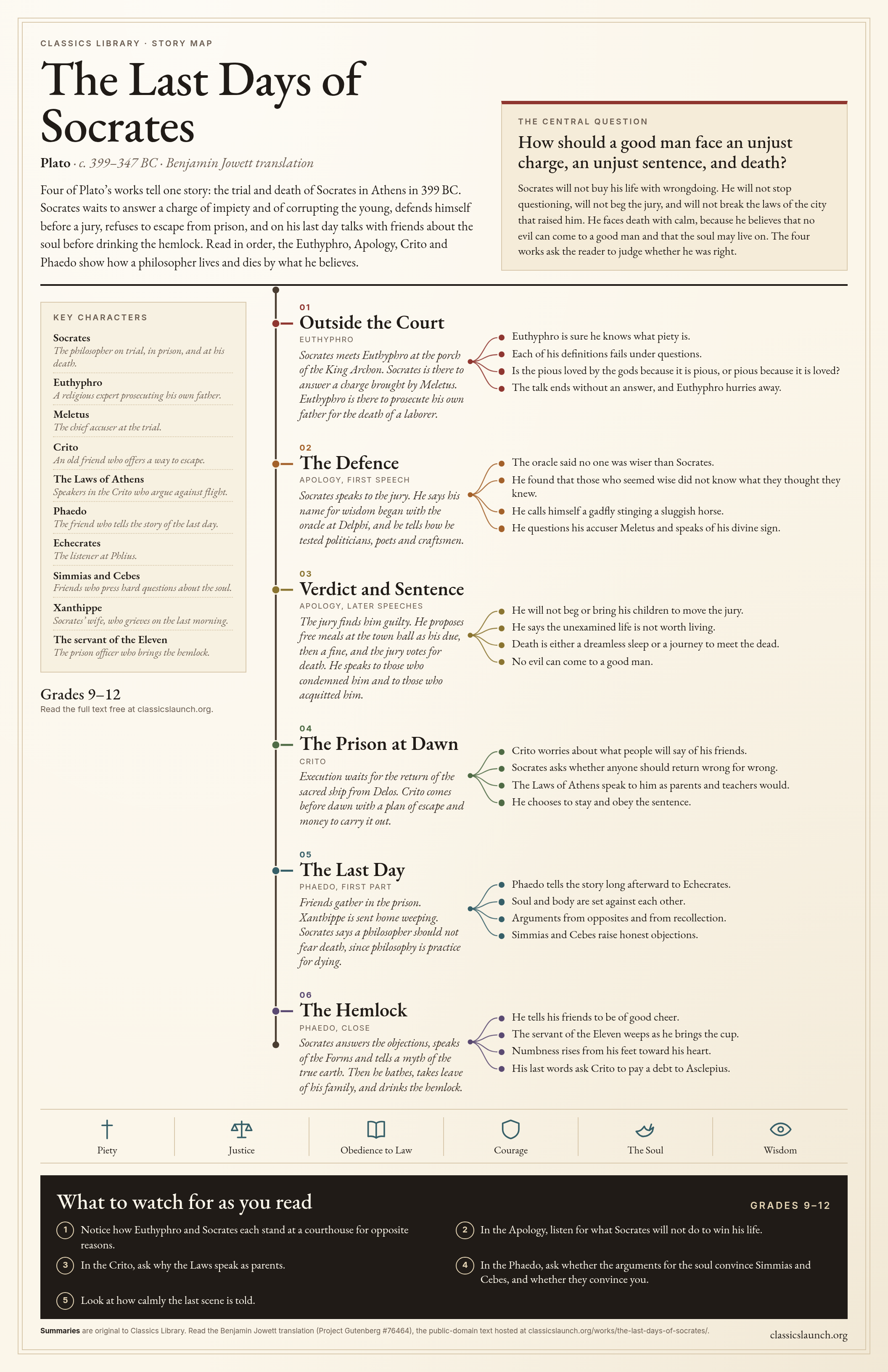
Four of Plato’s works tell one story: the trial and death of Socrates in Athens in 399 BC. Socrates waits to answer a charge of impiety and of corrupting the young, defends himself before a jury, refuses to escape from prison, and on his last day talks with friends about the soul before drinking the hemlock. Read in order, the Euthyphro, Apology, Crito and Phaedo show how a philosopher lives and dies by what he believes.
The central question
How should a good man face an unjust charge, an unjust sentence, and death?
Socrates will not buy his life with wrongdoing. He will not stop questioning, will not beg the jury, and will not break the laws of the city that raised him. He faces death with calm, because he believes that no evil can come to a good man and that the soul may live on. The four works ask the reader to judge whether he was right.
- 01
Outside the Court
Euthyphro
Socrates meets Euthyphro at the porch of the King Archon. Socrates is there to answer a charge brought by Meletus. Euthyphro is there to prosecute his own father for the death of a laborer.
- Euthyphro is sure he knows what piety is.
- Each of his definitions fails under questions.
- Is the pious loved by the gods because it is pious, or pious because it is loved?
- The talk ends without an answer, and Euthyphro hurries away.
- 02
The Defence
Apology, first speech
Socrates speaks to the jury. He says his name for wisdom began with the oracle at Delphi, and he tells how he tested politicians, poets and craftsmen.
- The oracle said no one was wiser than Socrates.
- He found that those who seemed wise did not know what they thought they knew.
- He calls himself a gadfly stinging a sluggish horse.
- He questions his accuser Meletus and speaks of his divine sign.
- 03
Verdict and Sentence
Apology, later speeches
The jury finds him guilty. He proposes free meals at the town hall as his due, then a fine, and the jury votes for death. He speaks to those who condemned him and to those who acquitted him.
- He will not beg or bring his children to move the jury.
- He says the unexamined life is not worth living.
- Death is either a dreamless sleep or a journey to meet the dead.
- No evil can come to a good man.
- 04
The Prison at Dawn
Crito
Execution waits for the return of the sacred ship from Delos. Crito comes before dawn with a plan of escape and money to carry it out.
- Crito worries about what people will say of his friends.
- Socrates asks whether anyone should return wrong for wrong.
- The Laws of Athens speak to him as parents and teachers would.
- He chooses to stay and obey the sentence.
- 05
The Last Day
Phaedo, first part
Friends gather in the prison. Xanthippe is sent home weeping. Socrates says a philosopher should not fear death, since philosophy is practice for dying.
- Phaedo tells the story long afterward to Echecrates.
- Soul and body are set against each other.
- Arguments from opposites and from recollection.
- Simmias and Cebes raise honest objections.
- 06
The Hemlock
Phaedo, close
Socrates answers the objections, speaks of the Forms and tells a myth of the true earth. Then he bathes, takes leave of his family, and drinks the hemlock.
- He tells his friends to be of good cheer.
- The servant of the Eleven weeps as he brings the cup.
- Numbness rises from his feet toward his heart.
- His last words ask Crito to pay a debt to Asclepius.
- Piety
- Justice
- Obedience to Law
- Courage
- The Soul
- Wisdom
What to watch for as you read
Grades 9–12- Notice how Euthyphro and Socrates each stand at a courthouse for opposite reasons.
- In the Apology, listen for what Socrates will not do to win his life.
- In the Crito, ask why the Laws speak as parents.
- In the Phaedo, ask whether the arguments for the soul convince Simmias and Cebes, and whether they convince you.
- Look at how calmly the last scene is told.
Every quotation is word for word from the Benjamin Jowett translation hosted in this library and is checked against that text each time the site is built. Citations give book and chapter (or canto and line).