Story maps · Grades 8–12
The Man in the Iron Mask: A Story Map
The PDF is one tabloid page (11 × 17 in). On letter paper, choose “Fit to page.”
In a prison of the Bastille a young man learns that he is the king’s brother. Aramis conceives a substitution; Philippe’s brief hope, Louis’s fury, Porthos’s last strength, and a mask at the end complete the musketeers’ long story. The hosted English is uncredited, and it has a proper ending.
The central question
What is owed to a hidden prince, to a king, and to the friends who have grown old in service—and can a last adventure be paid for except with death?
“I am the brother of the king of France--a prisoner to-day--a madman to-morrow.”
The last great musketeer novel (the close of the Bragelonne cycle in this English) is not only a prison riddle. It is a plot against a throne, a split among friends, a failed substitution, and then a long recession: Fouquet, Belle-Isle, the death of Porthos, the grief of Athos, a mask that is not a legend only. The hosted text (PG #2759) is an anonymous 19th-century English and runs to a real end. Quote its typography: ‘to-day,’ ‘to-morrow,’ and the dashes. ‘Help, help! I am the king.’ is Louis’s cry, not Philippe’s. For older students.
- 01
A Prisoner in the Bastille
The opening
Aramis, now a great churchman, visits a prisoner who has been raised in the dark of a royal secret. The young man’s name in the story is Philippe.
- The riddle is political and personal at once: a twin, a throne, a conscience.
- Aramis’s plot is the last, proud scheme of a musketeer turned prelate.
- Quote this English’s wording for the prisoner’s claim.
“I am the brother of the king of France--a prisoner to-day--a madman to-morrow.”
- 02
A Substitution
The central attempt
For a short, terrible interval the plot tries to place Philippe on Louis’s seat. The king, shut away, cries that he is the king. The attempt will not hold.
- ‘Help, help! I am the king.’ is Louis’s line in this text, in his rage at the locked door.
- Fouquet’s part in the night is a moral hinge, not a footnote.
- The failure is swift; the cost will be long.
- 03
Friends Divided
The aftermath
D’Artagnan serves the crown he has always served. Aramis has overplayed. Porthos, loyal and not always understanding, will follow a friend into a last fortress.
- The old motto is under a new strain: duty to the king, duty to a friend.
- Porthos’s simplicity is not comic here; it is heading toward a death.
- Athos and Raoul have their own grief coming.
- 04
Belle-Isle, and Porthos
The last stand
The war closes around a fortress and a cave. Porthos’s strength, so long a jest and a glory, is spent in a way the earlier books never required.
- The hosted text includes this ending; it is not a cut volume.
- Do not rush past Porthos’s death; the cycle is paying its bill.
- Aramis survives with a different kind of loss.
- 05
A Mask, and an End
The close
Philippe’s fate is the iron mask of the title; other graves are filled; D’Artagnan’s road also ends. The book concludes in this file.
- Flag the uncredited English (PG #2759), as with Twenty Years After.
- Typographical forms: ‘to-day,’ ‘to-morrow,’ and double dashes --.
- This is the end of a cycle, for older students: a usurping plot, a prison, deaths of beloved friends. Teach it without cheap mystery-mongering.
- A Hidden Prince
- Friendship’s Last Duty
- Ambition
- Prison
- A Costly End
What to watch for as you read
Grades 8–12- The hosted text is Project Gutenberg #2759, an anonymous 19th-century English translation (the catalogue names no translator). It has a proper ending in this file, including Belle-Isle and the deaths that close the cycle. Quote this typography: ‘to-day,’ ‘to-morrow,’ and dashes written as --.
- Philippe’s written cry is exact: “I am the brother of the king of France--a prisoner to-day--a madman to-morrow.” “Help, help! I am the king.” is Louis’s cry, not the prisoner’s. Do not confuse the two voices.
- This is the close of the musketeer cycle, not a stand-alone riddle tale. It is for older students. Do not sensationalize the mask or Porthos’s death.
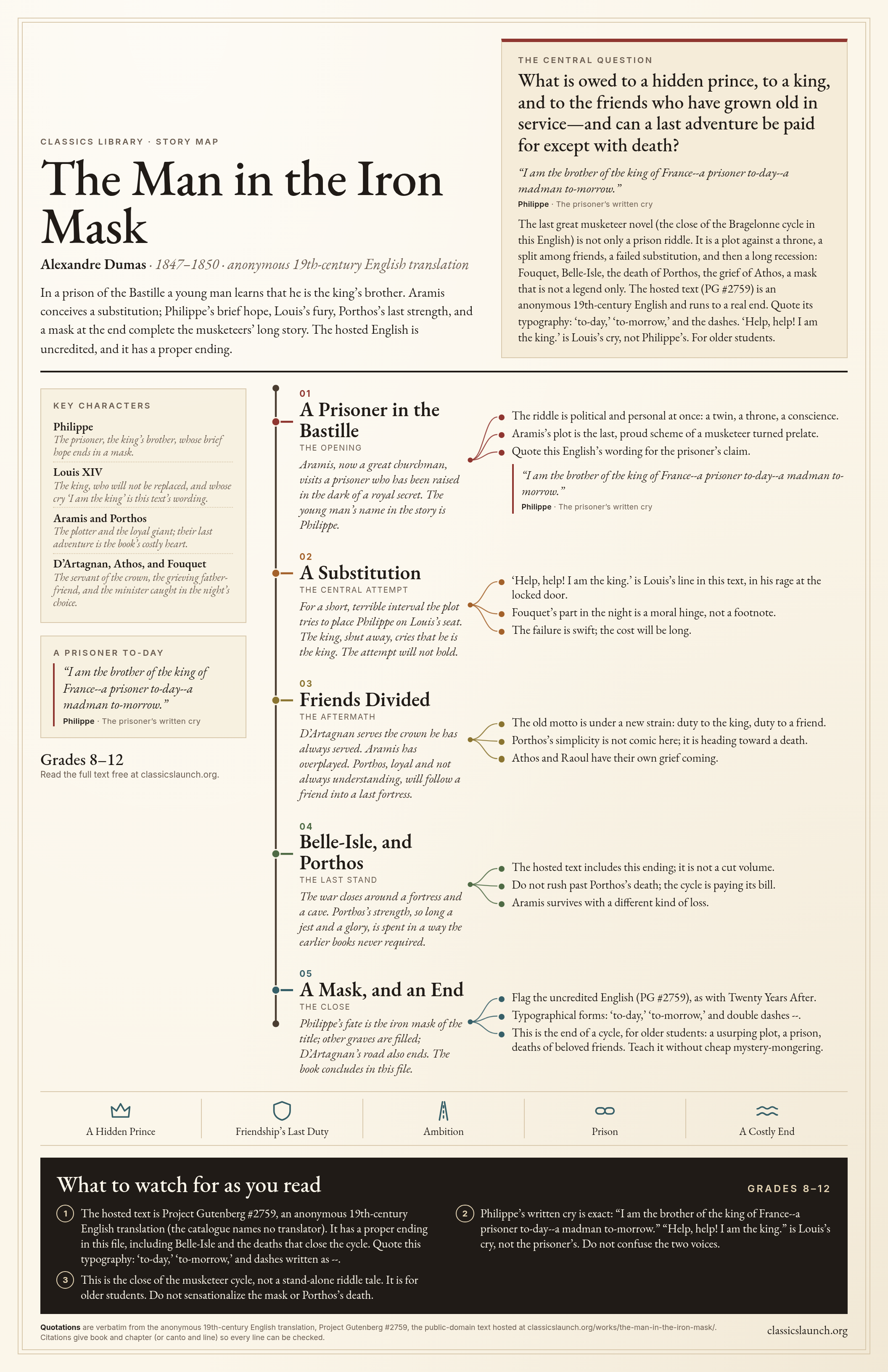
Every quotation is word for word from the anonymous 19th-century English translation hosted in this library and is checked against that text each time the site is built. Citations give book and chapter (or canto and line).