Story maps · Grades 9–12
The Misanthrope and Other Plays: A Story Map
The PDF is one tabloid page (11 × 17 in). On letter paper, choose “Fit to page.”
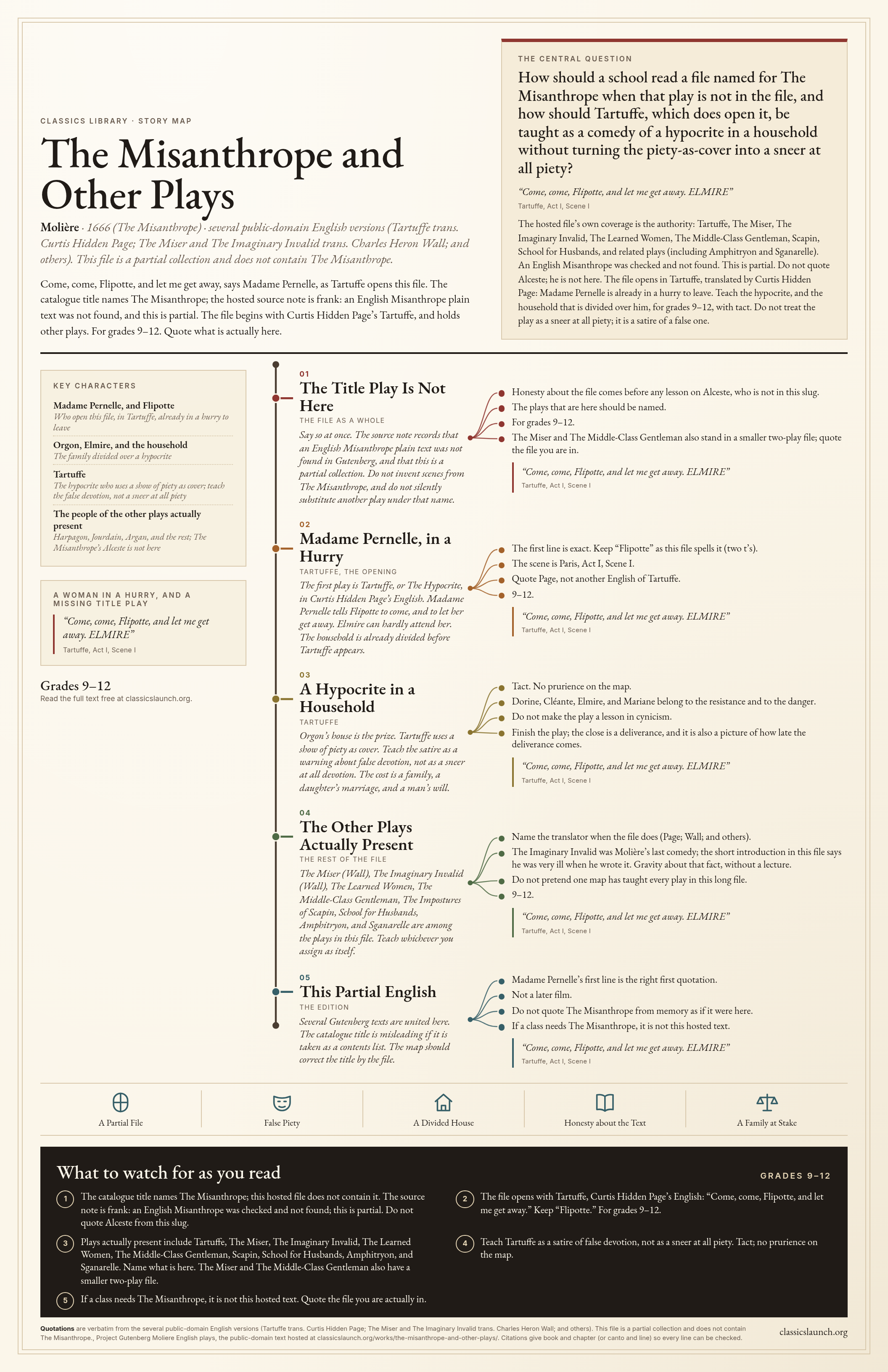
Come, come, Flipotte, and let me get away, says Madame Pernelle, as Tartuffe opens this file. The catalogue title names The Misanthrope; the hosted source note is frank: an English Misanthrope plain text was not found, and this is partial. The file begins with Curtis Hidden Page’s Tartuffe, and holds other plays. For grades 9–12. Quote what is actually here.
The central question
How should a school read a file named for The Misanthrope when that play is not in the file, and how should Tartuffe, which does open it, be taught as a comedy of a hypocrite in a household without turning the piety-as-cover into a sneer at all piety?
“Come, come, Flipotte, and let me get away. ELMIRE”
The hosted file’s own coverage is the authority: Tartuffe, The Miser, The Imaginary Invalid, The Learned Women, The Middle-Class Gentleman, Scapin, School for Husbands, and related plays (including Amphitryon and Sganarelle). An English Misanthrope was checked and not found. This is partial. Do not quote Alceste; he is not here. The file opens in Tartuffe, translated by Curtis Hidden Page: Madame Pernelle is already in a hurry to leave. Teach the hypocrite, and the household that is divided over him, for grades 9–12, with tact. Do not treat the play as a sneer at all piety; it is a satire of a false one.
- 01
The Title Play Is Not Here
The file as a whole
Say so at once. The source note records that an English Misanthrope plain text was not found in Gutenberg, and that this is a partial collection. Do not invent scenes from The Misanthrope, and do not silently substitute another play under that name.
- Honesty about the file comes before any lesson on Alceste, who is not in this slug.
- The plays that are here should be named.
- For grades 9–12.
- The Miser and The Middle-Class Gentleman also stand in a smaller two-play file; quote the file you are in.
“Come, come, Flipotte, and let me get away. ELMIRE”
- 02
Madame Pernelle, in a Hurry
Tartuffe, the opening
The first play is Tartuffe, or The Hypocrite, in Curtis Hidden Page’s English. Madame Pernelle tells Flipotte to come, and to let her get away. Elmire can hardly attend her. The household is already divided before Tartuffe appears.
- The first line is exact. Keep “Flipotte” as this file spells it (two t’s).
- The scene is Paris, Act I, Scene I.
- Quote Page, not another English of Tartuffe.
- 9–12.
“Come, come, Flipotte, and let me get away. ELMIRE”
- 03
A Hypocrite in a Household
Tartuffe
Orgon’s house is the prize. Tartuffe uses a show of piety as cover. Teach the satire as a warning about false devotion, not as a sneer at all devotion. The cost is a family, a daughter’s marriage, and a man’s will.
- Tact. No prurience on the map.
- Dorine, Cléante, Elmire, and Mariane belong to the resistance and to the danger.
- Do not make the play a lesson in cynicism.
- Finish the play; the close is a deliverance, and it is also a picture of how late the deliverance comes.
“Come, come, Flipotte, and let me get away. ELMIRE”
- 04
The Other Plays Actually Present
The rest of the file
The Miser (Wall), The Imaginary Invalid (Wall), The Learned Women, The Middle-Class Gentleman, The Impostures of Scapin, School for Husbands, Amphitryon, and Sganarelle are among the plays in this file. Teach whichever you assign as itself.
- Name the translator when the file does (Page; Wall; and others).
- The Imaginary Invalid was Molière’s last comedy; the short introduction in this file says he was very ill when he wrote it. Gravity about that fact, without a lecture.
- Do not pretend one map has taught every play in this long file.
- 9–12.
“Come, come, Flipotte, and let me get away. ELMIRE”
- 05
This Partial English
The edition
Several Gutenberg texts are united here. The catalogue title is misleading if it is taken as a contents list. The map should correct the title by the file.
- Madame Pernelle’s first line is the right first quotation.
- Not a later film.
- Do not quote The Misanthrope from memory as if it were here.
- If a class needs The Misanthrope, it is not this hosted text.
“Come, come, Flipotte, and let me get away. ELMIRE”
- A Partial File
- False Piety
- A Divided House
- Honesty about the Text
- A Family at Stake
What to watch for as you read
Grades 9–12- The catalogue title names The Misanthrope; this hosted file does not contain it. The source note is frank: an English Misanthrope was checked and not found; this is partial. Do not quote Alceste from this slug.
- The file opens with Tartuffe, Curtis Hidden Page’s English: “Come, come, Flipotte, and let me get away.” Keep “Flipotte.” For grades 9–12.
- Plays actually present include Tartuffe, The Miser, The Imaginary Invalid, The Learned Women, The Middle-Class Gentleman, Scapin, School for Husbands, Amphitryon, and Sganarelle. Name what is here. The Miser and The Middle-Class Gentleman also have a smaller two-play file.
- Teach Tartuffe as a satire of false devotion, not as a sneer at all piety. Tact; no prurience on the map.
- If a class needs The Misanthrope, it is not this hosted text. Quote the file you are actually in.
Every quotation is word for word from the several public-domain English versions (Tartuffe trans. Curtis Hidden Page; The Miser and The Imaginary Invalid trans. Charles Heron Wall; and others). This file is a partial collection and does not contain The Misanthrope. hosted in this library and is checked against that text each time the site is built. Citations give book and chapter (or canto and line).