Story maps · Grades 9–12
The Moonstone: A Story Map
The PDF is one tabloid page (11 × 17 in). On letter paper, choose “Fit to page.”
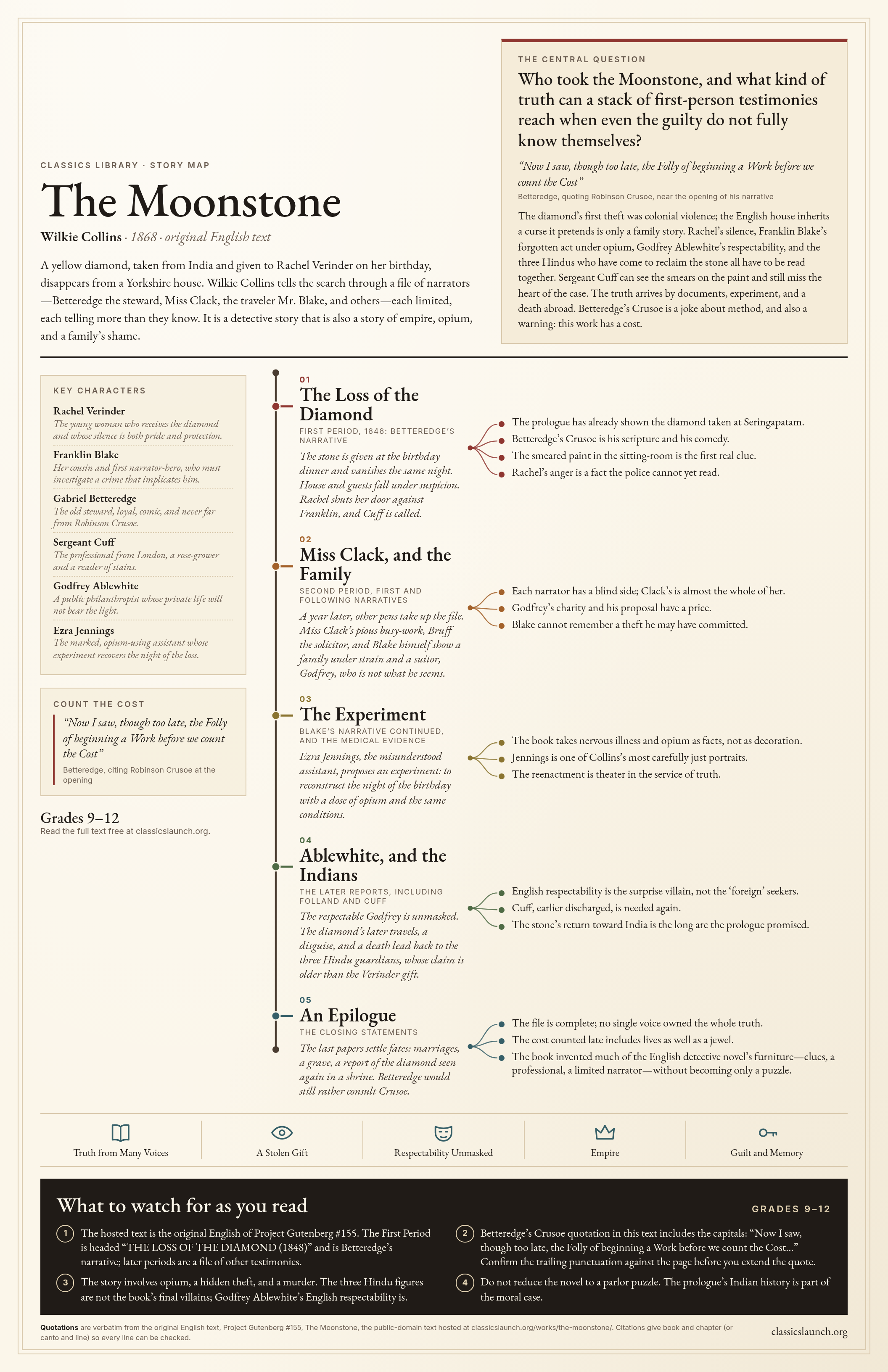
A yellow diamond, taken from India and given to Rachel Verinder on her birthday, disappears from a Yorkshire house. Wilkie Collins tells the search through a file of narrators—Betteredge the steward, Miss Clack, the traveler Mr. Blake, and others—each limited, each telling more than they know. It is a detective story that is also a story of empire, opium, and a family’s shame.
The central question
Who took the Moonstone, and what kind of truth can a stack of first-person testimonies reach when even the guilty do not fully know themselves?
“Now I saw, though too late, the Folly of beginning a Work before we count the Cost”
The diamond’s first theft was colonial violence; the English house inherits a curse it pretends is only a family story. Rachel’s silence, Franklin Blake’s forgotten act under opium, Godfrey Ablewhite’s respectability, and the three Hindus who have come to reclaim the stone all have to be read together. Sergeant Cuff can see the smears on the paint and still miss the heart of the case. The truth arrives by documents, experiment, and a death abroad. Betteredge’s Crusoe is a joke about method, and also a warning: this work has a cost.
- 01
The Loss of the Diamond
First Period, 1848: Betteredge’s narrative
The stone is given at the birthday dinner and vanishes the same night. House and guests fall under suspicion. Rachel shuts her door against Franklin, and Cuff is called.
- The prologue has already shown the diamond taken at Seringapatam.
- Betteredge’s Crusoe is his scripture and his comedy.
- The smeared paint in the sitting-room is the first real clue.
- Rachel’s anger is a fact the police cannot yet read.
- 02
Miss Clack, and the Family
Second Period, First and following narratives
A year later, other pens take up the file. Miss Clack’s pious busy-work, Bruff the solicitor, and Blake himself show a family under strain and a suitor, Godfrey, who is not what he seems.
- Each narrator has a blind side; Clack’s is almost the whole of her.
- Godfrey’s charity and his proposal have a price.
- Blake cannot remember a theft he may have committed.
- 03
The Experiment
Blake’s narrative continued, and the medical evidence
Ezra Jennings, the misunderstood assistant, proposes an experiment: to reconstruct the night of the birthday with a dose of opium and the same conditions.
- The book takes nervous illness and opium as facts, not as decoration.
- Jennings is one of Collins’s most carefully just portraits.
- The reenactment is theater in the service of truth.
- 04
Ablewhite, and the Indians
The later reports, including Folland and Cuff
The respectable Godfrey is unmasked. The diamond’s later travels, a disguise, and a death lead back to the three Hindu guardians, whose claim is older than the Verinder gift.
- English respectability is the surprise villain, not the ‘foreign’ seekers.
- Cuff, earlier discharged, is needed again.
- The stone’s return toward India is the long arc the prologue promised.
- 05
An Epilogue
The closing statements
The last papers settle fates: marriages, a grave, a report of the diamond seen again in a shrine. Betteredge would still rather consult Crusoe.
- The file is complete; no single voice owned the whole truth.
- The cost counted late includes lives as well as a jewel.
- The book invented much of the English detective novel’s furniture—clues, a professional, a limited narrator—without becoming only a puzzle.
- Truth from Many Voices
- A Stolen Gift
- Respectability Unmasked
- Empire
- Guilt and Memory
What to watch for as you read
Grades 9–12- The hosted text is the original English of Project Gutenberg #155. The First Period is headed “THE LOSS OF THE DIAMOND (1848)” and is Betteredge’s narrative; later periods are a file of other testimonies.
- Betteredge’s Crusoe quotation in this text includes the capitals: “Now I saw, though too late, the Folly of beginning a Work before we count the Cost…” Confirm the trailing punctuation against the page before you extend the quote.
- The story involves opium, a hidden theft, and a murder. The three Hindu figures are not the book’s final villains; Godfrey Ablewhite’s English respectability is.
- Do not reduce the novel to a parlor puzzle. The prologue’s Indian history is part of the moral case.
Every quotation is word for word from the original English text hosted in this library and is checked against that text each time the site is built. Citations give book and chapter (or canto and line).