Story maps · Grades 6–12
The Mysterious Island: A Story Map
The PDF is one tabloid page (11 × 17 in). On letter paper, choose “Fit to page.”
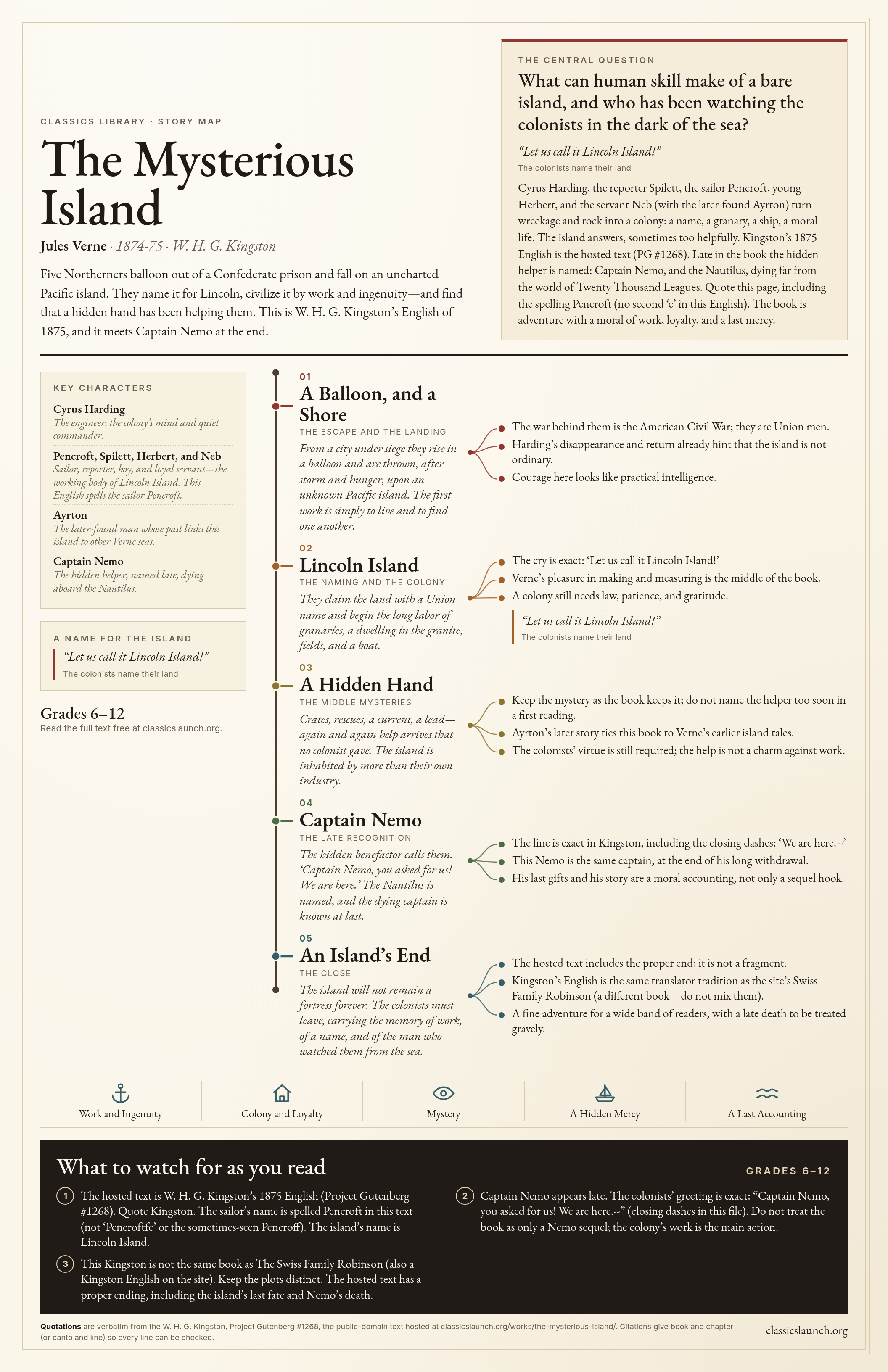
Five Northerners balloon out of a Confederate prison and fall on an uncharted Pacific island. They name it for Lincoln, civilize it by work and ingenuity—and find that a hidden hand has been helping them. This is W. H. G. Kingston’s English of 1875, and it meets Captain Nemo at the end.
The central question
What can human skill make of a bare island, and who has been watching the colonists in the dark of the sea?
“Let us call it Lincoln Island!”
Cyrus Harding, the reporter Spilett, the sailor Pencroft, young Herbert, and the servant Neb (with the later-found Ayrton) turn wreckage and rock into a colony: a name, a granary, a ship, a moral life. The island answers, sometimes too helpfully. Kingston’s 1875 English is the hosted text (PG #1268). Late in the book the hidden helper is named: Captain Nemo, and the Nautilus, dying far from the world of Twenty Thousand Leagues. Quote this page, including the spelling Pencroft (no second ‘e’ in this English). The book is adventure with a moral of work, loyalty, and a last mercy.
- 01
A Balloon, and a Shore
The escape and the landing
From a city under siege they rise in a balloon and are thrown, after storm and hunger, upon an unknown Pacific island. The first work is simply to live and to find one another.
- The war behind them is the American Civil War; they are Union men.
- Harding’s disappearance and return already hint that the island is not ordinary.
- Courage here looks like practical intelligence.
- 02
Lincoln Island
The naming and the colony
They claim the land with a Union name and begin the long labor of granaries, a dwelling in the granite, fields, and a boat.
- The cry is exact: ‘Let us call it Lincoln Island!’
- Verne’s pleasure in making and measuring is the middle of the book.
- A colony still needs law, patience, and gratitude.
“Let us call it Lincoln Island!”
- 03
A Hidden Hand
The middle mysteries
Crates, rescues, a current, a lead—again and again help arrives that no colonist gave. The island is inhabited by more than their own industry.
- Keep the mystery as the book keeps it; do not name the helper too soon in a first reading.
- Ayrton’s later story ties this book to Verne’s earlier island tales.
- The colonists’ virtue is still required; the help is not a charm against work.
- 04
Captain Nemo
The late recognition
The hidden benefactor calls them. ‘Captain Nemo, you asked for us! We are here.’ The Nautilus is named, and the dying captain is known at last.
- The line is exact in Kingston, including the closing dashes: ‘We are here.--’
- This Nemo is the same captain, at the end of his long withdrawal.
- His last gifts and his story are a moral accounting, not only a sequel hook.
- 05
An Island’s End
The close
The island will not remain a fortress forever. The colonists must leave, carrying the memory of work, of a name, and of the man who watched them from the sea.
- The hosted text includes the proper end; it is not a fragment.
- Kingston’s English is the same translator tradition as the site’s Swiss Family Robinson (a different book—do not mix them).
- A fine adventure for a wide band of readers, with a late death to be treated gravely.
- Work and Ingenuity
- Colony and Loyalty
- Mystery
- A Hidden Mercy
- A Last Accounting
What to watch for as you read
Grades 6–12- The hosted text is W. H. G. Kingston’s 1875 English (Project Gutenberg #1268). Quote Kingston. The sailor’s name is spelled Pencroft in this text (not ‘Pencroftfe’ or the sometimes-seen Pencroff). The island’s name is Lincoln Island.
- Captain Nemo appears late. The colonists’ greeting is exact: “Captain Nemo, you asked for us! We are here.--” (closing dashes in this file). Do not treat the book as only a Nemo sequel; the colony’s work is the main action.
- This Kingston is not the same book as The Swiss Family Robinson (also a Kingston English on the site). Keep the plots distinct. The hosted text has a proper ending, including the island’s last fate and Nemo’s death.
Every quotation is word for word from the W. H. G. Kingston hosted in this library and is checked against that text each time the site is built. Citations give book and chapter (or canto and line).