Story maps · Grades 9–12
The Nibelungenlied: A Story Map
The PDF is one tabloid page (11 × 17 in). On letter paper, choose “Fit to page.”
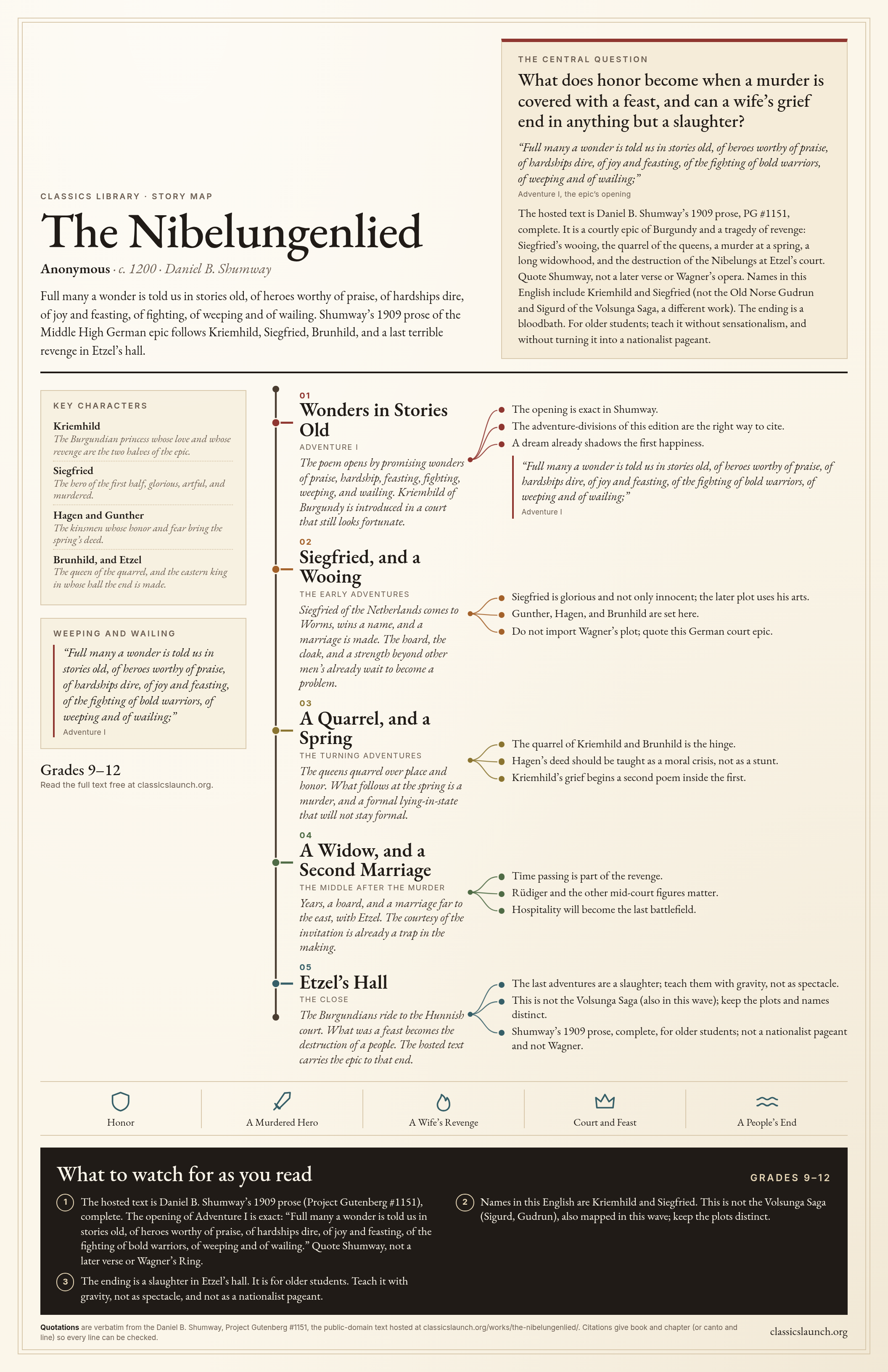
Full many a wonder is told us in stories old, of heroes worthy of praise, of hardships dire, of joy and feasting, of fighting, of weeping and of wailing. Shumway’s 1909 prose of the Middle High German epic follows Kriemhild, Siegfried, Brunhild, and a last terrible revenge in Etzel’s hall.
The central question
What does honor become when a murder is covered with a feast, and can a wife’s grief end in anything but a slaughter?
“Full many a wonder is told us in stories old, of heroes worthy of praise, of hardships dire, of joy and feasting, of the fighting of bold warriors, of weeping and of wailing;”
The hosted text is Daniel B. Shumway’s 1909 prose, PG #1151, complete. It is a courtly epic of Burgundy and a tragedy of revenge: Siegfried’s wooing, the quarrel of the queens, a murder at a spring, a long widowhood, and the destruction of the Nibelungs at Etzel’s court. Quote Shumway, not a later verse or Wagner’s opera. Names in this English include Kriemhild and Siegfried (not the Old Norse Gudrun and Sigurd of the Volsunga Saga, a different work). The ending is a bloodbath. For older students; teach it without sensationalism, and without turning it into a nationalist pageant.
- 01
Wonders in Stories Old
Adventure I
The poem opens by promising wonders of praise, hardship, feasting, fighting, weeping, and wailing. Kriemhild of Burgundy is introduced in a court that still looks fortunate.
- The opening is exact in Shumway.
- The adventure-divisions of this edition are the right way to cite.
- A dream already shadows the first happiness.
“Full many a wonder is told us in stories old, of heroes worthy of praise, of hardships dire, of joy and feasting, of the fighting of bold warriors, of weeping and of wailing;”
- 02
Siegfried, and a Wooing
The early adventures
Siegfried of the Netherlands comes to Worms, wins a name, and a marriage is made. The hoard, the cloak, and a strength beyond other men’s already wait to become a problem.
- Siegfried is glorious and not only innocent; the later plot uses his arts.
- Gunther, Hagen, and Brunhild are set here.
- Do not import Wagner’s plot; quote this German court epic.
- 03
A Quarrel, and a Spring
The turning adventures
The queens quarrel over place and honor. What follows at the spring is a murder, and a formal lying-in-state that will not stay formal.
- The quarrel of Kriemhild and Brunhild is the hinge.
- Hagen’s deed should be taught as a moral crisis, not as a stunt.
- Kriemhild’s grief begins a second poem inside the first.
- 04
A Widow, and a Second Marriage
The middle after the murder
Years, a hoard, and a marriage far to the east, with Etzel. The courtesy of the invitation is already a trap in the making.
- Time passing is part of the revenge.
- Rüdiger and the other mid-court figures matter.
- Hospitality will become the last battlefield.
- 05
Etzel’s Hall
The close
The Burgundians ride to the Hunnish court. What was a feast becomes the destruction of a people. The hosted text carries the epic to that end.
- The last adventures are a slaughter; teach them with gravity, not as spectacle.
- This is not the Volsunga Saga (also in this wave); keep the plots and names distinct.
- Shumway’s 1909 prose, complete, for older students; not a nationalist pageant and not Wagner.
- Honor
- A Murdered Hero
- A Wife’s Revenge
- Court and Feast
- A People’s End
What to watch for as you read
Grades 9–12- The hosted text is Daniel B. Shumway’s 1909 prose (Project Gutenberg #1151), complete. The opening of Adventure I is exact: “Full many a wonder is told us in stories old, of heroes worthy of praise, of hardships dire, of joy and feasting, of the fighting of bold warriors, of weeping and of wailing.” Quote Shumway, not a later verse or Wagner’s Ring.
- Names in this English are Kriemhild and Siegfried. This is not the Volsunga Saga (Sigurd, Gudrun), also mapped in this wave; keep the plots distinct.
- The ending is a slaughter in Etzel’s hall. It is for older students. Teach it with gravity, not as spectacle, and not as a nationalist pageant.
Every quotation is word for word from the Daniel B. Shumway hosted in this library and is checked against that text each time the site is built. Citations give book and chapter (or canto and line).