Story maps · Grades 9–12
The Oresteia: A Story Map
The PDF is one tabloid page (11 × 17 in). On letter paper, choose “Fit to page.”
The only complete Greek tragic trilogy that survives: Agamemnon, The Libation-Bearers, and The Furies. A house is paid in blood for blood until Athena founds a court on Ares’ Hill. Morshead’s English, the text hosted here, keeps the argument: wisdom schooled by affliction, and persuasion set against endless vendetta.
The central question
When blood has answered blood, can justice become something other than another killing—and can wrath itself be given a home?
“Men shall learn wisdom, by affliction schooled.”
The chorus names the law: men learn wisdom by affliction. Clytemnestra kills the king; Orestes kills her, at Apollo’s bidding; the Furies hunt him. Athena does not deny the claim of blood. She founds a court, casts the deciding mind, and by persuasion offers the Furies honor in the city instead of a curse without end.
- 01
The Watch and the Return
Agamemnon, opening
A beacon, a victory, and a house already heavy with an old sacrifice.
- A watchman on the roof sees the beacon that signals Troy has fallen
- The chorus of Argive elders recalls the war’s beginning at Aulis, and Iphigenia slain for a wind
- They hymn Zeus, and the hard schooling of wisdom by affliction
- Clytemnestra meets the returning king with speech that is too smooth, and a welcome already laid
“Men shall learn wisdom, by affliction schooled.”
- 02
The Purple Path
Agamemnon, the homecoming
A king is persuaded to tread what a man should fear to tread.
- Agamemnon comes home with Cassandra, prize of the army, in his train
- Clytemnestra spreads precious dyed garments for him to walk on; he is reluctant, then yields
- He passes in on purples to his home—an act the play treats as dangerous pride
- Cassandra, who sees the end, goes in to death with her eyes open
“I will pass in on purples to my home.”
- 03
The Third Blow
Agamemnon, close
The queen claims the deed, and Aegisthus claims the throne.
- Clytemnestra displays the body and will not deny the killing
- She trapped him in a robe, then struck, and with a last third blow finished the work
- She calls it justice for Iphigenia, and more than justice; the chorus is appalled
- Aegisthus, her lover, now stands in the dead king’s place; the house is not at peace
“Once more I smote him, with the last third blow, / Sacred to Hades, saviour of the dead.”
- 04
The Son’s Return
The Libation-Bearers
Orestes comes home to do what Apollo has charged, and what the dead demand.
- Orestes and Electra meet at Agamemnon’s tomb; libations and recognition bind them
- The chorus of slave-women urges the old law of blood for blood
- Orestes kills Aegisthus, then his mother, and avows the deed
- The Furies, unseen by others, already press upon him as he flies to Apollo’s shrine
“Slew her, my mother—lo, it stands avowed! / With blood for blood avenging my loved sire;”
- 05
The Court on Ares’ Hill
The Furies
A city is given a tribunal, and wrath is offered a place within it.
- The Furies hunt Orestes to Athens; Apollo defends the son who obeyed him
- Athena founds a council-court, pure, unsullied by the lust of gain, to judge blood-guilt
- The votes are equal, or as close as the play allows; Orestes is released
- Athena will not spurn the elder goddesses: by persuasion she offers them honor in the land
“Thus I ordain it now, a council-court / Pure and unsullied by the lust of gain, / Sacred and swift to vengeance, wakeful ever / To champion men who sleep, the country’s guard.”
- Justice
- Wisdom through Suffering
- Blood and Kinship
- Persuasion
- The City’s Law
- Piety
What to watch for as you read
Grades 9–12- This is E. D. A. Morshead’s English, not a later prose crib. Famous lines you remember from other versions (“learning by suffering,” “the doer shall suffer”) will not match this wording.
- The three plays are one argument. Do not treat the murder of Agamemnon as the end, or the court as a mere appendix.
- The purple garments are not decoration. Agamemnon’s hesitation and his yielding are the play’s measure of hybris just before the blow.
- Orestes’s avowal “Slew her, my mother” is spoken before Athena in The Furies, when he tells the court what he has done.
- Athena does not abolish the Furies. She offers them honor and a home. Watch whether the close is a defeat of wrath, or its conversion.
- The hosted volume is titled The House of Atreus; the three plays are Agamemnon, The Libation-Bearers, and The Furies (Eumenides).
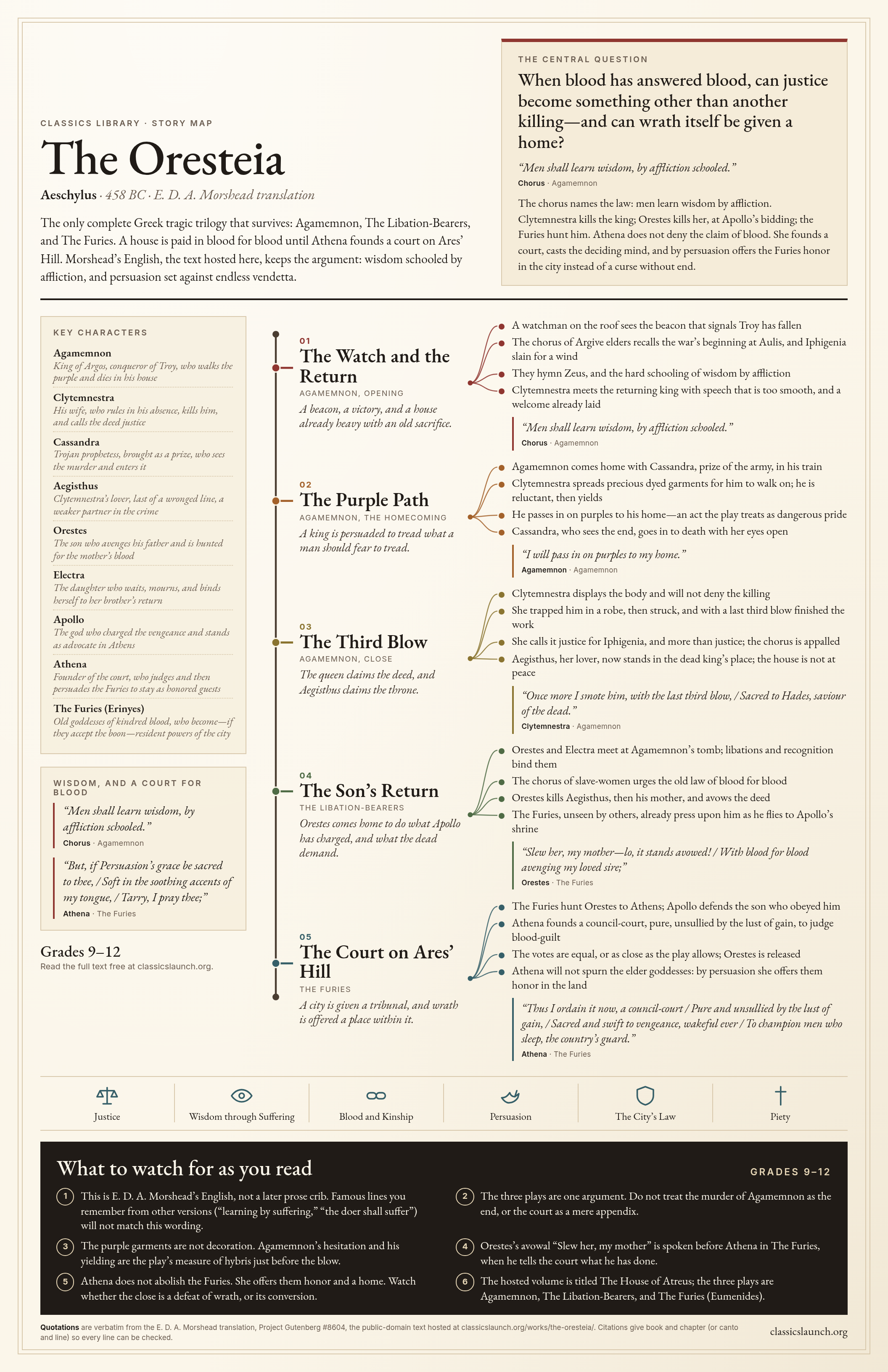
Every quotation is word for word from the E. D. A. Morshead translation hosted in this library and is checked against that text each time the site is built. Citations give book and chapter (or canto and line).