Story maps · Grades 7–12
The Phantom of the Opera: A Story Map
The PDF is one tabloid page (11 × 17 in). On letter paper, choose “Fit to page.”
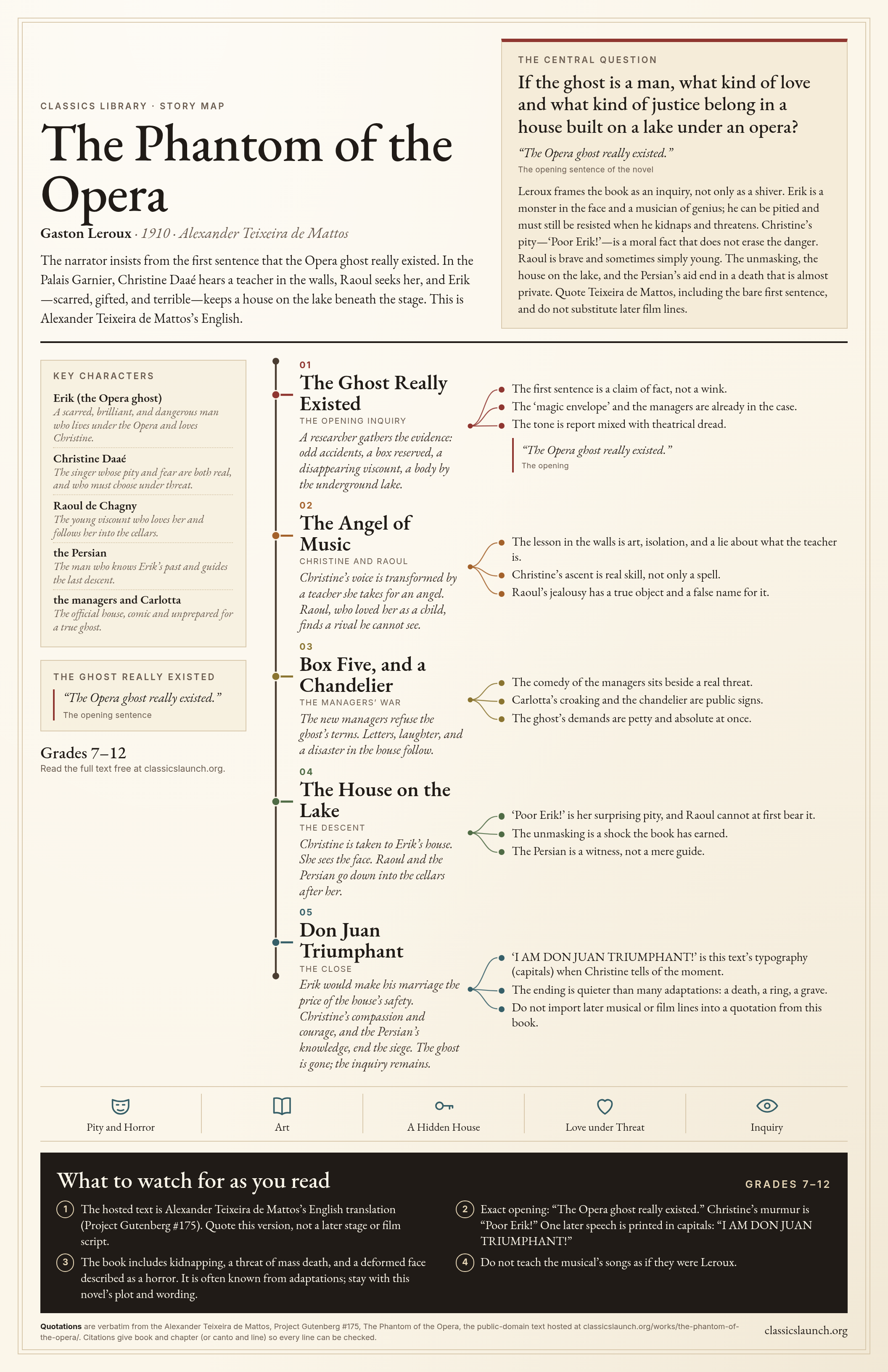
The narrator insists from the first sentence that the Opera ghost really existed. In the Palais Garnier, Christine Daaé hears a teacher in the walls, Raoul seeks her, and Erik—scarred, gifted, and terrible—keeps a house on the lake beneath the stage. This is Alexander Teixeira de Mattos’s English.
The central question
If the ghost is a man, what kind of love and what kind of justice belong in a house built on a lake under an opera?
“The Opera ghost really existed.”
Leroux frames the book as an inquiry, not only as a shiver. Erik is a monster in the face and a musician of genius; he can be pitied and must still be resisted when he kidnaps and threatens. Christine’s pity—‘Poor Erik!’—is a moral fact that does not erase the danger. Raoul is brave and sometimes simply young. The unmasking, the house on the lake, and the Persian’s aid end in a death that is almost private. Quote Teixeira de Mattos, including the bare first sentence, and do not substitute later film lines.
- 01
The Ghost Really Existed
The opening inquiry
A researcher gathers the evidence: odd accidents, a box reserved, a disappearing viscount, a body by the underground lake.
- The first sentence is a claim of fact, not a wink.
- The ‘magic envelope’ and the managers are already in the case.
- The tone is report mixed with theatrical dread.
“The Opera ghost really existed.”
- 02
The Angel of Music
Christine and Raoul
Christine’s voice is transformed by a teacher she takes for an angel. Raoul, who loved her as a child, finds a rival he cannot see.
- The lesson in the walls is art, isolation, and a lie about what the teacher is.
- Christine’s ascent is real skill, not only a spell.
- Raoul’s jealousy has a true object and a false name for it.
- 03
Box Five, and a Chandelier
The managers’ war
The new managers refuse the ghost’s terms. Letters, laughter, and a disaster in the house follow.
- The comedy of the managers sits beside a real threat.
- Carlotta’s croaking and the chandelier are public signs.
- The ghost’s demands are petty and absolute at once.
- 04
The House on the Lake
The descent
Christine is taken to Erik’s house. She sees the face. Raoul and the Persian go down into the cellars after her.
- ‘Poor Erik!’ is her surprising pity, and Raoul cannot at first bear it.
- The unmasking is a shock the book has earned.
- The Persian is a witness, not a mere guide.
- 05
Don Juan Triumphant
The close
Erik would make his marriage the price of the house’s safety. Christine’s compassion and courage, and the Persian’s knowledge, end the siege. The ghost is gone; the inquiry remains.
- ‘I AM DON JUAN TRIUMPHANT!’ is this text’s typography (capitals) when Christine tells of the moment.
- The ending is quieter than many adaptations: a death, a ring, a grave.
- Do not import later musical or film lines into a quotation from this book.
- Pity and Horror
- Art
- A Hidden House
- Love under Threat
- Inquiry
What to watch for as you read
Grades 7–12- The hosted text is Alexander Teixeira de Mattos’s English translation (Project Gutenberg #175). Quote this version, not a later stage or film script.
- Exact opening: “The Opera ghost really existed.” Christine’s murmur is “Poor Erik!” One later speech is printed in capitals: “I AM DON JUAN TRIUMPHANT!”
- The book includes kidnapping, a threat of mass death, and a deformed face described as a horror. It is often known from adaptations; stay with this novel’s plot and wording.
- Do not teach the musical’s songs as if they were Leroux.
Every quotation is word for word from the Alexander Teixeira de Mattos hosted in this library and is checked against that text each time the site is built. Citations give book and chapter (or canto and line).