Story maps · Grades 11–12
The Picture of Dorian Gray: A Story Map
The PDF is one tabloid page (11 × 17 in). On letter paper, choose “Fit to page.”
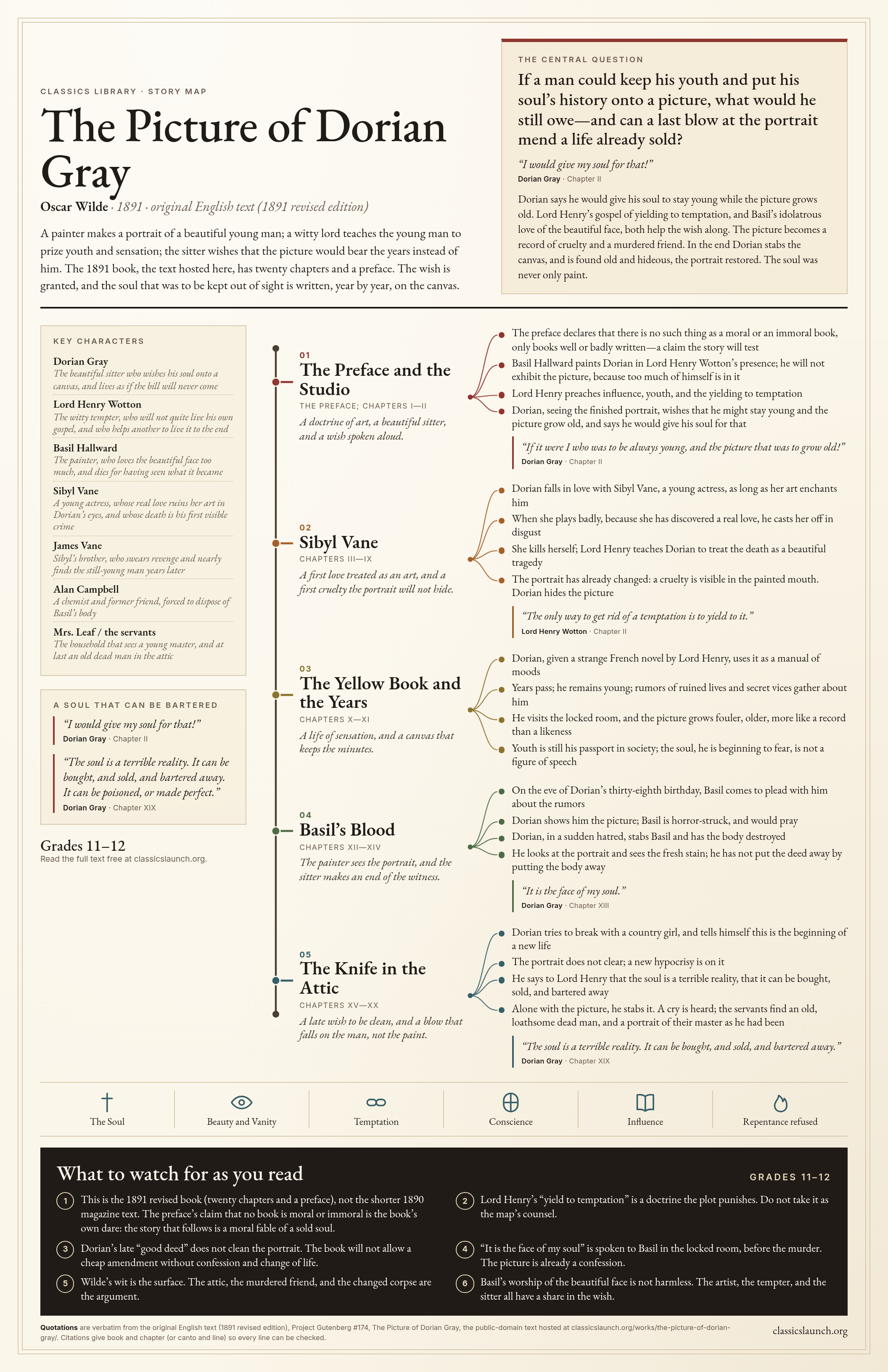
A painter makes a portrait of a beautiful young man; a witty lord teaches the young man to prize youth and sensation; the sitter wishes that the picture would bear the years instead of him. The 1891 book, the text hosted here, has twenty chapters and a preface. The wish is granted, and the soul that was to be kept out of sight is written, year by year, on the canvas.
The central question
If a man could keep his youth and put his soul’s history onto a picture, what would he still owe—and can a last blow at the portrait mend a life already sold?
“I would give my soul for that!”
Dorian says he would give his soul to stay young while the picture grows old. Lord Henry’s gospel of yielding to temptation, and Basil’s idolatrous love of the beautiful face, both help the wish along. The picture becomes a record of cruelty and a murdered friend. In the end Dorian stabs the canvas, and is found old and hideous, the portrait restored. The soul was never only paint.
- 01
The Preface and the Studio
The Preface; Chapters I—II
A doctrine of art, a beautiful sitter, and a wish spoken aloud.
- The preface declares that there is no such thing as a moral or an immoral book, only books well or badly written—a claim the story will test
- Basil Hallward paints Dorian in Lord Henry Wotton’s presence; he will not exhibit the picture, because too much of himself is in it
- Lord Henry preaches influence, youth, and the yielding to temptation
- Dorian, seeing the finished portrait, wishes that he might stay young and the picture grow old, and says he would give his soul for that
“If it were I who was to be always young, and the picture that was to grow old!”
- 02
Sibyl Vane
Chapters III—IX
A first love treated as an art, and a first cruelty the portrait will not hide.
- Dorian falls in love with Sibyl Vane, a young actress, as long as her art enchants him
- When she plays badly, because she has discovered a real love, he casts her off in disgust
- She kills herself; Lord Henry teaches Dorian to treat the death as a beautiful tragedy
- The portrait has already changed: a cruelty is visible in the painted mouth. Dorian hides the picture
“The only way to get rid of a temptation is to yield to it.”
- 03
The Yellow Book and the Years
Chapters X—XI
A life of sensation, and a canvas that keeps the minutes.
- Dorian, given a strange French novel by Lord Henry, uses it as a manual of moods
- Years pass; he remains young; rumors of ruined lives and secret vices gather about him
- He visits the locked room, and the picture grows fouler, older, more like a record than a likeness
- Youth is still his passport in society; the soul, he is beginning to fear, is not a figure of speech
- 04
Basil’s Blood
Chapters XII—XIV
The painter sees the portrait, and the sitter makes an end of the witness.
- On the eve of Dorian’s thirty-eighth birthday, Basil comes to plead with him about the rumors
- Dorian shows him the picture; Basil is horror-struck, and would pray
- Dorian, in a sudden hatred, stabs Basil and has the body destroyed
- He looks at the portrait and sees the fresh stain; he has not put the deed away by putting the body away
“It is the face of my soul.”
- 05
The Knife in the Attic
Chapters XV—XX
A late wish to be clean, and a blow that falls on the man, not the paint.
- Dorian tries to break with a country girl, and tells himself this is the beginning of a new life
- The portrait does not clear; a new hypocrisy is on it
- He says to Lord Henry that the soul is a terrible reality, that it can be bought, sold, and bartered away
- Alone with the picture, he stabs it. A cry is heard; the servants find an old, loathsome dead man, and a portrait of their master as he had been
“The soul is a terrible reality. It can be bought, and sold, and bartered away.”
- The Soul
- Beauty and Vanity
- Temptation
- Conscience
- Influence
- Repentance refused
What to watch for as you read
Grades 11–12- This is the 1891 revised book (twenty chapters and a preface), not the shorter 1890 magazine text. The preface’s claim that no book is moral or immoral is the book’s own dare: the story that follows is a moral fable of a sold soul.
- Lord Henry’s “yield to temptation” is a doctrine the plot punishes. Do not take it as the map’s counsel.
- Dorian’s late “good deed” does not clean the portrait. The book will not allow a cheap amendment without confession and change of life.
- “It is the face of my soul” is spoken to Basil in the locked room, before the murder. The picture is already a confession.
- Wilde’s wit is the surface. The attic, the murdered friend, and the changed corpse are the argument.
- Basil’s worship of the beautiful face is not harmless. The artist, the tempter, and the sitter all have a share in the wish.
Every quotation is word for word from the original English text (1891 revised edition) hosted in this library and is checked against that text each time the site is built. Citations give book and chapter (or canto and line).