Story maps · Grades 9–12
The Princess of Cleves: A Story Map
The PDF is one tabloid page (11 × 17 in). On letter paper, choose “Fit to page.”
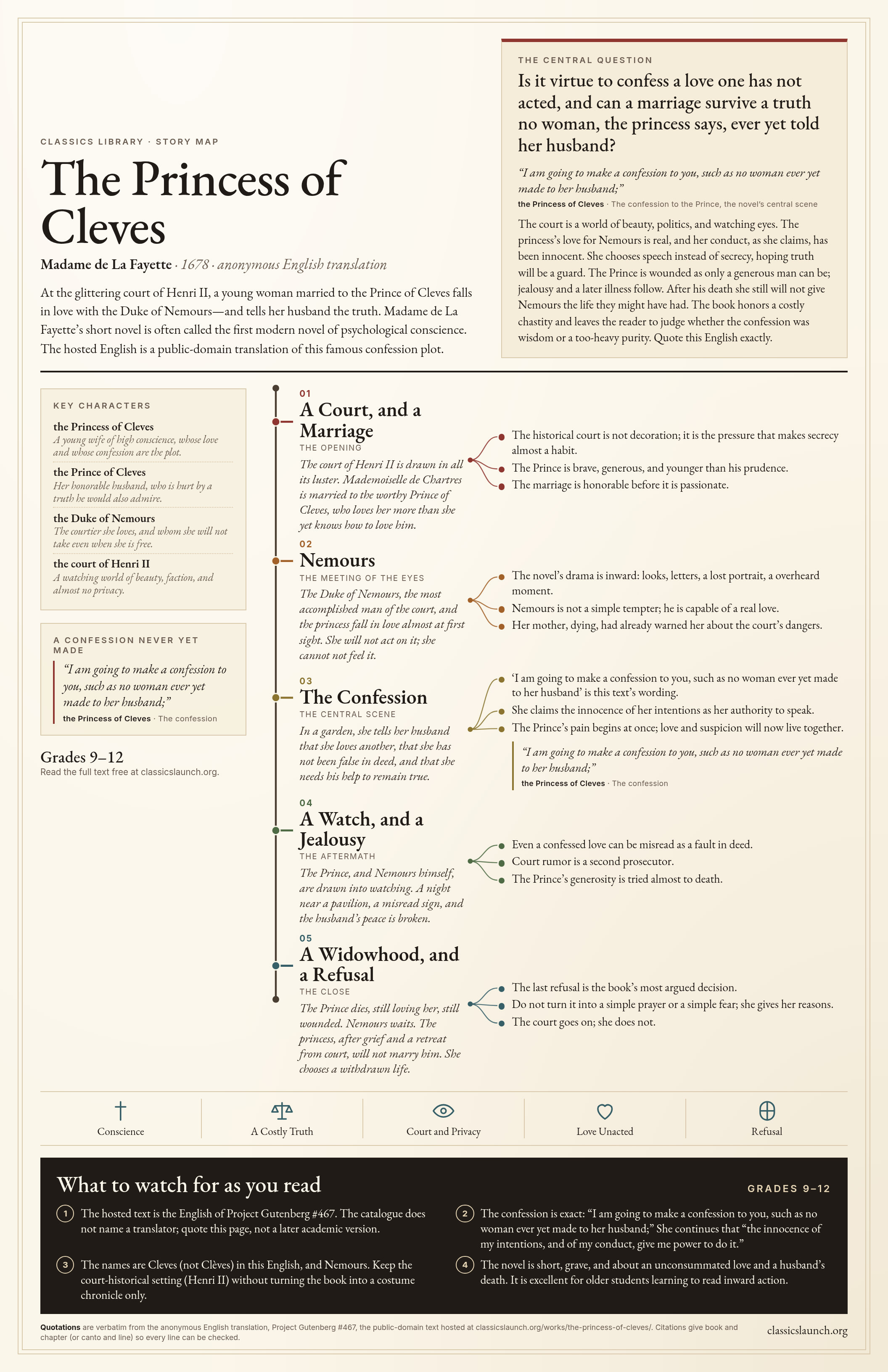
At the glittering court of Henri II, a young woman married to the Prince of Cleves falls in love with the Duke of Nemours—and tells her husband the truth. Madame de La Fayette’s short novel is often called the first modern novel of psychological conscience. The hosted English is a public-domain translation of this famous confession plot.
The central question
Is it virtue to confess a love one has not acted, and can a marriage survive a truth no woman, the princess says, ever yet told her husband?
“I am going to make a confession to you, such as no woman ever yet made to her husband;”
The court is a world of beauty, politics, and watching eyes. The princess’s love for Nemours is real, and her conduct, as she claims, has been innocent. She chooses speech instead of secrecy, hoping truth will be a guard. The Prince is wounded as only a generous man can be; jealousy and a later illness follow. After his death she still will not give Nemours the life they might have had. The book honors a costly chastity and leaves the reader to judge whether the confession was wisdom or a too-heavy purity. Quote this English exactly.
- 01
A Court, and a Marriage
The opening
The court of Henri II is drawn in all its luster. Mademoiselle de Chartres is married to the worthy Prince of Cleves, who loves her more than she yet knows how to love him.
- The historical court is not decoration; it is the pressure that makes secrecy almost a habit.
- The Prince is brave, generous, and younger than his prudence.
- The marriage is honorable before it is passionate.
- 02
Nemours
The meeting of the eyes
The Duke of Nemours, the most accomplished man of the court, and the princess fall in love almost at first sight. She will not act on it; she cannot not feel it.
- The novel’s drama is inward: looks, letters, a lost portrait, a overheard moment.
- Nemours is not a simple tempter; he is capable of a real love.
- Her mother, dying, had already warned her about the court’s dangers.
- 03
The Confession
The central scene
In a garden, she tells her husband that she loves another, that she has not been false in deed, and that she needs his help to remain true.
- ‘I am going to make a confession to you, such as no woman ever yet made to her husband’ is this text’s wording.
- She claims the innocence of her intentions as her authority to speak.
- The Prince’s pain begins at once; love and suspicion will now live together.
“I am going to make a confession to you, such as no woman ever yet made to her husband;”
- 04
A Watch, and a Jealousy
The aftermath
The Prince, and Nemours himself, are drawn into watching. A night near a pavilion, a misread sign, and the husband’s peace is broken.
- Even a confessed love can be misread as a fault in deed.
- Court rumor is a second prosecutor.
- The Prince’s generosity is tried almost to death.
- 05
A Widowhood, and a Refusal
The close
The Prince dies, still loving her, still wounded. Nemours waits. The princess, after grief and a retreat from court, will not marry him. She chooses a withdrawn life.
- The last refusal is the book’s most argued decision.
- Do not turn it into a simple prayer or a simple fear; she gives her reasons.
- The court goes on; she does not.
- Conscience
- A Costly Truth
- Court and Privacy
- Love Unacted
- Refusal
What to watch for as you read
Grades 9–12- The hosted text is the English of Project Gutenberg #467. The catalogue does not name a translator; quote this page, not a later academic version.
- The confession is exact: “I am going to make a confession to you, such as no woman ever yet made to her husband;” She continues that “the innocence of my intentions, and of my conduct, give me power to do it.”
- The names are Cleves (not Clèves) in this English, and Nemours. Keep the court-historical setting (Henri II) without turning the book into a costume chronicle only.
- The novel is short, grave, and about an unconsummated love and a husband’s death. It is excellent for older students learning to read inward action.
Every quotation is word for word from the anonymous English translation hosted in this library and is checked against that text each time the site is built. Citations give book and chapter (or canto and line).