Story maps · Grades 10–12
The Republic: A Story Map
The PDF is one tabloid page (11 × 17 in). On letter paper, choose “Fit to page.”
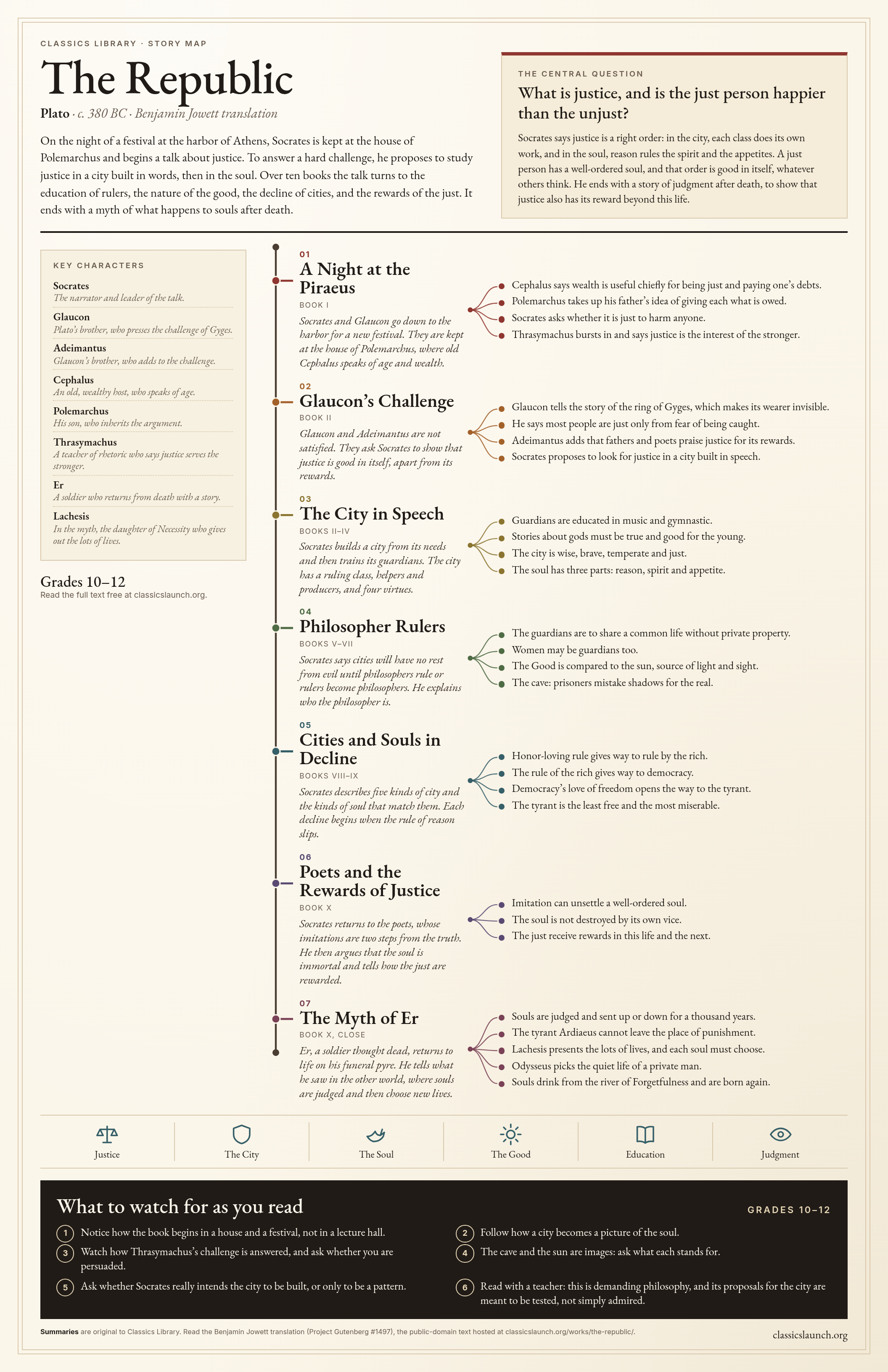
On the night of a festival at the harbor of Athens, Socrates is kept at the house of Polemarchus and begins a talk about justice. To answer a hard challenge, he proposes to study justice in a city built in words, then in the soul. Over ten books the talk turns to the education of rulers, the nature of the good, the decline of cities, and the rewards of the just. It ends with a myth of what happens to souls after death.
The central question
What is justice, and is the just person happier than the unjust?
Socrates says justice is a right order: in the city, each class does its own work, and in the soul, reason rules the spirit and the appetites. A just person has a well-ordered soul, and that order is good in itself, whatever others think. He ends with a story of judgment after death, to show that justice also has its reward beyond this life.
- 01
A Night at the Piraeus
Book I
Socrates and Glaucon go down to the harbor for a new festival. They are kept at the house of Polemarchus, where old Cephalus speaks of age and wealth.
- Cephalus says wealth is useful chiefly for being just and paying one’s debts.
- Polemarchus takes up his father’s idea of giving each what is owed.
- Socrates asks whether it is just to harm anyone.
- Thrasymachus bursts in and says justice is the interest of the stronger.
- 02
Glaucon’s Challenge
Book II
Glaucon and Adeimantus are not satisfied. They ask Socrates to show that justice is good in itself, apart from its rewards.
- Glaucon tells the story of the ring of Gyges, which makes its wearer invisible.
- He says most people are just only from fear of being caught.
- Adeimantus adds that fathers and poets praise justice for its rewards.
- Socrates proposes to look for justice in a city built in speech.
- 03
The City in Speech
Books II–IV
Socrates builds a city from its needs and then trains its guardians. The city has a ruling class, helpers and producers, and four virtues.
- Guardians are educated in music and gymnastic.
- Stories about gods must be true and good for the young.
- The city is wise, brave, temperate and just.
- The soul has three parts: reason, spirit and appetite.
- 04
Philosopher Rulers
Books V–VII
Socrates says cities will have no rest from evil until philosophers rule or rulers become philosophers. He explains who the philosopher is.
- The guardians are to share a common life without private property.
- Women may be guardians too.
- The Good is compared to the sun, source of light and sight.
- The cave: prisoners mistake shadows for the real.
- 05
Cities and Souls in Decline
Books VIII–IX
Socrates describes five kinds of city and the kinds of soul that match them. Each decline begins when the rule of reason slips.
- Honor-loving rule gives way to rule by the rich.
- The rule of the rich gives way to democracy.
- Democracy’s love of freedom opens the way to the tyrant.
- The tyrant is the least free and the most miserable.
- 06
Poets and the Rewards of Justice
Book X
Socrates returns to the poets, whose imitations are two steps from the truth. He then argues that the soul is immortal and tells how the just are rewarded.
- Imitation can unsettle a well-ordered soul.
- The soul is not destroyed by its own vice.
- The just receive rewards in this life and the next.
- 07
The Myth of Er
Book X, close
Er, a soldier thought dead, returns to life on his funeral pyre. He tells what he saw in the other world, where souls are judged and then choose new lives.
- Souls are judged and sent up or down for a thousand years.
- The tyrant Ardiaeus cannot leave the place of punishment.
- Lachesis presents the lots of lives, and each soul must choose.
- Odysseus picks the quiet life of a private man.
- Souls drink from the river of Forgetfulness and are born again.
- Justice
- The City
- The Soul
- The Good
- Education
- Judgment
What to watch for as you read
Grades 10–12- Notice how the book begins in a house and a festival, not in a lecture hall.
- Follow how a city becomes a picture of the soul.
- Watch how Thrasymachus’s challenge is answered, and ask whether you are persuaded.
- The cave and the sun are images: ask what each stands for.
- Ask whether Socrates really intends the city to be built, or only to be a pattern.
- Read with a teacher: this is demanding philosophy, and its proposals for the city are meant to be tested, not simply admired.
Every quotation is word for word from the Benjamin Jowett translation hosted in this library and is checked against that text each time the site is built. Citations give book and chapter (or canto and line).