Story maps · Grades 11–12
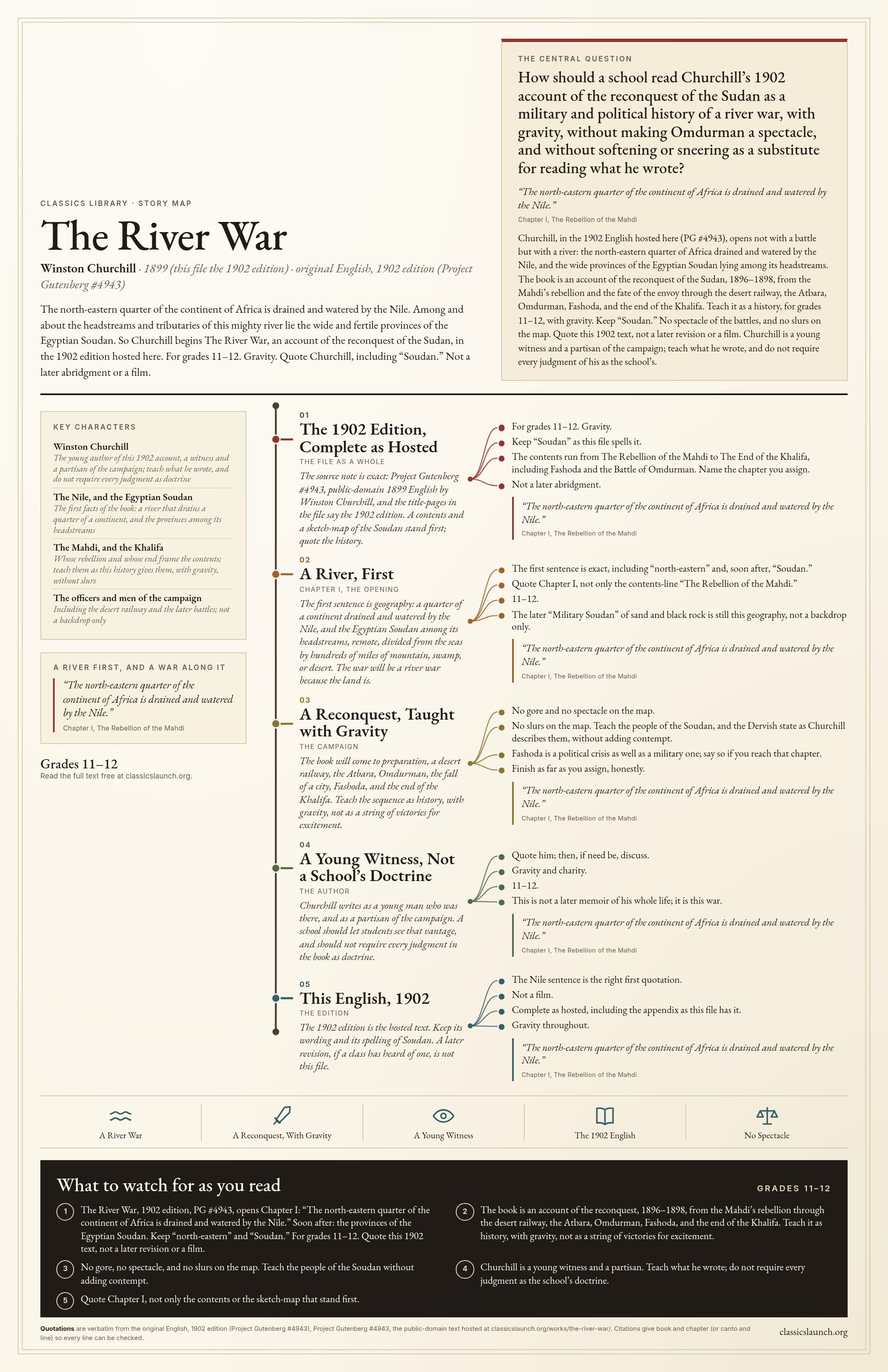
The River War: A Story Map
The PDF is one tabloid page (11 × 17 in). On letter paper, choose “Fit to page.”
The north-eastern quarter of the continent of Africa is drained and watered by the Nile. Among and about the headstreams and tributaries of this mighty river lie the wide and fertile provinces of the Egyptian Soudan. So Churchill begins The River War, an account of the reconquest of the Sudan, in the 1902 edition hosted here. For grades 11–12. Gravity. Quote Churchill, including “Soudan.” Not a later abridgment or a film.
The central question
How should a school read Churchill’s 1902 account of the reconquest of the Sudan as a military and political history of a river war, with gravity, without making Omdurman a spectacle, and without softening or sneering as a substitute for reading what he wrote?
“The north-eastern quarter of the continent of Africa is drained and watered by the Nile.”
Churchill, in the 1902 English hosted here (PG #4943), opens not with a battle but with a river: the north-eastern quarter of Africa drained and watered by the Nile, and the wide provinces of the Egyptian Soudan lying among its headstreams. The book is an account of the reconquest of the Sudan, 1896–1898, from the Mahdi’s rebellion and the fate of the envoy through the desert railway, the Atbara, Omdurman, Fashoda, and the end of the Khalifa. Teach it as a history, for grades 11–12, with gravity. Keep “Soudan.” No spectacle of the battles, and no slurs on the map. Quote this 1902 text, not a later revision or a film. Churchill is a young witness and a partisan of the campaign; teach what he wrote, and do not require every judgment of his as the school’s.
- 01
The 1902 Edition, Complete as Hosted
The file as a whole
The source note is exact: Project Gutenberg #4943, public-domain 1899 English by Winston Churchill, and the title-pages in the file say the 1902 edition. A contents and a sketch-map of the Soudan stand first; quote the history.
- For grades 11–12. Gravity.
- Keep “Soudan” as this file spells it.
- The contents run from The Rebellion of the Mahdi to The End of the Khalifa, including Fashoda and the Battle of Omdurman. Name the chapter you assign.
- Not a later abridgment.
“The north-eastern quarter of the continent of Africa is drained and watered by the Nile.”
- 02
A River, First
Chapter I, the opening
The first sentence is geography: a quarter of a continent drained and watered by the Nile, and the Egyptian Soudan among its headstreams, remote, divided from the seas by hundreds of miles of mountain, swamp, or desert. The war will be a river war because the land is.
- The first sentence is exact, including “north-eastern” and, soon after, “Soudan.”
- Quote Chapter I, not only the contents-line “The Rebellion of the Mahdi.”
- 11–12.
- The later “Military Soudan” of sand and black rock is still this geography, not a backdrop only.
“The north-eastern quarter of the continent of Africa is drained and watered by the Nile.”
- 03
A Reconquest, Taught with Gravity
The campaign
The book will come to preparation, a desert railway, the Atbara, Omdurman, the fall of a city, Fashoda, and the end of the Khalifa. Teach the sequence as history, with gravity, not as a string of victories for excitement.
- No gore and no spectacle on the map.
- No slurs on the map. Teach the people of the Soudan, and the Dervish state as Churchill describes them, without adding contempt.
- Fashoda is a political crisis as well as a military one; say so if you reach that chapter.
- Finish as far as you assign, honestly.
“The north-eastern quarter of the continent of Africa is drained and watered by the Nile.”
- 04
A Young Witness, Not a School’s Doctrine
The author
Churchill writes as a young man who was there, and as a partisan of the campaign. A school should let students see that vantage, and should not require every judgment in the book as doctrine.
- Quote him; then, if need be, discuss.
- Gravity and charity.
- 11–12.
- This is not a later memoir of his whole life; it is this war.
“The north-eastern quarter of the continent of Africa is drained and watered by the Nile.”
- 05
This English, 1902
The edition
The 1902 edition is the hosted text. Keep its wording and its spelling of Soudan. A later revision, if a class has heard of one, is not this file.
- The Nile sentence is the right first quotation.
- Not a film.
- Complete as hosted, including the appendix as this file has it.
- Gravity throughout.
“The north-eastern quarter of the continent of Africa is drained and watered by the Nile.”
- A River War
- A Reconquest, With Gravity
- A Young Witness
- The 1902 English
- No Spectacle
What to watch for as you read
Grades 11–12- The River War, 1902 edition, PG #4943, opens Chapter I: “The north-eastern quarter of the continent of Africa is drained and watered by the Nile.” Soon after: the provinces of the Egyptian Soudan. Keep “north-eastern” and “Soudan.” For grades 11–12. Quote this 1902 text, not a later revision or a film.
- The book is an account of the reconquest, 1896–1898, from the Mahdi’s rebellion through the desert railway, the Atbara, Omdurman, Fashoda, and the end of the Khalifa. Teach it as history, with gravity, not as a string of victories for excitement.
- No gore, no spectacle, and no slurs on the map. Teach the people of the Soudan without adding contempt.
- Churchill is a young witness and a partisan. Teach what he wrote; do not require every judgment as the school’s doctrine.
- Quote Chapter I, not only the contents or the sketch-map that stand first.
Every quotation is word for word from the original English, 1902 edition (Project Gutenberg #4943) hosted in this library and is checked against that text each time the site is built. Citations give book and chapter (or canto and line).