Story maps · Grades 8–12
The Sign of the Four: A Story Map
The PDF is one tabloid page (11 × 17 in). On letter paper, choose “Fit to page.”
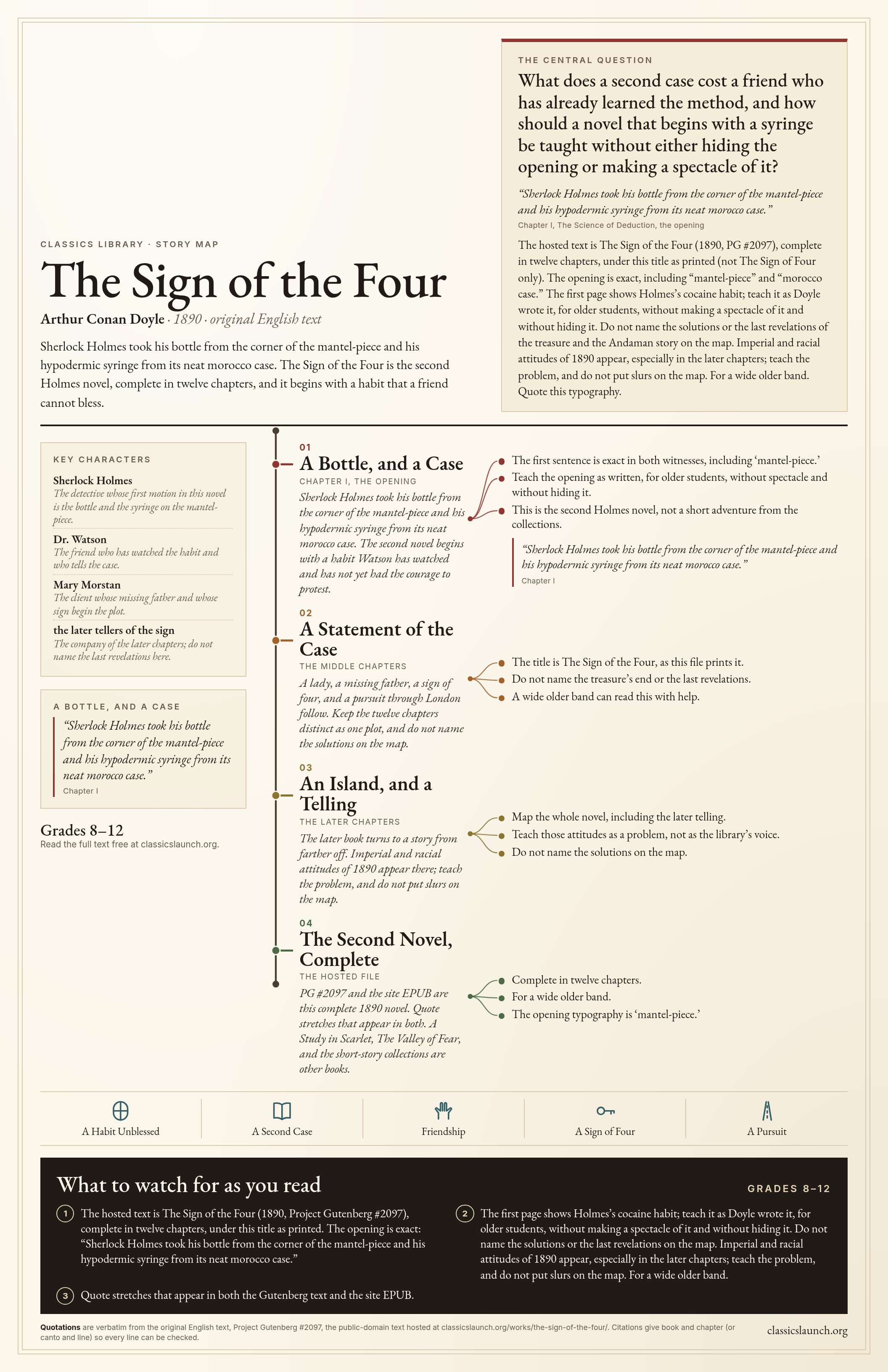
Sherlock Holmes took his bottle from the corner of the mantel-piece and his hypodermic syringe from its neat morocco case. The Sign of the Four is the second Holmes novel, complete in twelve chapters, and it begins with a habit that a friend cannot bless.
The central question
What does a second case cost a friend who has already learned the method, and how should a novel that begins with a syringe be taught without either hiding the opening or making a spectacle of it?
“Sherlock Holmes took his bottle from the corner of the mantel-piece and his hypodermic syringe from its neat morocco case.”
The hosted text is The Sign of the Four (1890, PG #2097), complete in twelve chapters, under this title as printed (not The Sign of Four only). The opening is exact, including “mantel-piece” and “morocco case.” The first page shows Holmes’s cocaine habit; teach it as Doyle wrote it, for older students, without making a spectacle of it and without hiding it. Do not name the solutions or the last revelations of the treasure and the Andaman story on the map. Imperial and racial attitudes of 1890 appear, especially in the later chapters; teach the problem, and do not put slurs on the map. For a wide older band. Quote this typography.
- 01
A Bottle, and a Case
Chapter I, the opening
Sherlock Holmes took his bottle from the corner of the mantel-piece and his hypodermic syringe from its neat morocco case. The second novel begins with a habit Watson has watched and has not yet had the courage to protest.
- The first sentence is exact in both witnesses, including ‘mantel-piece.’
- Teach the opening as written, for older students, without spectacle and without hiding it.
- This is the second Holmes novel, not a short adventure from the collections.
“Sherlock Holmes took his bottle from the corner of the mantel-piece and his hypodermic syringe from its neat morocco case.”
- 02
A Statement of the Case
The middle chapters
A lady, a missing father, a sign of four, and a pursuit through London follow. Keep the twelve chapters distinct as one plot, and do not name the solutions on the map.
- The title is The Sign of the Four, as this file prints it.
- Do not name the treasure’s end or the last revelations.
- A wide older band can read this with help.
- 03
An Island, and a Telling
The later chapters
The later book turns to a story from farther off. Imperial and racial attitudes of 1890 appear there; teach the problem, and do not put slurs on the map.
- Map the whole novel, including the later telling.
- Teach those attitudes as a problem, not as the library’s voice.
- Do not name the solutions on the map.
- 04
The Second Novel, Complete
The hosted file
PG #2097 and the site EPUB are this complete 1890 novel. Quote stretches that appear in both. A Study in Scarlet, The Valley of Fear, and the short-story collections are other books.
- Complete in twelve chapters.
- For a wide older band.
- The opening typography is ‘mantel-piece.’
- A Habit Unblessed
- A Second Case
- Friendship
- A Sign of Four
- A Pursuit
What to watch for as you read
Grades 8–12- The hosted text is The Sign of the Four (1890, Project Gutenberg #2097), complete in twelve chapters, under this title as printed. The opening is exact: “Sherlock Holmes took his bottle from the corner of the mantel-piece and his hypodermic syringe from its neat morocco case.”
- The first page shows Holmes’s cocaine habit; teach it as Doyle wrote it, for older students, without making a spectacle of it and without hiding it. Do not name the solutions or the last revelations on the map. Imperial and racial attitudes of 1890 appear, especially in the later chapters; teach the problem, and do not put slurs on the map. For a wide older band.
- Quote stretches that appear in both the Gutenberg text and the site EPUB.
Every quotation is word for word from the original English text hosted in this library and is checked against that text each time the site is built. Citations give book and chapter (or canto and line).