Story maps · Grades 9–10
The Song of Roland: A Story Map
The PDF is one tabloid page (11 × 17 in). On letter paper, choose “Fit to page.”
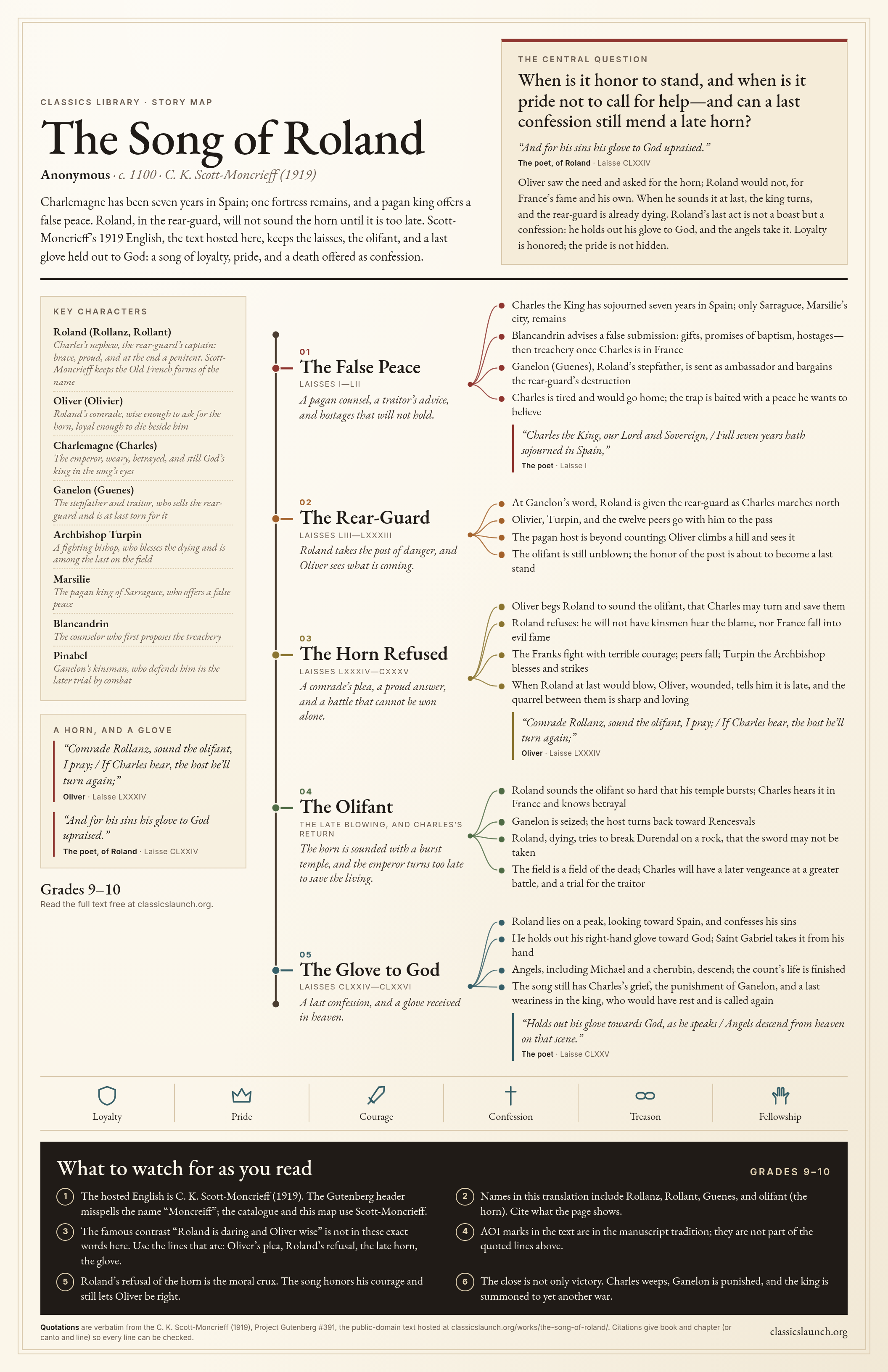
Charlemagne has been seven years in Spain; one fortress remains, and a pagan king offers a false peace. Roland, in the rear-guard, will not sound the horn until it is too late. Scott-Moncrieff’s 1919 English, the text hosted here, keeps the laisses, the olifant, and a last glove held out to God: a song of loyalty, pride, and a death offered as confession.
The central question
When is it honor to stand, and when is it pride not to call for help—and can a last confession still mend a late horn?
“And for his sins his glove to God upraised.”
Oliver saw the need and asked for the horn; Roland would not, for France’s fame and his own. When he sounds it at last, the king turns, and the rear-guard is already dying. Roland’s last act is not a boast but a confession: he holds out his glove to God, and the angels take it. Loyalty is honored; the pride is not hidden.
- 01
The False Peace
Laisses I—LII
A pagan counsel, a traitor’s advice, and hostages that will not hold.
- Charles the King has sojourned seven years in Spain; only Sarraguce, Marsilie’s city, remains
- Blancandrin advises a false submission: gifts, promises of baptism, hostages—then treachery once Charles is in France
- Ganelon (Guenes), Roland’s stepfather, is sent as ambassador and bargains the rear-guard’s destruction
- Charles is tired and would go home; the trap is baited with a peace he wants to believe
“Charles the King, our Lord and Sovereign, / Full seven years hath sojourned in Spain,”
- 02
The Rear-Guard
Laisses LIII—LXXXIII
Roland takes the post of danger, and Oliver sees what is coming.
- At Ganelon’s word, Roland is given the rear-guard as Charles marches north
- Olivier, Turpin, and the twelve peers go with him to the pass
- The pagan host is beyond counting; Oliver climbs a hill and sees it
- The olifant is still unblown; the honor of the post is about to become a last stand
- 03
The Horn Refused
Laisses LXXXIV—CXXXV
A comrade’s plea, a proud answer, and a battle that cannot be won alone.
- Oliver begs Roland to sound the olifant, that Charles may turn and save them
- Roland refuses: he will not have kinsmen hear the blame, nor France fall into evil fame
- The Franks fight with terrible courage; peers fall; Turpin the Archbishop blesses and strikes
- When Roland at last would blow, Oliver, wounded, tells him it is late, and the quarrel between them is sharp and loving
“Comrade Rollanz, sound the olifant, I pray; / If Charles hear, the host he’ll turn again;”
- 04
The Olifant
The late blowing, and Charles’s return
The horn is sounded with a burst temple, and the emperor turns too late to save the living.
- Roland sounds the olifant so hard that his temple bursts; Charles hears it in France and knows betrayal
- Ganelon is seized; the host turns back toward Rencesvals
- Roland, dying, tries to break Durendal on a rock, that the sword may not be taken
- The field is a field of the dead; Charles will have a later vengeance at a greater battle, and a trial for the traitor
- 05
The Glove to God
Laisses CLXXIV—CLXXVI
A last confession, and a glove received in heaven.
- Roland lies on a peak, looking toward Spain, and confesses his sins
- He holds out his right-hand glove toward God; Saint Gabriel takes it from his hand
- Angels, including Michael and a cherubin, descend; the count’s life is finished
- The song still has Charles’s grief, the punishment of Ganelon, and a last weariness in the king, who would have rest and is called again
“Holds out his glove towards God, as he speaks / Angels descend from heaven on that scene.”
- Loyalty
- Pride
- Courage
- Confession
- Treason
- Fellowship
What to watch for as you read
Grades 9–10- The hosted English is C. K. Scott-Moncrieff (1919). The Gutenberg header misspells the name “Moncreiff”; the catalogue and this map use Scott-Moncrieff.
- Names in this translation include Rollanz, Rollant, Guenes, and olifant (the horn). Cite what the page shows.
- The famous contrast “Roland is daring and Oliver wise” is not in these exact words here. Use the lines that are: Oliver’s plea, Roland’s refusal, the late horn, the glove.
- AOI marks in the text are in the manuscript tradition; they are not part of the quoted lines above.
- Roland’s refusal of the horn is the moral crux. The song honors his courage and still lets Oliver be right.
- The close is not only victory. Charles weeps, Ganelon is punished, and the king is summoned to yet another war.
Every quotation is word for word from the C. K. Scott-Moncrieff (1919) hosted in this library and is checked against that text each time the site is built. Citations give book and chapter (or canto and line).