Story maps · Grades 6–8
The Story of King Arthur and His Knights: A Story Map
The PDF is one tabloid page (11 × 17 in). On letter paper, choose “Fit to page.”
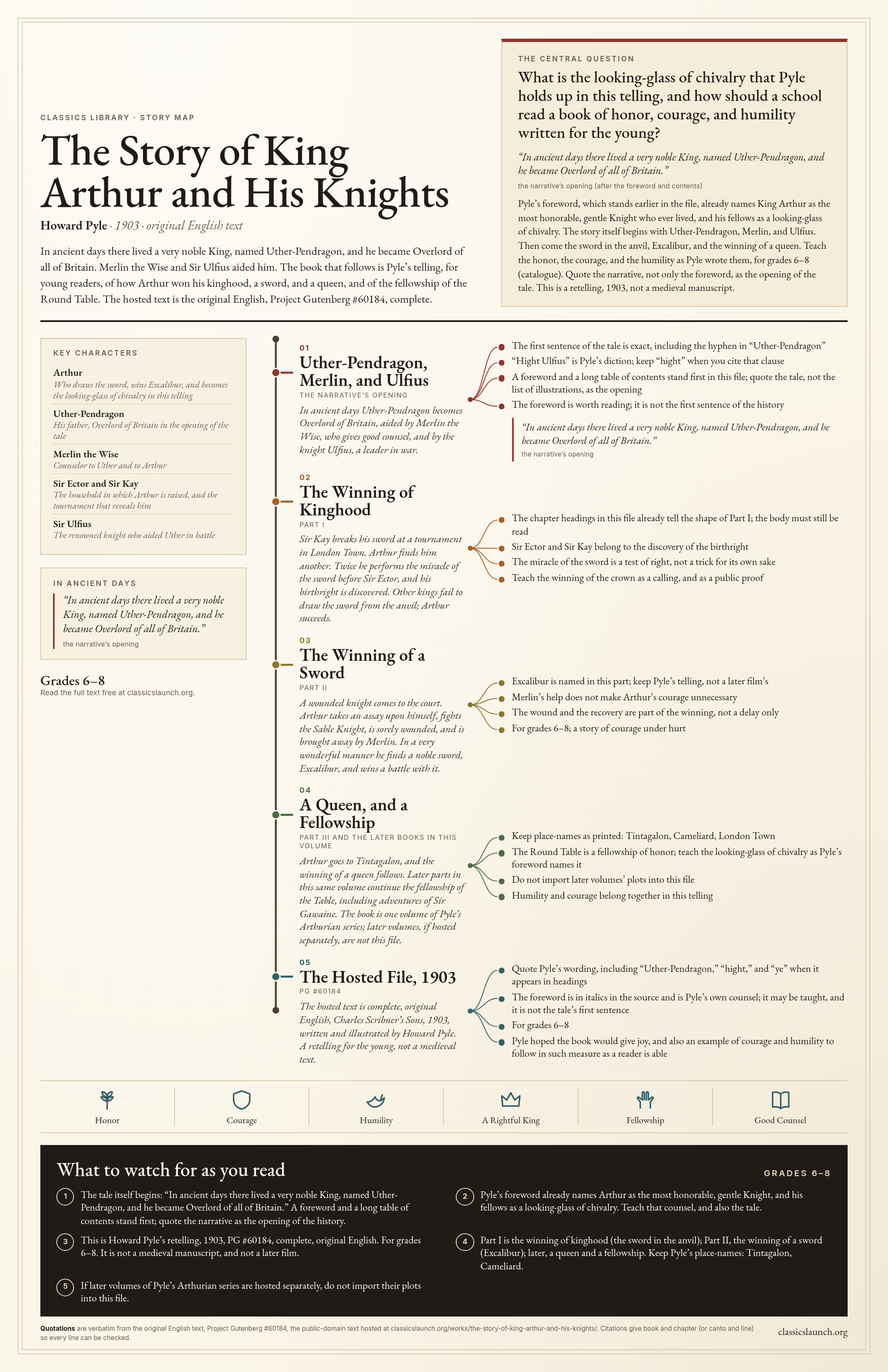
In ancient days there lived a very noble King, named Uther-Pendragon, and he became Overlord of all of Britain. Merlin the Wise and Sir Ulfius aided him. The book that follows is Pyle’s telling, for young readers, of how Arthur won his kinghood, a sword, and a queen, and of the fellowship of the Round Table. The hosted text is the original English, Project Gutenberg #60184, complete.
The central question
What is the looking-glass of chivalry that Pyle holds up in this telling, and how should a school read a book of honor, courage, and humility written for the young?
“In ancient days there lived a very noble King, named Uther-Pendragon, and he became Overlord of all of Britain.”
Pyle’s foreword, which stands earlier in the file, already names King Arthur as the most honorable, gentle Knight who ever lived, and his fellows as a looking-glass of chivalry. The story itself begins with Uther-Pendragon, Merlin, and Ulfius. Then come the sword in the anvil, Excalibur, and the winning of a queen. Teach the honor, the courage, and the humility as Pyle wrote them, for grades 6–8 (catalogue). Quote the narrative, not only the foreword, as the opening of the tale. This is a retelling, 1903, not a medieval manuscript.
- 01
Uther-Pendragon, Merlin, and Ulfius
The narrative’s opening
In ancient days Uther-Pendragon becomes Overlord of Britain, aided by Merlin the Wise, who gives good counsel, and by the knight Ulfius, a leader in war.
- The first sentence of the tale is exact, including the hyphen in “Uther-Pendragon”
- “Hight Ulfius” is Pyle’s diction; keep “hight” when you cite that clause
- A foreword and a long table of contents stand first in this file; quote the tale, not the list of illustrations, as the opening
- The foreword is worth reading; it is not the first sentence of the history
“In ancient days there lived a very noble King, named Uther-Pendragon, and he became Overlord of all of Britain.”
- 02
The Winning of Kinghood
Part I
Sir Kay breaks his sword at a tournament in London Town. Arthur finds him another. Twice he performs the miracle of the sword before Sir Ector, and his birthright is discovered. Other kings fail to draw the sword from the anvil; Arthur succeeds.
- The chapter headings in this file already tell the shape of Part I; the body must still be read
- Sir Ector and Sir Kay belong to the discovery of the birthright
- The miracle of the sword is a test of right, not a trick for its own sake
- Teach the winning of the crown as a calling, and as a public proof
- 03
The Winning of a Sword
Part II
A wounded knight comes to the court. Arthur takes an assay upon himself, fights the Sable Knight, is sorely wounded, and is brought away by Merlin. In a very wonderful manner he finds a noble sword, Excalibur, and wins a battle with it.
- Excalibur is named in this part; keep Pyle’s telling, not a later film’s
- Merlin’s help does not make Arthur’s courage unnecessary
- The wound and the recovery are part of the winning, not a delay only
- For grades 6–8; a story of courage under hurt
- 04
A Queen, and a Fellowship
Part III and the later books in this volume
Arthur goes to Tintagalon, and the winning of a queen follows. Later parts in this same volume continue the fellowship of the Table, including adventures of Sir Gawaine. The book is one volume of Pyle’s Arthurian series; later volumes, if hosted separately, are not this file.
- Keep place-names as printed: Tintagalon, Cameliard, London Town
- The Round Table is a fellowship of honor; teach the looking-glass of chivalry as Pyle’s foreword names it
- Do not import later volumes’ plots into this file
- Humility and courage belong together in this telling
- 05
The Hosted File, 1903
PG #60184
The hosted text is complete, original English, Charles Scribner’s Sons, 1903, written and illustrated by Howard Pyle. A retelling for the young, not a medieval text.
- Quote Pyle’s wording, including “Uther-Pendragon,” “hight,” and “ye” when it appears in headings
- The foreword is in italics in the source and is Pyle’s own counsel; it may be taught, and it is not the tale’s first sentence
- For grades 6–8
- Pyle hoped the book would give joy, and also an example of courage and humility to follow in such measure as a reader is able
- Honor
- Courage
- Humility
- A Rightful King
- Fellowship
- Good Counsel
What to watch for as you read
Grades 6–8- The tale itself begins: “In ancient days there lived a very noble King, named Uther-Pendragon, and he became Overlord of all of Britain.” A foreword and a long table of contents stand first; quote the narrative as the opening of the history.
- Pyle’s foreword already names Arthur as the most honorable, gentle Knight, and his fellows as a looking-glass of chivalry. Teach that counsel, and also the tale.
- This is Howard Pyle’s retelling, 1903, PG #60184, complete, original English. For grades 6–8. It is not a medieval manuscript, and not a later film.
- Part I is the winning of kinghood (the sword in the anvil); Part II, the winning of a sword (Excalibur); later, a queen and a fellowship. Keep Pyle’s place-names: Tintagalon, Cameliard.
- If later volumes of Pyle’s Arthurian series are hosted separately, do not import their plots into this file.
Every quotation is word for word from the original English text hosted in this library and is checked against that text each time the site is built. Citations give book and chapter (or canto and line).