Story maps · Grades 11–12
The Sun Also Rises: A Story Map
The PDF is one tabloid page (11 × 17 in). On letter paper, choose “Fit to page.”
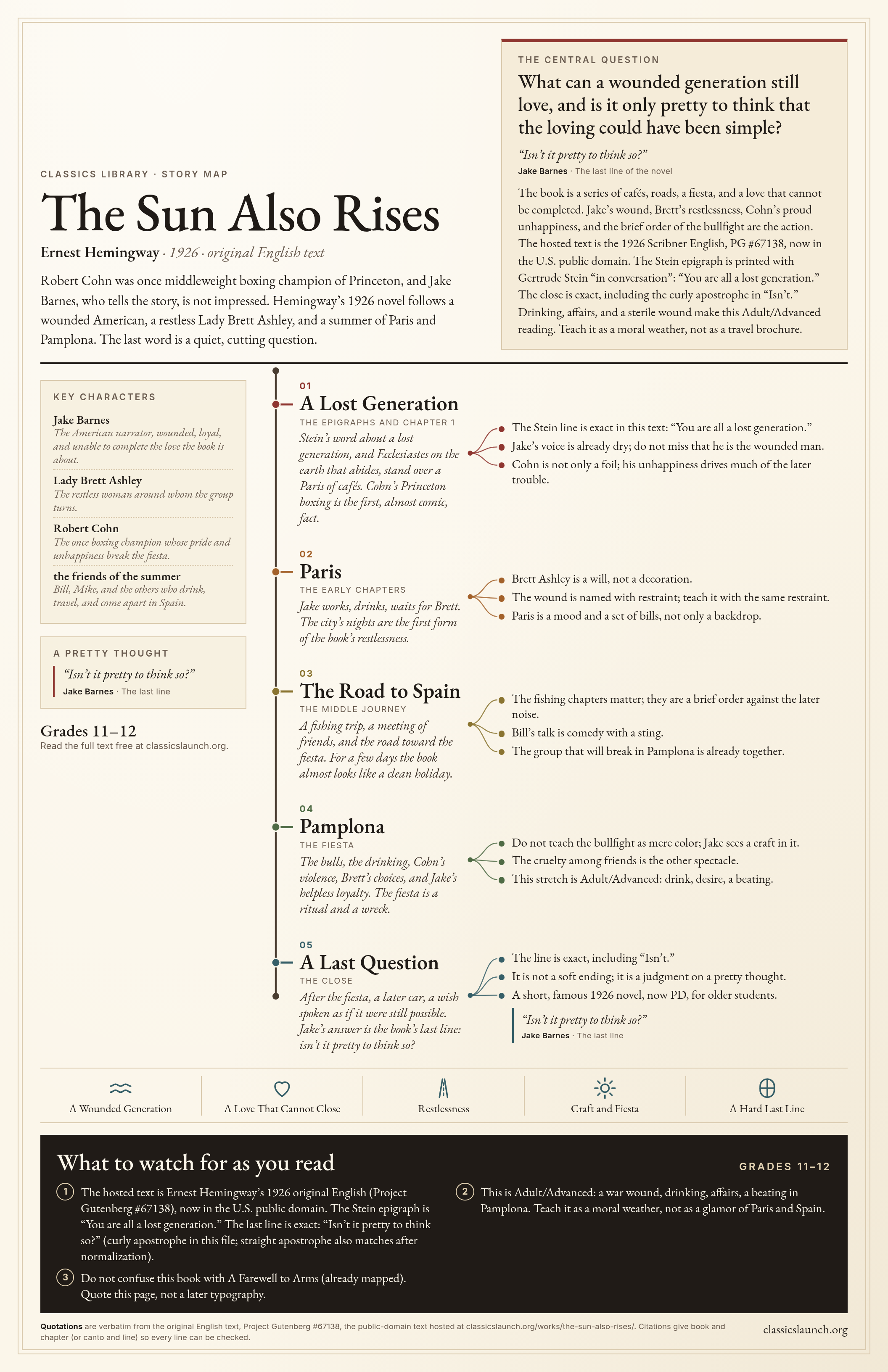
Robert Cohn was once middleweight boxing champion of Princeton, and Jake Barnes, who tells the story, is not impressed. Hemingway’s 1926 novel follows a wounded American, a restless Lady Brett Ashley, and a summer of Paris and Pamplona. The last word is a quiet, cutting question.
The central question
What can a wounded generation still love, and is it only pretty to think that the loving could have been simple?
“Isn’t it pretty to think so?”
The book is a series of cafés, roads, a fiesta, and a love that cannot be completed. Jake’s wound, Brett’s restlessness, Cohn’s proud unhappiness, and the brief order of the bullfight are the action. The hosted text is the 1926 Scribner English, PG #67138, now in the U.S. public domain. The Stein epigraph is printed with Gertrude Stein “in conversation”: “You are all a lost generation.” The close is exact, including the curly apostrophe in “Isn’t.” Drinking, affairs, and a sterile wound make this Adult/Advanced reading. Teach it as a moral weather, not as a travel brochure.
- 01
A Lost Generation
The epigraphs and Chapter 1
Stein’s word about a lost generation, and Ecclesiastes on the earth that abides, stand over a Paris of cafés. Cohn’s Princeton boxing is the first, almost comic, fact.
- The Stein line is exact in this text: “You are all a lost generation.”
- Jake’s voice is already dry; do not miss that he is the wounded man.
- Cohn is not only a foil; his unhappiness drives much of the later trouble.
- 02
Paris
The early chapters
Jake works, drinks, waits for Brett. The city’s nights are the first form of the book’s restlessness.
- Brett Ashley is a will, not a decoration.
- The wound is named with restraint; teach it with the same restraint.
- Paris is a mood and a set of bills, not only a backdrop.
- 03
The Road to Spain
The middle journey
A fishing trip, a meeting of friends, and the road toward the fiesta. For a few days the book almost looks like a clean holiday.
- The fishing chapters matter; they are a brief order against the later noise.
- Bill’s talk is comedy with a sting.
- The group that will break in Pamplona is already together.
- 04
Pamplona
The fiesta
The bulls, the drinking, Cohn’s violence, Brett’s choices, and Jake’s helpless loyalty. The fiesta is a ritual and a wreck.
- Do not teach the bullfight as mere color; Jake sees a craft in it.
- The cruelty among friends is the other spectacle.
- This stretch is Adult/Advanced: drink, desire, a beating.
- 05
A Last Question
The close
After the fiesta, a later car, a wish spoken as if it were still possible. Jake’s answer is the book’s last line: isn’t it pretty to think so?
- The line is exact, including “Isn’t.”
- It is not a soft ending; it is a judgment on a pretty thought.
- A short, famous 1926 novel, now PD, for older students.
“Isn’t it pretty to think so?”
- A Wounded Generation
- A Love That Cannot Close
- Restlessness
- Craft and Fiesta
- A Hard Last Line
What to watch for as you read
Grades 11–12- The hosted text is Ernest Hemingway’s 1926 original English (Project Gutenberg #67138), now in the U.S. public domain. The Stein epigraph is “You are all a lost generation.” The last line is exact: “Isn’t it pretty to think so?” (curly apostrophe in this file; straight apostrophe also matches after normalization).
- This is Adult/Advanced: a war wound, drinking, affairs, a beating in Pamplona. Teach it as a moral weather, not as a glamor of Paris and Spain.
- Do not confuse this book with A Farewell to Arms (already mapped). Quote this page, not a later typography.
Every quotation is word for word from the original English text hosted in this library and is checked against that text each time the site is built. Citations give book and chapter (or canto and line).