Story maps · Grades 11–12
The Twelve Caesars: A Story Map
The PDF is one tabloid page (11 × 17 in). On letter paper, choose “Fit to page.”
Julius Caesar, in this English, is already called the Divine when the first life opens. Suetonius’s twelve lives, from the Divine Julius to Domitian, are here complete, with later lives of grammarians, rhetoricians, and poets appended. Quote the twelve; flag the rest.
The central question
What does a life of emperors look like when it is told as a series of habits, omens, crimes, and official acts, and what should a reader do with such a record?
“he repudiated Cossutia, who was very wealthy, although her family belonged only to the equestrian order,”
The translation is Alexander Thomson, revised and corrected by Thomas Forester, PG #6400. The twelve lives (Julius through Domitian) are complete in the hosted text and EPUB. The same volume also contains Suetonius’s lives of the grammarians, rhetoricians, and poets; map the twelve; flag the companions; do not quote the later lives as the Caesars. This edition is heavy with footnote numbers in brackets; quote only a continuous stretch without them. An anecdotal, often severe imperial gallery, for older and advanced students; do not sensationalize the crimes.
- 01
The Divine Julius
The first life
Caesar loses his father in youth, is nominated high-priest of Jupiter, and repudiates Cossutia. The first life is already a mix of office, marriage, and omen.
- ‘he repudiated Cossutia, who was very wealthy, although her family belonged only to the equestrian order,’ is exact, without the preceding footnote number.
- The title ‘the Divine’ is this edition’s wording.
- Do not import another English Suetonius.
“he repudiated Cossutia, who was very wealthy, although her family belonged only to the equestrian order,”
- 02
Augustus to Claudius
The Julio-Claudian lives
The founding of the principate, and the household that follows. Virtue, craft, and cruelty are set down as habits as much as events.
- Keep the twelve lives distinct.
- Teach the darker households with gravity, for older students; do not sensationalize them.
- Footnote numbers in brackets must not enter a quotation.
- 03
Nero, and the Year of Four
The middle lives
Nero, then Galba, Otho, Vitellius. The principate becomes a prize and a wreck in a short span.
- The civil year after Nero is four lives, not a blur.
- The record is anecdotal and severe; read it as Suetonius wrote it.
- For older and advanced students.
- 04
The Flavians, to Domitian
The last of the twelve
Vespasian, Titus, and Domitian close the twelve. The hosted file then goes on with other Suetonian lives.
- All twelve names are in both witnesses.
- Stop the map at Domitian.
- The later lives are a companion appendix, not the title work.
- 05
What This Volume Also Holds
The hosted file
PG #6400 and the site EPUB include the lives of the grammarians, rhetoricians, and poets after the twelve. Map the Caesars; flag the rest; do not quote those later lives as this work.
- Thomson, revised by Forester.
- An anecdotal imperial gallery, complete in twelve lives, for older and advanced students.
- Quote stretches that appear in both witnesses, from the twelve.
- Twelve Lives
- Office and Habit
- Virtue and Crime
- A Throne as Prize
- Memory of Emperors
What to watch for as you read
Grades 11–12- The translation is Alexander Thomson, revised and corrected by Thomas Forester, Project Gutenberg #6400. The twelve lives (Julius through Domitian) are complete. The same volume also contains lives of the grammarians, rhetoricians, and poets; map the twelve; flag the companions; do not quote the later lives as the Caesars.
- This edition is heavy with footnote numbers in brackets; quote only a continuous stretch without them. An anecdotal, often severe imperial gallery, for older and advanced students. Do not sensationalize the crimes.
- Quote stretches that appear in both the Gutenberg text and the site EPUB.
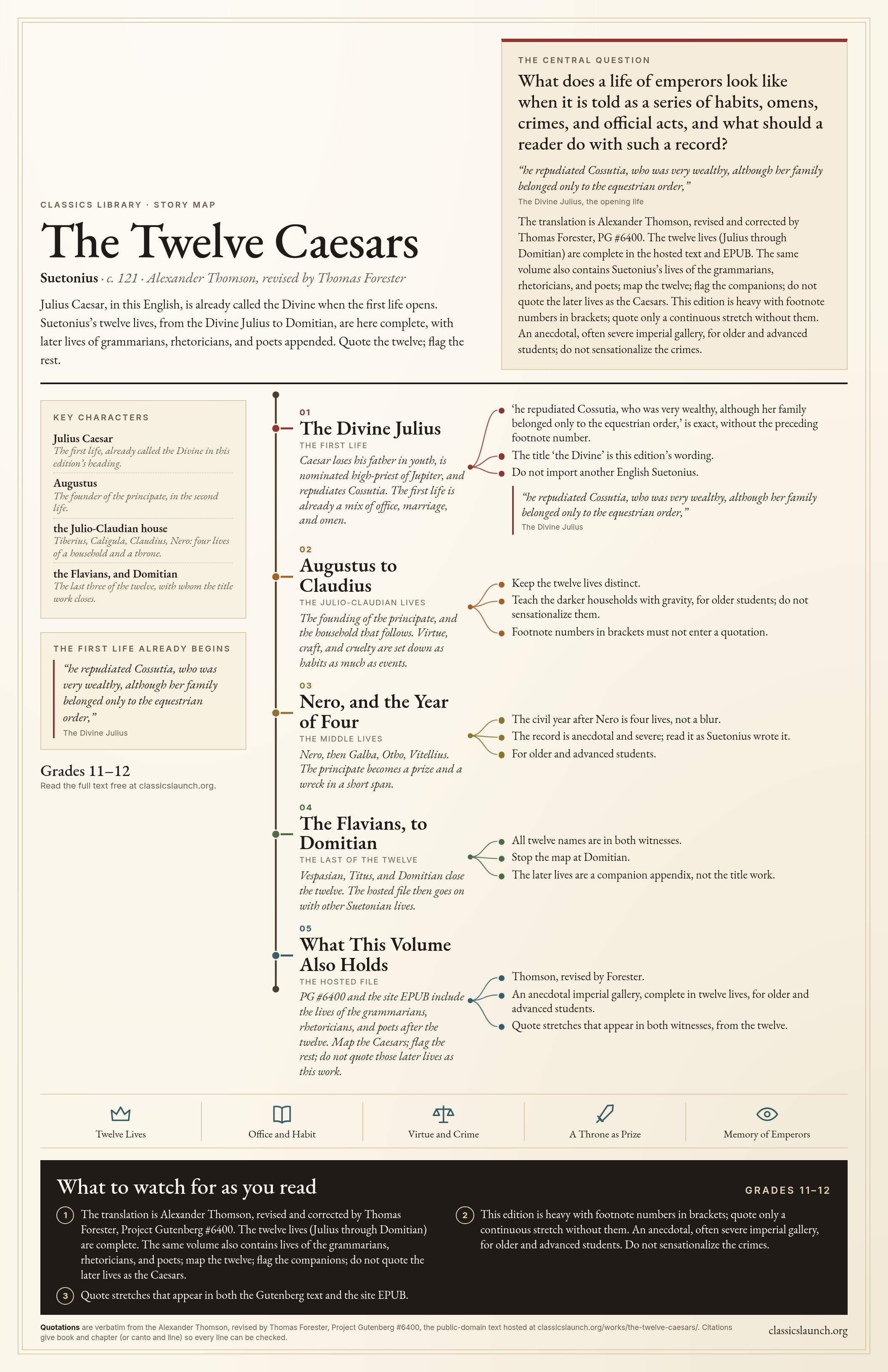
Every quotation is word for word from the Alexander Thomson, revised by Thomas Forester hosted in this library and is checked against that text each time the site is built. Citations give book and chapter (or canto and line).