Story maps · Grades 6–8
The War of the Worlds: A Story Map
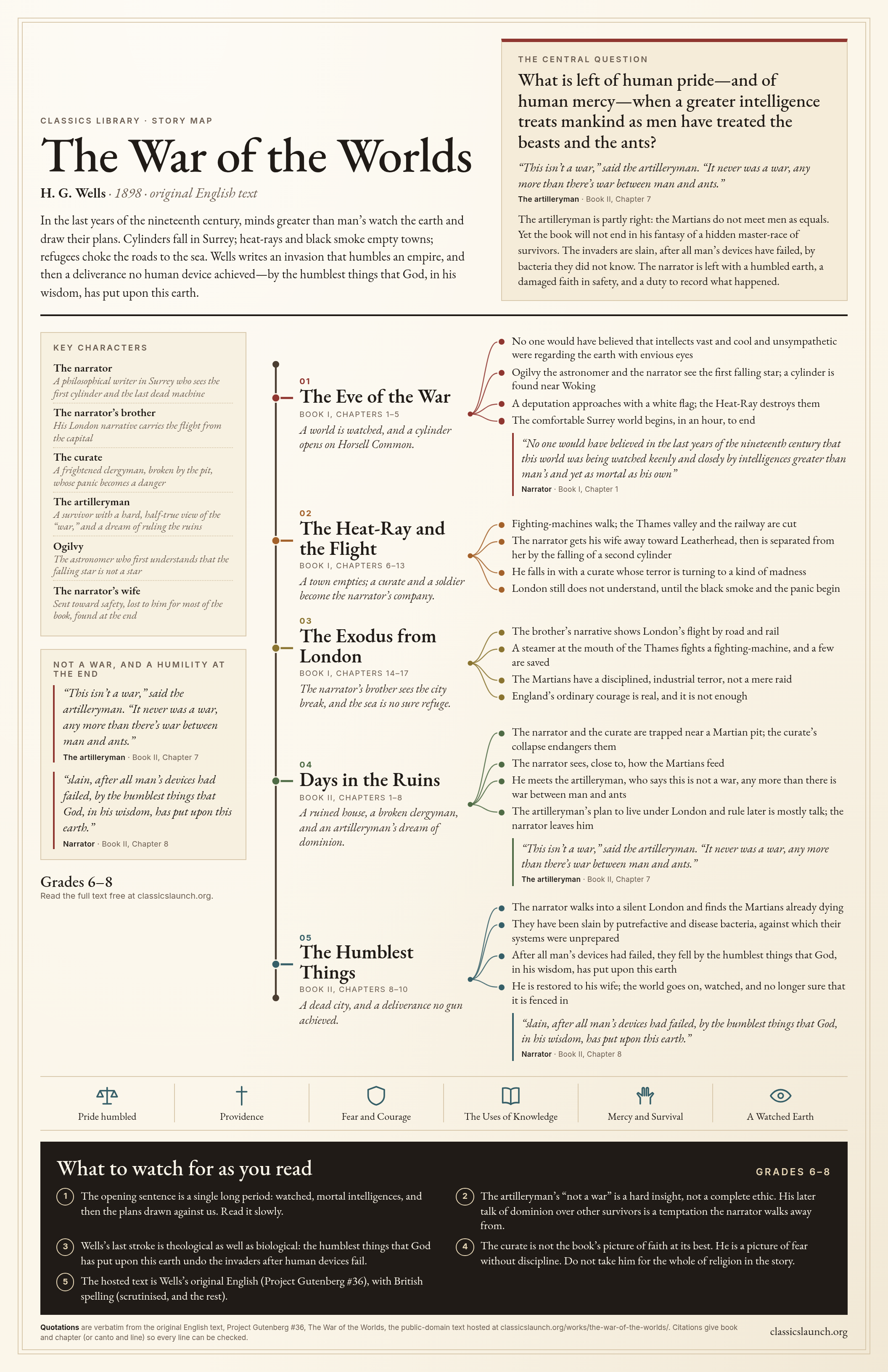
The PDF is one tabloid page (11 × 17 in). On letter paper, choose “Fit to page.”
In the last years of the nineteenth century, minds greater than man’s watch the earth and draw their plans. Cylinders fall in Surrey; heat-rays and black smoke empty towns; refugees choke the roads to the sea. Wells writes an invasion that humbles an empire, and then a deliverance no human device achieved—by the humblest things that God, in his wisdom, has put upon this earth.
The central question
What is left of human pride—and of human mercy—when a greater intelligence treats mankind as men have treated the beasts and the ants?
“This isn’t a war,” said the artilleryman. “It never was a war, any more than there’s war between man and ants.”
The artilleryman is partly right: the Martians do not meet men as equals. Yet the book will not end in his fantasy of a hidden master-race of survivors. The invaders are slain, after all man’s devices have failed, by bacteria they did not know. The narrator is left with a humbled earth, a damaged faith in safety, and a duty to record what happened.
- 01
The Eve of the War
Book I, Chapters 1–5
A world is watched, and a cylinder opens on Horsell Common.
- No one would have believed that intellects vast and cool and unsympathetic were regarding the earth with envious eyes
- Ogilvy the astronomer and the narrator see the first falling star; a cylinder is found near Woking
- A deputation approaches with a white flag; the Heat-Ray destroys them
- The comfortable Surrey world begins, in an hour, to end
“No one would have believed in the last years of the nineteenth century that this world was being watched keenly and closely by intelligences greater than man’s and yet as mortal as his own”
- 02
The Heat-Ray and the Flight
Book I, Chapters 6–13
A town empties; a curate and a soldier become the narrator’s company.
- Fighting-machines walk; the Thames valley and the railway are cut
- The narrator gets his wife away toward Leatherhead, then is separated from her by the falling of a second cylinder
- He falls in with a curate whose terror is turning to a kind of madness
- London still does not understand, until the black smoke and the panic begin
- 03
The Exodus from London
Book I, Chapters 14–17
The narrator’s brother sees the city break, and the sea is no sure refuge.
- The brother’s narrative shows London’s flight by road and rail
- A steamer at the mouth of the Thames fights a fighting-machine, and a few are saved
- The Martians have a disciplined, industrial terror, not a mere raid
- England’s ordinary courage is real, and it is not enough
- 04
Days in the Ruins
Book II, Chapters 1–8
A ruined house, a broken clergyman, and an artilleryman’s dream of dominion.
- The narrator and the curate are trapped near a Martian pit; the curate’s collapse endangers them
- The narrator sees, close to, how the Martians feed
- He meets the artilleryman, who says this is not a war, any more than there is war between man and ants
- The artilleryman’s plan to live under London and rule later is mostly talk; the narrator leaves him
“This isn’t a war,” said the artilleryman. “It never was a war, any more than there’s war between man and ants.”
- 05
The Humblest Things
Book II, Chapters 8–10
A dead city, and a deliverance no gun achieved.
- The narrator walks into a silent London and finds the Martians already dying
- They have been slain by putrefactive and disease bacteria, against which their systems were unprepared
- After all man’s devices had failed, they fell by the humblest things that God, in his wisdom, has put upon this earth
- He is restored to his wife; the world goes on, watched, and no longer sure that it is fenced in
“slain, after all man’s devices had failed, by the humblest things that God, in his wisdom, has put upon this earth.”
- Pride humbled
- Providence
- Fear and Courage
- The Uses of Knowledge
- Mercy and Survival
- A Watched Earth
What to watch for as you read
Grades 6–8- The opening sentence is a single long period: watched, mortal intelligences, and then the plans drawn against us. Read it slowly.
- The artilleryman’s “not a war” is a hard insight, not a complete ethic. His later talk of dominion over other survivors is a temptation the narrator walks away from.
- Wells’s last stroke is theological as well as biological: the humblest things that God has put upon this earth undo the invaders after human devices fail.
- The curate is not the book’s picture of faith at its best. He is a picture of fear without discipline. Do not take him for the whole of religion in the story.
- The hosted text is Wells’s original English (Project Gutenberg #36), with British spelling (scrutinised, and the rest).
Every quotation is word for word from the original English text hosted in this library and is checked against that text each time the site is built. Citations give book and chapter (or canto and line).