Story maps · Grades 9–12
The Winter's Tale: A Story Map
The PDF is one tabloid page (11 × 17 in). On letter paper, choose “Fit to page.”
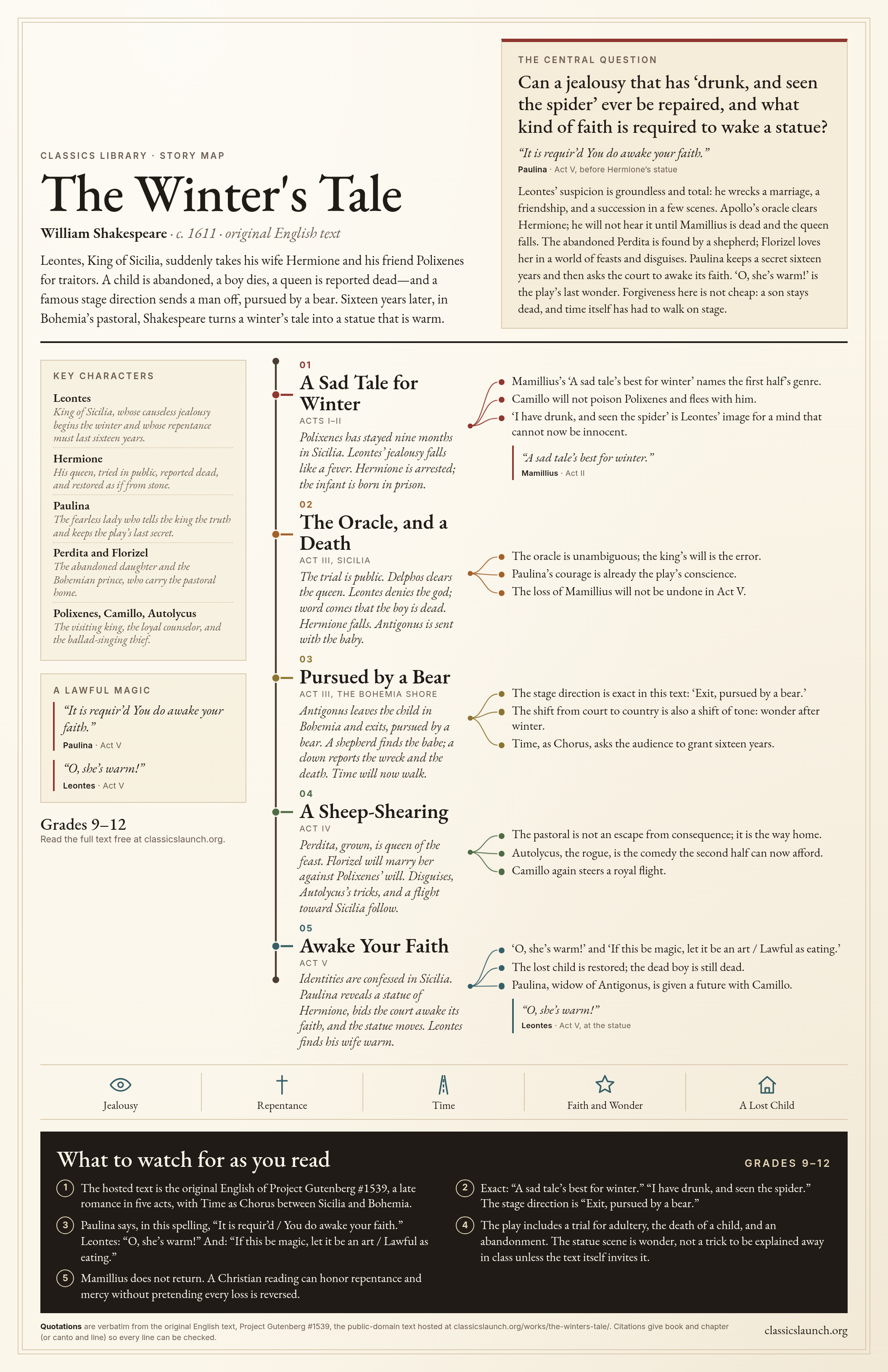
Leontes, King of Sicilia, suddenly takes his wife Hermione and his friend Polixenes for traitors. A child is abandoned, a boy dies, a queen is reported dead—and a famous stage direction sends a man off, pursued by a bear. Sixteen years later, in Bohemia’s pastoral, Shakespeare turns a winter’s tale into a statue that is warm.
The central question
Can a jealousy that has ‘drunk, and seen the spider’ ever be repaired, and what kind of faith is required to wake a statue?
“It is requir’d You do awake your faith.”
Leontes’ suspicion is groundless and total: he wrecks a marriage, a friendship, and a succession in a few scenes. Apollo’s oracle clears Hermione; he will not hear it until Mamillius is dead and the queen falls. The abandoned Perdita is found by a shepherd; Florizel loves her in a world of feasts and disguises. Paulina keeps a secret sixteen years and then asks the court to awake its faith. ‘O, she’s warm!’ is the play’s last wonder. Forgiveness here is not cheap: a son stays dead, and time itself has had to walk on stage.
- 01
A Sad Tale for Winter
Acts I–II
Polixenes has stayed nine months in Sicilia. Leontes’ jealousy falls like a fever. Hermione is arrested; the infant is born in prison.
- Mamillius’s ‘A sad tale’s best for winter’ names the first half’s genre.
- Camillo will not poison Polixenes and flees with him.
- ‘I have drunk, and seen the spider’ is Leontes’ image for a mind that cannot now be innocent.
“A sad tale’s best for winter.”
- 02
The Oracle, and a Death
Act III, Sicilia
The trial is public. Delphos clears the queen. Leontes denies the god; word comes that the boy is dead. Hermione falls. Antigonus is sent with the baby.
- The oracle is unambiguous; the king’s will is the error.
- Paulina’s courage is already the play’s conscience.
- The loss of Mamillius will not be undone in Act V.
- 03
Pursued by a Bear
Act III, the Bohemia shore
Antigonus leaves the child in Bohemia and exits, pursued by a bear. A shepherd finds the babe; a clown reports the wreck and the death. Time will now walk.
- The stage direction is exact in this text: ‘Exit, pursued by a bear.’
- The shift from court to country is also a shift of tone: wonder after winter.
- Time, as Chorus, asks the audience to grant sixteen years.
- 04
A Sheep-Shearing
Act IV
Perdita, grown, is queen of the feast. Florizel will marry her against Polixenes’ will. Disguises, Autolycus’s tricks, and a flight toward Sicilia follow.
- The pastoral is not an escape from consequence; it is the way home.
- Autolycus, the rogue, is the comedy the second half can now afford.
- Camillo again steers a royal flight.
- 05
Awake Your Faith
Act V
Identities are confessed in Sicilia. Paulina reveals a statue of Hermione, bids the court awake its faith, and the statue moves. Leontes finds his wife warm.
- ‘O, she’s warm!’ and ‘If this be magic, let it be an art / Lawful as eating.’
- The lost child is restored; the dead boy is still dead.
- Paulina, widow of Antigonus, is given a future with Camillo.
“O, she’s warm!”
- Jealousy
- Repentance
- Time
- Faith and Wonder
- A Lost Child
What to watch for as you read
Grades 9–12- The hosted text is the original English of Project Gutenberg #1539, a late romance in five acts, with Time as Chorus between Sicilia and Bohemia.
- Exact: “A sad tale’s best for winter.” “I have drunk, and seen the spider.” The stage direction is “Exit, pursued by a bear.”
- Paulina says, in this spelling, “It is requir’d / You do awake your faith.” Leontes: “O, she’s warm!” And: “If this be magic, let it be an art / Lawful as eating.”
- The play includes a trial for adultery, the death of a child, and an abandonment. The statue scene is wonder, not a trick to be explained away in class unless the text itself invites it.
- Mamillius does not return. A Christian reading can honor repentance and mercy without pretending every loss is reversed.
Every quotation is word for word from the original English text hosted in this library and is checked against that text each time the site is built. Citations give book and chapter (or canto and line).