Story maps · Grades 11–12
This Side of Paradise: A Story Map
The PDF is one tabloid page (11 × 17 in). On letter paper, choose “Fit to page.”
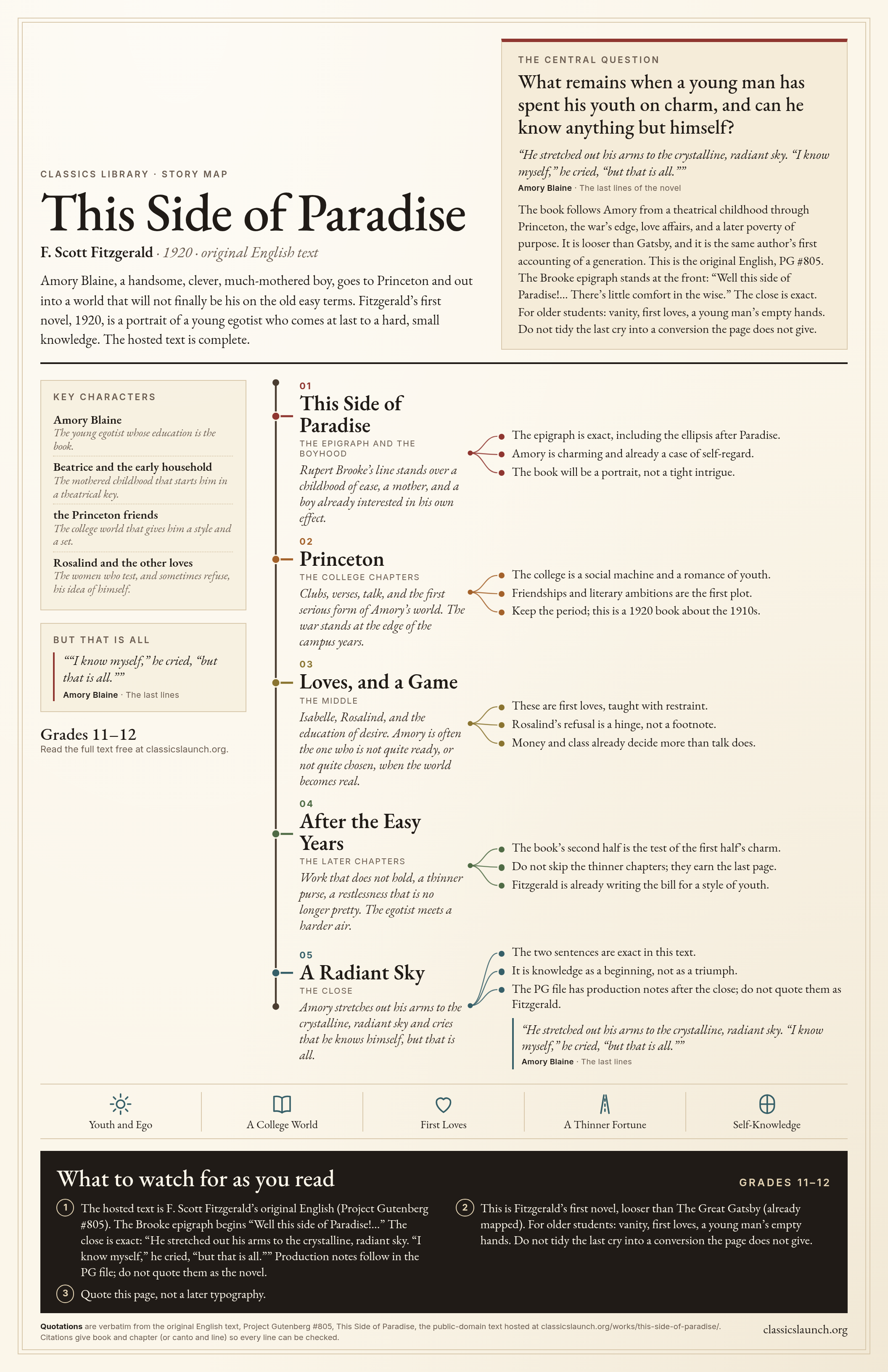
Amory Blaine, a handsome, clever, much-mothered boy, goes to Princeton and out into a world that will not finally be his on the old easy terms. Fitzgerald’s first novel, 1920, is a portrait of a young egotist who comes at last to a hard, small knowledge. The hosted text is complete.
The central question
What remains when a young man has spent his youth on charm, and can he know anything but himself?
“He stretched out his arms to the crystalline, radiant sky. “I know myself,” he cried, “but that is all.””
The book follows Amory from a theatrical childhood through Princeton, the war’s edge, love affairs, and a later poverty of purpose. It is looser than Gatsby, and it is the same author’s first accounting of a generation. This is the original English, PG #805. The Brooke epigraph stands at the front: “Well this side of Paradise!… There’s little comfort in the wise.” The close is exact. For older students: vanity, first loves, a young man’s empty hands. Do not tidy the last cry into a conversion the page does not give.
- 01
This Side of Paradise
The epigraph and the boyhood
Rupert Brooke’s line stands over a childhood of ease, a mother, and a boy already interested in his own effect.
- The epigraph is exact, including the ellipsis after Paradise.
- Amory is charming and already a case of self-regard.
- The book will be a portrait, not a tight intrigue.
- 02
Princeton
The college chapters
Clubs, verses, talk, and the first serious form of Amory’s world. The war stands at the edge of the campus years.
- The college is a social machine and a romance of youth.
- Friendships and literary ambitions are the first plot.
- Keep the period; this is a 1920 book about the 1910s.
- 03
Loves, and a Game
The middle
Isabelle, Rosalind, and the education of desire. Amory is often the one who is not quite ready, or not quite chosen, when the world becomes real.
- These are first loves, taught with restraint.
- Rosalind’s refusal is a hinge, not a footnote.
- Money and class already decide more than talk does.
- 04
After the Easy Years
The later chapters
Work that does not hold, a thinner purse, a restlessness that is no longer pretty. The egotist meets a harder air.
- The book’s second half is the test of the first half’s charm.
- Do not skip the thinner chapters; they earn the last page.
- Fitzgerald is already writing the bill for a style of youth.
- 05
A Radiant Sky
The close
Amory stretches out his arms to the crystalline, radiant sky and cries that he knows himself, but that is all.
- The two sentences are exact in this text.
- It is knowledge as a beginning, not as a triumph.
- The PG file has production notes after the close; do not quote them as Fitzgerald.
“He stretched out his arms to the crystalline, radiant sky. “I know myself,” he cried, “but that is all.””
- Youth and Ego
- A College World
- First Loves
- A Thinner Fortune
- Self-Knowledge
What to watch for as you read
Grades 11–12- The hosted text is F. Scott Fitzgerald’s original English (Project Gutenberg #805). The Brooke epigraph begins “Well this side of Paradise!…” The close is exact: “He stretched out his arms to the crystalline, radiant sky. “I know myself,” he cried, “but that is all.”” Production notes follow in the PG file; do not quote them as the novel.
- This is Fitzgerald’s first novel, looser than The Great Gatsby (already mapped). For older students: vanity, first loves, a young man’s empty hands. Do not tidy the last cry into a conversion the page does not give.
- Quote this page, not a later typography.
Every quotation is word for word from the original English text hosted in this library and is checked against that text each time the site is built. Citations give book and chapter (or canto and line).