Story maps · Grades 10–12
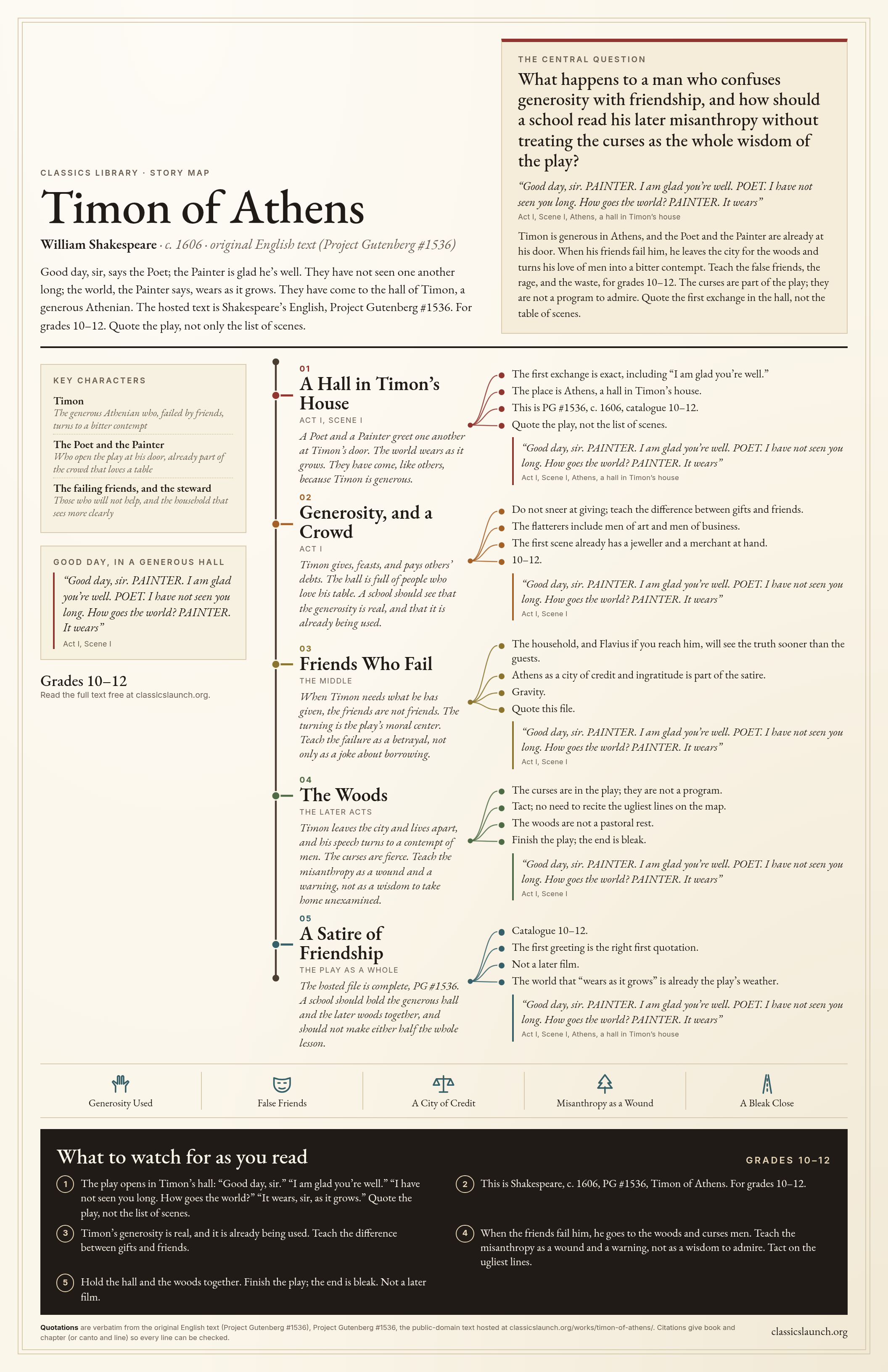
Timon of Athens: A Story Map
The PDF is one tabloid page (11 × 17 in). On letter paper, choose “Fit to page.”
Good day, sir, says the Poet; the Painter is glad he’s well. They have not seen one another long; the world, the Painter says, wears as it grows. They have come to the hall of Timon, a generous Athenian. The hosted text is Shakespeare’s English, Project Gutenberg #1536. For grades 10–12. Quote the play, not only the list of scenes.
The central question
What happens to a man who confuses generosity with friendship, and how should a school read his later misanthropy without treating the curses as the whole wisdom of the play?
“Good day, sir. PAINTER. I am glad you’re well. POET. I have not seen you long. How goes the world? PAINTER. It wears”
Timon is generous in Athens, and the Poet and the Painter are already at his door. When his friends fail him, he leaves the city for the woods and turns his love of men into a bitter contempt. Teach the false friends, the rage, and the waste, for grades 10–12. The curses are part of the play; they are not a program to admire. Quote the first exchange in the hall, not the table of scenes.
- 01
A Hall in Timon’s House
Act I, Scene I
A Poet and a Painter greet one another at Timon’s door. The world wears as it grows. They have come, like others, because Timon is generous.
- The first exchange is exact, including “I am glad you’re well.”
- The place is Athens, a hall in Timon’s house.
- This is PG #1536, c. 1606, catalogue 10–12.
- Quote the play, not the list of scenes.
“Good day, sir. PAINTER. I am glad you’re well. POET. I have not seen you long. How goes the world? PAINTER. It wears”
- 02
Generosity, and a Crowd
Act I
Timon gives, feasts, and pays others’ debts. The hall is full of people who love his table. A school should see that the generosity is real, and that it is already being used.
- Do not sneer at giving; teach the difference between gifts and friends.
- The flatterers include men of art and men of business.
- The first scene already has a jeweller and a merchant at hand.
- 10–12.
“Good day, sir. PAINTER. I am glad you’re well. POET. I have not seen you long. How goes the world? PAINTER. It wears”
- 03
Friends Who Fail
The middle
When Timon needs what he has given, the friends are not friends. The turning is the play’s moral center. Teach the failure as a betrayal, not only as a joke about borrowing.
- The household, and Flavius if you reach him, will see the truth sooner than the guests.
- Athens as a city of credit and ingratitude is part of the satire.
- Gravity.
- Quote this file.
“Good day, sir. PAINTER. I am glad you’re well. POET. I have not seen you long. How goes the world? PAINTER. It wears”
- 04
The Woods
The later acts
Timon leaves the city and lives apart, and his speech turns to a contempt of men. The curses are fierce. Teach the misanthropy as a wound and a warning, not as a wisdom to take home unexamined.
- The curses are in the play; they are not a program.
- Tact; no need to recite the ugliest lines on the map.
- The woods are not a pastoral rest.
- Finish the play; the end is bleak.
“Good day, sir. PAINTER. I am glad you’re well. POET. I have not seen you long. How goes the world? PAINTER. It wears”
- 05
A Satire of Friendship
The play as a whole
The hosted file is complete, PG #1536. A school should hold the generous hall and the later woods together, and should not make either half the whole lesson.
- Catalogue 10–12.
- The first greeting is the right first quotation.
- Not a later film.
- The world that “wears as it grows” is already the play’s weather.
“Good day, sir. PAINTER. I am glad you’re well. POET. I have not seen you long. How goes the world? PAINTER. It wears”
- Generosity Used
- False Friends
- A City of Credit
- Misanthropy as a Wound
- A Bleak Close
What to watch for as you read
Grades 10–12- The play opens in Timon’s hall: “Good day, sir.” “I am glad you’re well.” “I have not seen you long. How goes the world?” “It wears, sir, as it grows.” Quote the play, not the list of scenes.
- This is Shakespeare, c. 1606, PG #1536, Timon of Athens. For grades 10–12.
- Timon’s generosity is real, and it is already being used. Teach the difference between gifts and friends.
- When the friends fail him, he goes to the woods and curses men. Teach the misanthropy as a wound and a warning, not as a wisdom to admire. Tact on the ugliest lines.
- Hold the hall and the woods together. Finish the play; the end is bleak. Not a later film.
Every quotation is word for word from the original English text (Project Gutenberg #1536) hosted in this library and is checked against that text each time the site is built. Citations give book and chapter (or canto and line).