Story maps · Grades 11–12
Titus Andronicus: A Story Map
The PDF is one tabloid page (11 × 17 in). On letter paper, choose “Fit to page.”
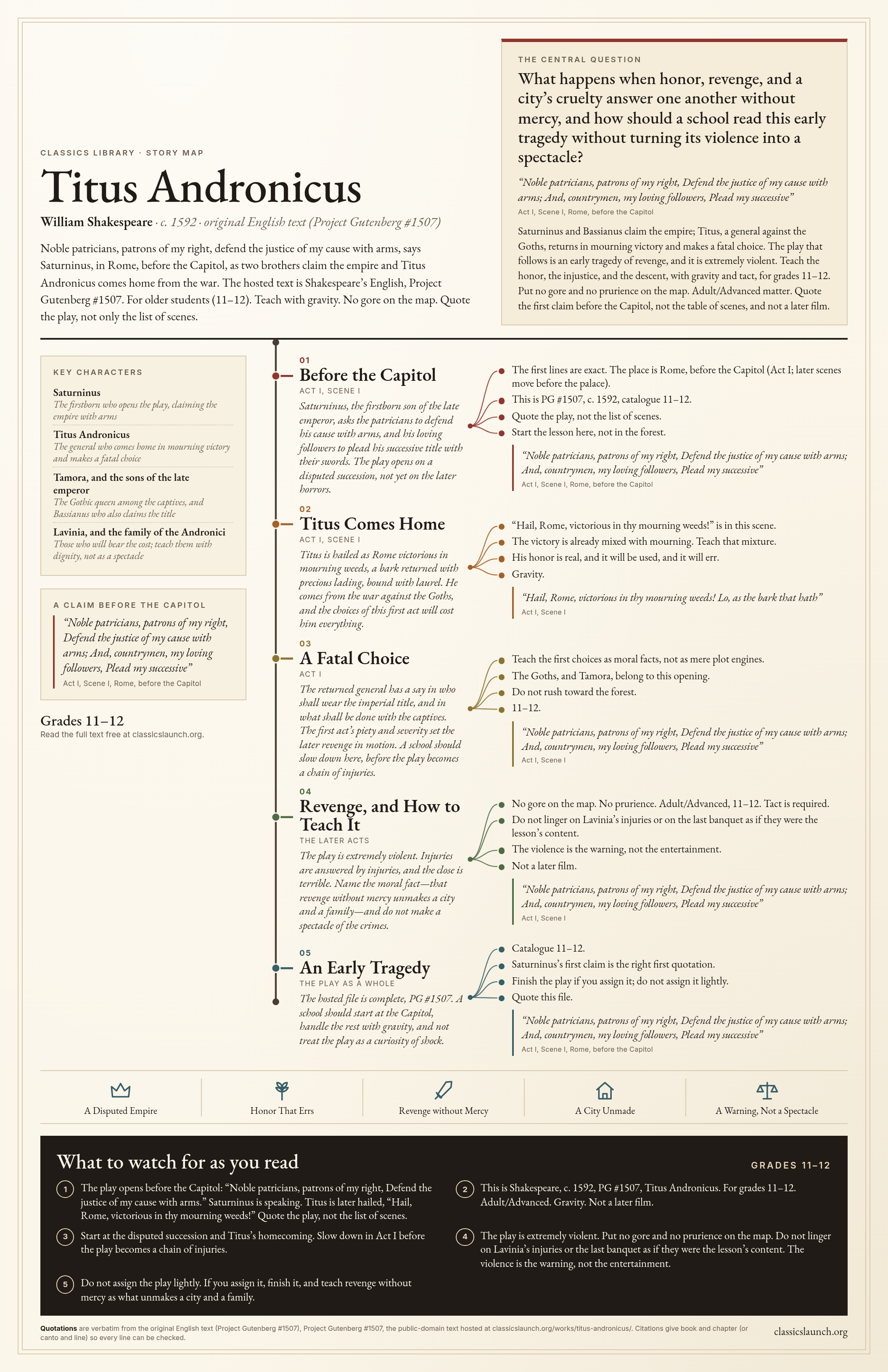
Noble patricians, patrons of my right, defend the justice of my cause with arms, says Saturninus, in Rome, before the Capitol, as two brothers claim the empire and Titus Andronicus comes home from the war. The hosted text is Shakespeare’s English, Project Gutenberg #1507. For older students (11–12). Teach with gravity. No gore on the map. Quote the play, not only the list of scenes.
The central question
What happens when honor, revenge, and a city’s cruelty answer one another without mercy, and how should a school read this early tragedy without turning its violence into a spectacle?
“Noble patricians, patrons of my right, Defend the justice of my cause with arms; And, countrymen, my loving followers, Plead my successive”
Saturninus and Bassianus claim the empire; Titus, a general against the Goths, returns in mourning victory and makes a fatal choice. The play that follows is an early tragedy of revenge, and it is extremely violent. Teach the honor, the injustice, and the descent, with gravity and tact, for grades 11–12. Put no gore and no prurience on the map. Adult/Advanced matter. Quote the first claim before the Capitol, not the table of scenes, and not a later film.
- 01
Before the Capitol
Act I, Scene I
Saturninus, the firstborn son of the late emperor, asks the patricians to defend his cause with arms, and his loving followers to plead his successive title with their swords. The play opens on a disputed succession, not yet on the later horrors.
- The first lines are exact. The place is Rome, before the Capitol (Act I; later scenes move before the palace).
- This is PG #1507, c. 1592, catalogue 11–12.
- Quote the play, not the list of scenes.
- Start the lesson here, not in the forest.
“Noble patricians, patrons of my right, Defend the justice of my cause with arms; And, countrymen, my loving followers, Plead my successive”
- 02
Titus Comes Home
Act I, Scene I
Titus is hailed as Rome victorious in mourning weeds, a bark returned with precious lading, bound with laurel. He comes from the war against the Goths, and the choices of this first act will cost him everything.
- “Hail, Rome, victorious in thy mourning weeds!” is in this scene.
- The victory is already mixed with mourning. Teach that mixture.
- His honor is real, and it will be used, and it will err.
- Gravity.
“Hail, Rome, victorious in thy mourning weeds! Lo, as the bark that hath”
- 03
A Fatal Choice
Act I
The returned general has a say in who shall wear the imperial title, and in what shall be done with the captives. The first act’s piety and severity set the later revenge in motion. A school should slow down here, before the play becomes a chain of injuries.
- Teach the first choices as moral facts, not as mere plot engines.
- The Goths, and Tamora, belong to this opening.
- Do not rush toward the forest.
- 11–12.
“Noble patricians, patrons of my right, Defend the justice of my cause with arms; And, countrymen, my loving followers, Plead my successive”
- 04
Revenge, and How to Teach It
The later acts
The play is extremely violent. Injuries are answered by injuries, and the close is terrible. Name the moral fact—that revenge without mercy unmakes a city and a family—and do not make a spectacle of the crimes.
- No gore on the map. No prurience. Adult/Advanced, 11–12. Tact is required.
- Do not linger on Lavinia’s injuries or on the last banquet as if they were the lesson’s content.
- The violence is the warning, not the entertainment.
- Not a later film.
“Noble patricians, patrons of my right, Defend the justice of my cause with arms; And, countrymen, my loving followers, Plead my successive”
- 05
An Early Tragedy
The play as a whole
The hosted file is complete, PG #1507. A school should start at the Capitol, handle the rest with gravity, and not treat the play as a curiosity of shock.
- Catalogue 11–12.
- Saturninus’s first claim is the right first quotation.
- Finish the play if you assign it; do not assign it lightly.
- Quote this file.
“Noble patricians, patrons of my right, Defend the justice of my cause with arms; And, countrymen, my loving followers, Plead my successive”
- A Disputed Empire
- Honor That Errs
- Revenge without Mercy
- A City Unmade
- A Warning, Not a Spectacle
What to watch for as you read
Grades 11–12- The play opens before the Capitol: “Noble patricians, patrons of my right, Defend the justice of my cause with arms.” Saturninus is speaking. Titus is later hailed, “Hail, Rome, victorious in thy mourning weeds!” Quote the play, not the list of scenes.
- This is Shakespeare, c. 1592, PG #1507, Titus Andronicus. For grades 11–12. Adult/Advanced. Gravity. Not a later film.
- Start at the disputed succession and Titus’s homecoming. Slow down in Act I before the play becomes a chain of injuries.
- The play is extremely violent. Put no gore and no prurience on the map. Do not linger on Lavinia’s injuries or the last banquet as if they were the lesson’s content. The violence is the warning, not the entertainment.
- Do not assign the play lightly. If you assign it, finish it, and teach revenge without mercy as what unmakes a city and a family.
Every quotation is word for word from the original English text (Project Gutenberg #1507) hosted in this library and is checked against that text each time the site is built. Citations give book and chapter (or canto and line).