Story maps · Grades 10–12
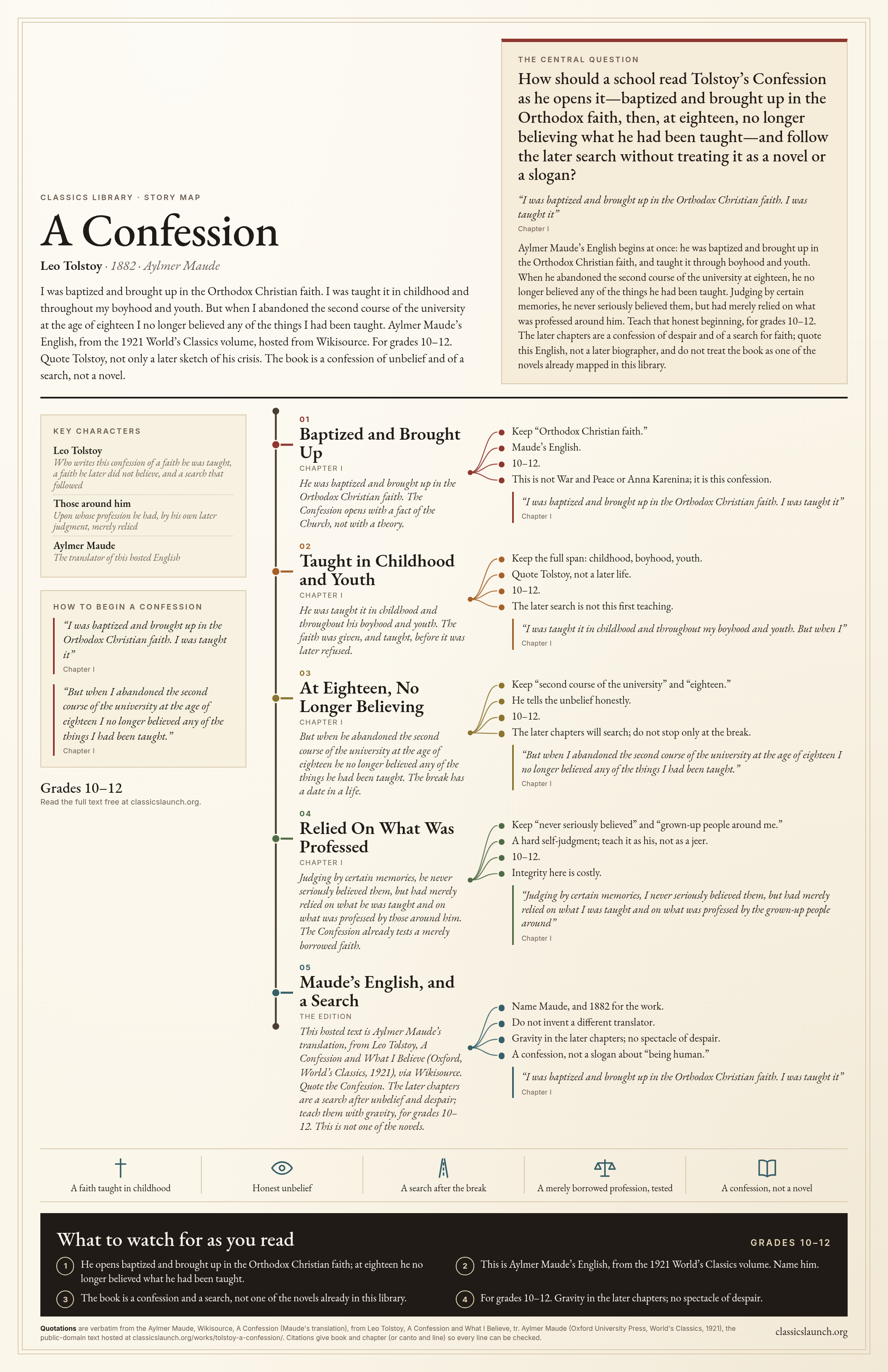
A Confession: A Story Map
The PDF is one tabloid page (11 × 17 in). On letter paper, choose “Fit to page.”
I was baptized and brought up in the Orthodox Christian faith. I was taught it in childhood and throughout my boyhood and youth. But when I abandoned the second course of the university at the age of eighteen I no longer believed any of the things I had been taught. Aylmer Maude’s English, from the 1921 World’s Classics volume, hosted from Wikisource. For grades 10–12. Quote Tolstoy, not only a later sketch of his crisis. The book is a confession of unbelief and of a search, not a novel.
The central question
How should a school read Tolstoy’s Confession as he opens it—baptized and brought up in the Orthodox faith, then, at eighteen, no longer believing what he had been taught—and follow the later search without treating it as a novel or a slogan?
“I was baptized and brought up in the Orthodox Christian faith. I was taught it”
Aylmer Maude’s English begins at once: he was baptized and brought up in the Orthodox Christian faith, and taught it through boyhood and youth. When he abandoned the second course of the university at eighteen, he no longer believed any of the things he had been taught. Judging by certain memories, he never seriously believed them, but had merely relied on what was professed around him. Teach that honest beginning, for grades 10–12. The later chapters are a confession of despair and of a search for faith; quote this English, not a later biographer, and do not treat the book as one of the novels already mapped in this library.
- 01
Baptized and Brought Up
Chapter I
He was baptized and brought up in the Orthodox Christian faith. The Confession opens with a fact of the Church, not with a theory.
- Keep “Orthodox Christian faith.”
- Maude’s English.
- 10–12.
- This is not War and Peace or Anna Karenina; it is this confession.
“I was baptized and brought up in the Orthodox Christian faith. I was taught it”
- 02
Taught in Childhood and Youth
Chapter I
He was taught it in childhood and throughout his boyhood and youth. The faith was given, and taught, before it was later refused.
- Keep the full span: childhood, boyhood, youth.
- Quote Tolstoy, not a later life.
- 10–12.
- The later search is not this first teaching.
“I was taught it in childhood and throughout my boyhood and youth. But when I”
- 03
At Eighteen, No Longer Believing
Chapter I
But when he abandoned the second course of the university at the age of eighteen he no longer believed any of the things he had been taught. The break has a date in a life.
- Keep “second course of the university” and “eighteen.”
- He tells the unbelief honestly.
- 10–12.
- The later chapters will search; do not stop only at the break.
“But when I abandoned the second course of the university at the age of eighteen I no longer believed any of the things I had been taught.”
- 04
Relied On What Was Professed
Chapter I
Judging by certain memories, he never seriously believed them, but had merely relied on what he was taught and on what was professed by those around him. The Confession already tests a merely borrowed faith.
- Keep “never seriously believed” and “grown-up people around me.”
- A hard self-judgment; teach it as his, not as a jeer.
- 10–12.
- Integrity here is costly.
“Judging by certain memories, I never seriously believed them, but had merely relied on what I was taught and on what was professed by the grown-up people around”
- 05
Maude’s English, and a Search
The edition
This hosted text is Aylmer Maude’s translation, from Leo Tolstoy, A Confession and What I Believe (Oxford, World’s Classics, 1921), via Wikisource. Quote the Confession. The later chapters are a search after unbelief and despair; teach them with gravity, for grades 10–12. This is not one of the novels.
- Name Maude, and 1882 for the work.
- Do not invent a different translator.
- Gravity in the later chapters; no spectacle of despair.
- A confession, not a slogan about “being human.”
“I was baptized and brought up in the Orthodox Christian faith. I was taught it”
- A faith taught in childhood
- Honest unbelief
- A search after the break
- A merely borrowed profession, tested
- A confession, not a novel
What to watch for as you read
Grades 10–12- He opens baptized and brought up in the Orthodox Christian faith; at eighteen he no longer believed what he had been taught.
- This is Aylmer Maude’s English, from the 1921 World’s Classics volume. Name him.
- The book is a confession and a search, not one of the novels already in this library.
- For grades 10–12. Gravity in the later chapters; no spectacle of despair.
Every quotation is word for word from the Aylmer Maude hosted in this library and is checked against that text each time the site is built. Citations give book and chapter (or canto and line).