Story maps · Grades 11–12
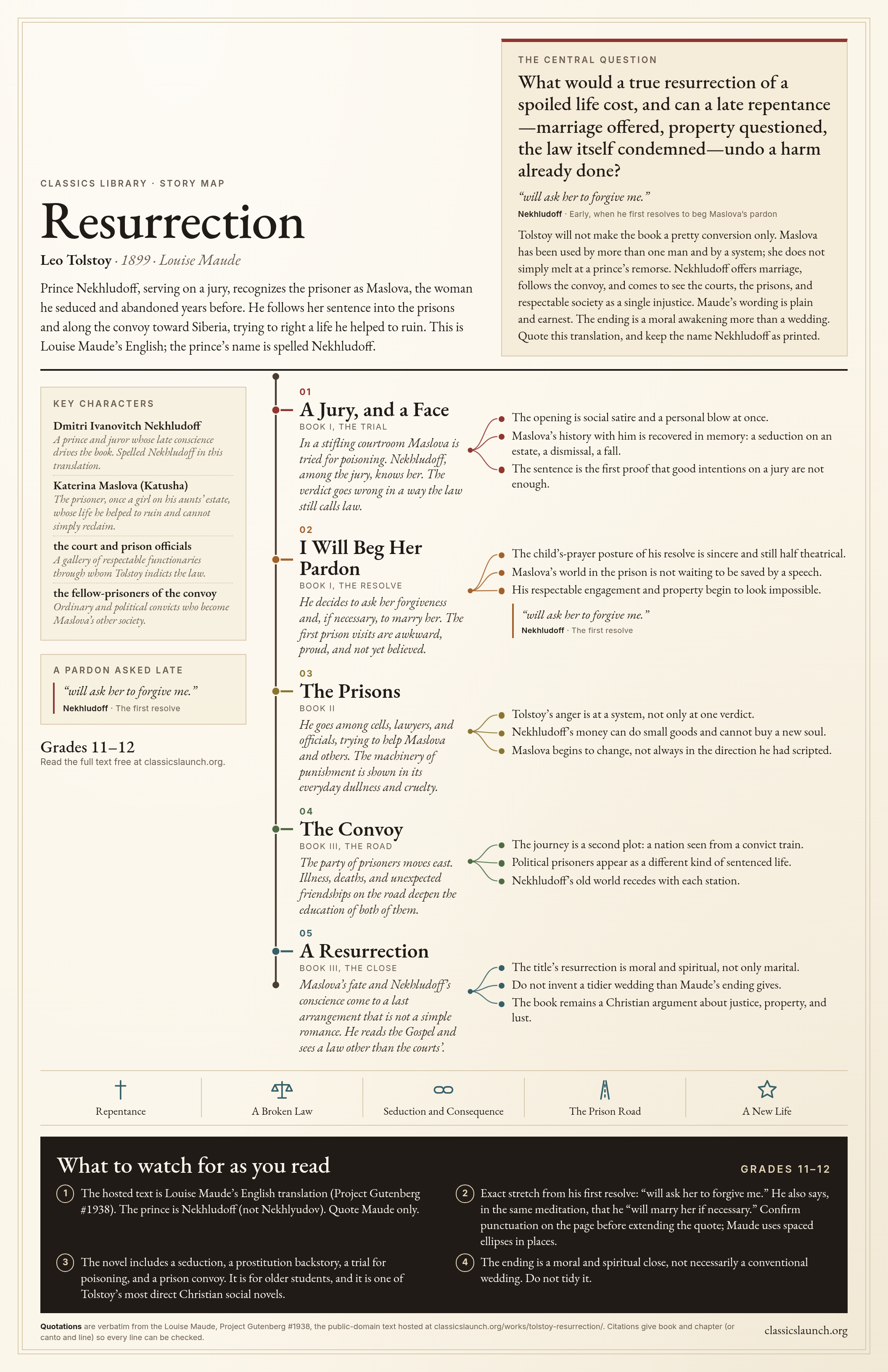
Resurrection: A Story Map
The PDF is one tabloid page (11 × 17 in). On letter paper, choose “Fit to page.”
Prince Nekhludoff, serving on a jury, recognizes the prisoner as Maslova, the woman he seduced and abandoned years before. He follows her sentence into the prisons and along the convoy toward Siberia, trying to right a life he helped to ruin. This is Louise Maude’s English; the prince’s name is spelled Nekhludoff.
The central question
What would a true resurrection of a spoiled life cost, and can a late repentance—marriage offered, property questioned, the law itself condemned—undo a harm already done?
“will ask her to forgive me.”
Tolstoy will not make the book a pretty conversion only. Maslova has been used by more than one man and by a system; she does not simply melt at a prince’s remorse. Nekhludoff offers marriage, follows the convoy, and comes to see the courts, the prisons, and respectable society as a single injustice. Maude’s wording is plain and earnest. The ending is a moral awakening more than a wedding. Quote this translation, and keep the name Nekhludoff as printed.
- 01
A Jury, and a Face
Book I, the trial
In a stifling courtroom Maslova is tried for poisoning. Nekhludoff, among the jury, knows her. The verdict goes wrong in a way the law still calls law.
- The opening is social satire and a personal blow at once.
- Maslova’s history with him is recovered in memory: a seduction on an estate, a dismissal, a fall.
- The sentence is the first proof that good intentions on a jury are not enough.
- 02
I Will Beg Her Pardon
Book I, the resolve
He decides to ask her forgiveness and, if necessary, to marry her. The first prison visits are awkward, proud, and not yet believed.
- The child’s-prayer posture of his resolve is sincere and still half theatrical.
- Maslova’s world in the prison is not waiting to be saved by a speech.
- His respectable engagement and property begin to look impossible.
“will ask her to forgive me.”
- 03
The Prisons
Book II
He goes among cells, lawyers, and officials, trying to help Maslova and others. The machinery of punishment is shown in its everyday dullness and cruelty.
- Tolstoy’s anger is at a system, not only at one verdict.
- Nekhludoff’s money can do small goods and cannot buy a new soul.
- Maslova begins to change, not always in the direction he had scripted.
- 04
The Convoy
Book III, the road
The party of prisoners moves east. Illness, deaths, and unexpected friendships on the road deepen the education of both of them.
- The journey is a second plot: a nation seen from a convict train.
- Political prisoners appear as a different kind of sentenced life.
- Nekhludoff’s old world recedes with each station.
- 05
A Resurrection
Book III, the close
Maslova’s fate and Nekhludoff’s conscience come to a last arrangement that is not a simple romance. He reads the Gospel and sees a law other than the courts’.
- The title’s resurrection is moral and spiritual, not only marital.
- Do not invent a tidier wedding than Maude’s ending gives.
- The book remains a Christian argument about justice, property, and lust.
- Repentance
- A Broken Law
- Seduction and Consequence
- The Prison Road
- A New Life
What to watch for as you read
Grades 11–12- The hosted text is Louise Maude’s English translation (Project Gutenberg #1938). The prince is Nekhludoff (not Nekhlyudov). Quote Maude only.
- Exact stretch from his first resolve: “will ask her to forgive me.” He also says, in the same meditation, that he “will marry her if necessary.” Confirm punctuation on the page before extending the quote; Maude uses spaced ellipses in places.
- The novel includes a seduction, a prostitution backstory, a trial for poisoning, and a prison convoy. It is for older students, and it is one of Tolstoy’s most direct Christian social novels.
- The ending is a moral and spiritual close, not necessarily a conventional wedding. Do not tidy it.
Every quotation is word for word from the Louise Maude hosted in this library and is checked against that text each time the site is built. Citations give book and chapter (or canto and line).