Story maps · Grades 11–12
Troilus and Cressida: A Story Map
The PDF is one tabloid page (11 × 17 in). On letter paper, choose “Fit to page.”
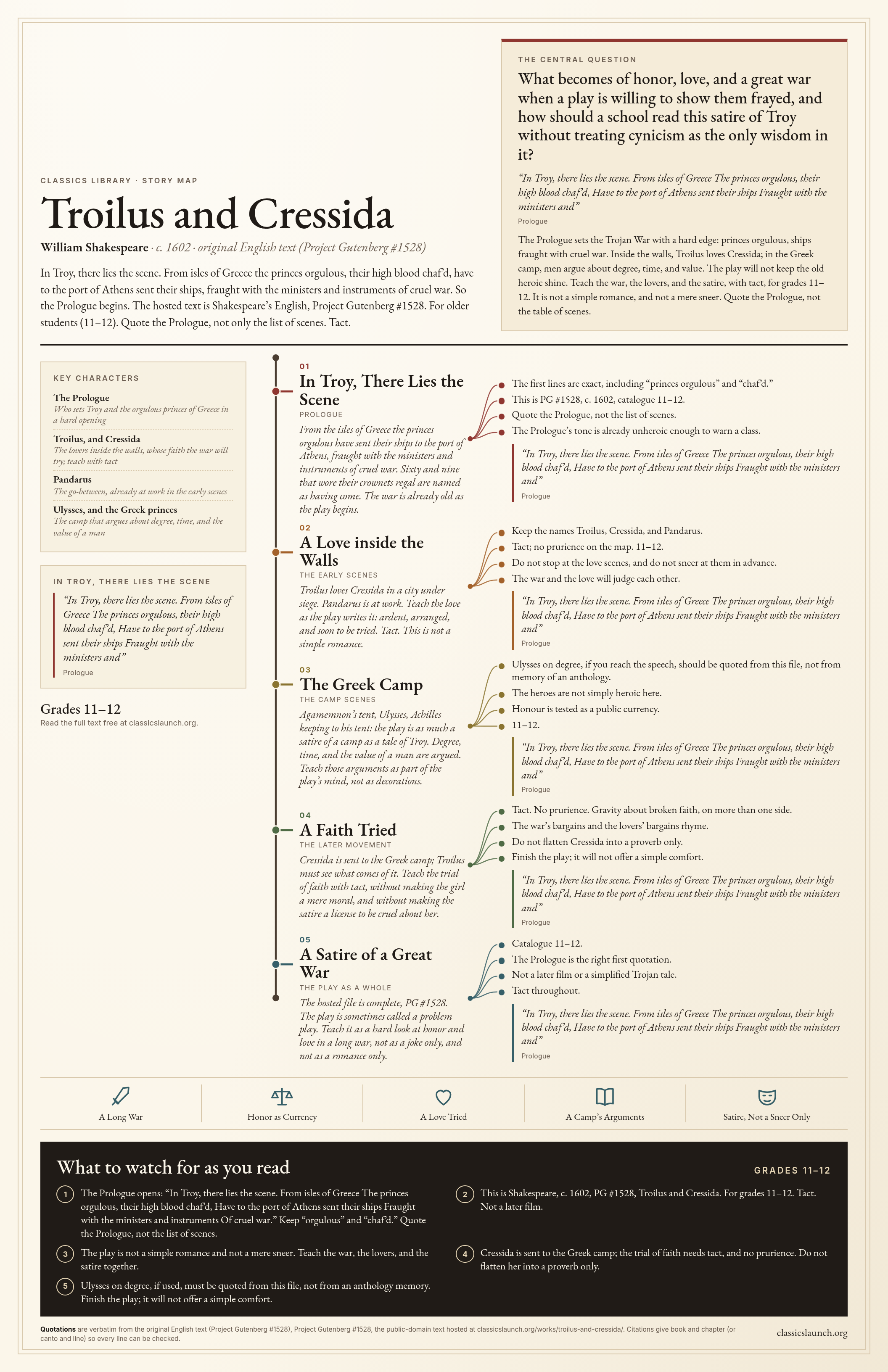
In Troy, there lies the scene. From isles of Greece the princes orgulous, their high blood chaf’d, have to the port of Athens sent their ships, fraught with the ministers and instruments of cruel war. So the Prologue begins. The hosted text is Shakespeare’s English, Project Gutenberg #1528. For older students (11–12). Quote the Prologue, not only the list of scenes. Tact.
The central question
What becomes of honor, love, and a great war when a play is willing to show them frayed, and how should a school read this satire of Troy without treating cynicism as the only wisdom in it?
“In Troy, there lies the scene. From isles of Greece The princes orgulous, their high blood chaf’d, Have to the port of Athens sent their ships Fraught with the ministers and”
The Prologue sets the Trojan War with a hard edge: princes orgulous, ships fraught with cruel war. Inside the walls, Troilus loves Cressida; in the Greek camp, men argue about degree, time, and value. The play will not keep the old heroic shine. Teach the war, the lovers, and the satire, with tact, for grades 11–12. It is not a simple romance, and not a mere sneer. Quote the Prologue, not the table of scenes.
- 01
In Troy, There Lies the Scene
Prologue
From the isles of Greece the princes orgulous have sent their ships to the port of Athens, fraught with the ministers and instruments of cruel war. Sixty and nine that wore their crownets regal are named as having come. The war is already old as the play begins.
- The first lines are exact, including “princes orgulous” and “chaf’d.”
- This is PG #1528, c. 1602, catalogue 11–12.
- Quote the Prologue, not the list of scenes.
- The Prologue’s tone is already unheroic enough to warn a class.
“In Troy, there lies the scene. From isles of Greece The princes orgulous, their high blood chaf’d, Have to the port of Athens sent their ships Fraught with the ministers and”
- 02
A Love inside the Walls
The early scenes
Troilus loves Cressida in a city under siege. Pandarus is at work. Teach the love as the play writes it: ardent, arranged, and soon to be tried. Tact. This is not a simple romance.
- Keep the names Troilus, Cressida, and Pandarus.
- Tact; no prurience on the map. 11–12.
- Do not stop at the love scenes, and do not sneer at them in advance.
- The war and the love will judge each other.
“In Troy, there lies the scene. From isles of Greece The princes orgulous, their high blood chaf’d, Have to the port of Athens sent their ships Fraught with the ministers and”
- 03
The Greek Camp
The camp scenes
Agamemnon’s tent, Ulysses, Achilles keeping to his tent: the play is as much a satire of a camp as a tale of Troy. Degree, time, and the value of a man are argued. Teach those arguments as part of the play’s mind, not as decorations.
- Ulysses on degree, if you reach the speech, should be quoted from this file, not from memory of an anthology.
- The heroes are not simply heroic here.
- Honour is tested as a public currency.
- 11–12.
“In Troy, there lies the scene. From isles of Greece The princes orgulous, their high blood chaf’d, Have to the port of Athens sent their ships Fraught with the ministers and”
- 04
A Faith Tried
The later movement
Cressida is sent to the Greek camp; Troilus must see what comes of it. Teach the trial of faith with tact, without making the girl a mere moral, and without making the satire a license to be cruel about her.
- Tact. No prurience. Gravity about broken faith, on more than one side.
- The war’s bargains and the lovers’ bargains rhyme.
- Do not flatten Cressida into a proverb only.
- Finish the play; it will not offer a simple comfort.
“In Troy, there lies the scene. From isles of Greece The princes orgulous, their high blood chaf’d, Have to the port of Athens sent their ships Fraught with the ministers and”
- 05
A Satire of a Great War
The play as a whole
The hosted file is complete, PG #1528. The play is sometimes called a problem play. Teach it as a hard look at honor and love in a long war, not as a joke only, and not as a romance only.
- Catalogue 11–12.
- The Prologue is the right first quotation.
- Not a later film or a simplified Trojan tale.
- Tact throughout.
“In Troy, there lies the scene. From isles of Greece The princes orgulous, their high blood chaf’d, Have to the port of Athens sent their ships Fraught with the ministers and”
- A Long War
- Honor as Currency
- A Love Tried
- A Camp’s Arguments
- Satire, Not a Sneer Only
What to watch for as you read
Grades 11–12- The Prologue opens: “In Troy, there lies the scene. From isles of Greece The princes orgulous, their high blood chaf’d, Have to the port of Athens sent their ships Fraught with the ministers and instruments Of cruel war.” Keep “orgulous” and “chaf’d.” Quote the Prologue, not the list of scenes.
- This is Shakespeare, c. 1602, PG #1528, Troilus and Cressida. For grades 11–12. Tact. Not a later film.
- The play is not a simple romance and not a mere sneer. Teach the war, the lovers, and the satire together.
- Cressida is sent to the Greek camp; the trial of faith needs tact, and no prurience. Do not flatten her into a proverb only.
- Ulysses on degree, if used, must be quoted from this file, not from an anthology memory. Finish the play; it will not offer a simple comfort.
Every quotation is word for word from the original English text (Project Gutenberg #1528) hosted in this library and is checked against that text each time the site is built. Citations give book and chapter (or canto and line).