Story maps · Grades 10–12
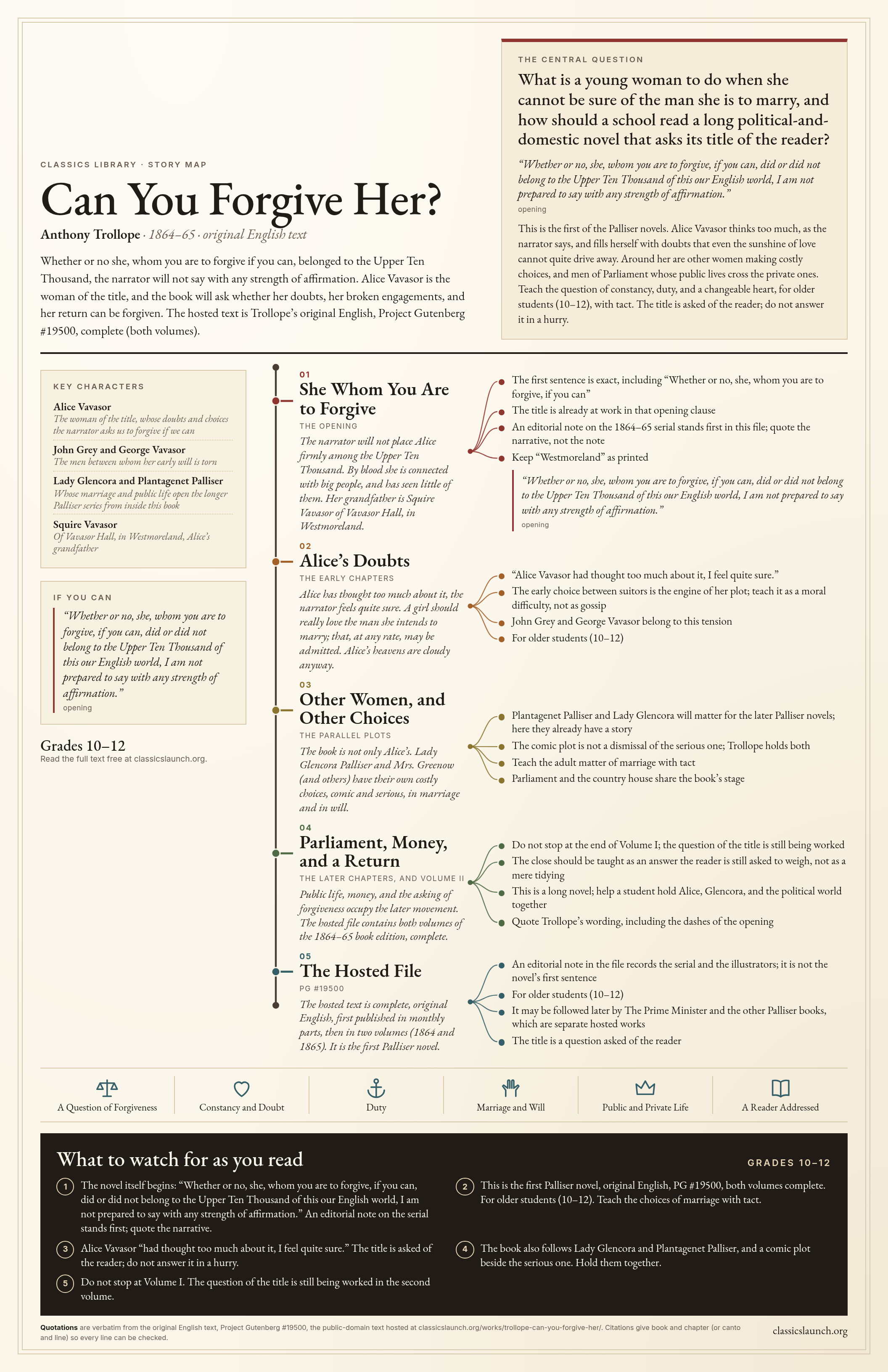
Can You Forgive Her?: A Story Map
The PDF is one tabloid page (11 × 17 in). On letter paper, choose “Fit to page.”
Whether or no she, whom you are to forgive if you can, belonged to the Upper Ten Thousand, the narrator will not say with any strength of affirmation. Alice Vavasor is the woman of the title, and the book will ask whether her doubts, her broken engagements, and her return can be forgiven. The hosted text is Trollope’s original English, Project Gutenberg #19500, complete (both volumes).
The central question
What is a young woman to do when she cannot be sure of the man she is to marry, and how should a school read a long political-and-domestic novel that asks its title of the reader?
“Whether or no, she, whom you are to forgive, if you can, did or did not belong to the Upper Ten Thousand of this our English world, I am not prepared to say with any strength of affirmation.”
This is the first of the Palliser novels. Alice Vavasor thinks too much, as the narrator says, and fills herself with doubts that even the sunshine of love cannot quite drive away. Around her are other women making costly choices, and men of Parliament whose public lives cross the private ones. Teach the question of constancy, duty, and a changeable heart, for older students (10–12), with tact. The title is asked of the reader; do not answer it in a hurry.
- 01
She Whom You Are to Forgive
The opening
The narrator will not place Alice firmly among the Upper Ten Thousand. By blood she is connected with big people, and has seen little of them. Her grandfather is Squire Vavasor of Vavasor Hall, in Westmoreland.
- The first sentence is exact, including “Whether or no, she, whom you are to forgive, if you can”
- The title is already at work in that opening clause
- An editorial note on the 1864–65 serial stands first in this file; quote the narrative, not the note
- Keep “Westmoreland” as printed
“Whether or no, she, whom you are to forgive, if you can, did or did not belong to the Upper Ten Thousand of this our English world, I am not prepared to say with any strength of affirmation.”
- 02
Alice’s Doubts
The early chapters
Alice has thought too much about it, the narrator feels quite sure. A girl should really love the man she intends to marry; that, at any rate, may be admitted. Alice’s heavens are cloudy anyway.
- “Alice Vavasor had thought too much about it, I feel quite sure.”
- The early choice between suitors is the engine of her plot; teach it as a moral difficulty, not as gossip
- John Grey and George Vavasor belong to this tension
- For older students (10–12)
- 03
Other Women, and Other Choices
The parallel plots
The book is not only Alice’s. Lady Glencora Palliser and Mrs. Greenow (and others) have their own costly choices, comic and serious, in marriage and in will.
- Plantagenet Palliser and Lady Glencora will matter for the later Palliser novels; here they already have a story
- The comic plot is not a dismissal of the serious one; Trollope holds both
- Teach the adult matter of marriage with tact
- Parliament and the country house share the book’s stage
- 04
Parliament, Money, and a Return
The later chapters, and Volume II
Public life, money, and the asking of forgiveness occupy the later movement. The hosted file contains both volumes of the 1864–65 book edition, complete.
- Do not stop at the end of Volume I; the question of the title is still being worked
- The close should be taught as an answer the reader is still asked to weigh, not as a mere tidying
- This is a long novel; help a student hold Alice, Glencora, and the political world together
- Quote Trollope’s wording, including the dashes of the opening
- 05
The Hosted File
PG #19500
The hosted text is complete, original English, first published in monthly parts, then in two volumes (1864 and 1865). It is the first Palliser novel.
- An editorial note in the file records the serial and the illustrators; it is not the novel’s first sentence
- For older students (10–12)
- It may be followed later by The Prime Minister and the other Palliser books, which are separate hosted works
- The title is a question asked of the reader
- A Question of Forgiveness
- Constancy and Doubt
- Duty
- Marriage and Will
- Public and Private Life
- A Reader Addressed
What to watch for as you read
Grades 10–12- The novel itself begins: “Whether or no, she, whom you are to forgive, if you can, did or did not belong to the Upper Ten Thousand of this our English world, I am not prepared to say with any strength of affirmation.” An editorial note on the serial stands first; quote the narrative.
- This is the first Palliser novel, original English, PG #19500, both volumes complete. For older students (10–12). Teach the choices of marriage with tact.
- Alice Vavasor “had thought too much about it, I feel quite sure.” The title is asked of the reader; do not answer it in a hurry.
- The book also follows Lady Glencora and Plantagenet Palliser, and a comic plot beside the serious one. Hold them together.
- Do not stop at Volume I. The question of the title is still being worked in the second volume.
Every quotation is word for word from the original English text hosted in this library and is checked against that text each time the site is built. Citations give book and chapter (or canto and line).