Story maps · Grades 10–12
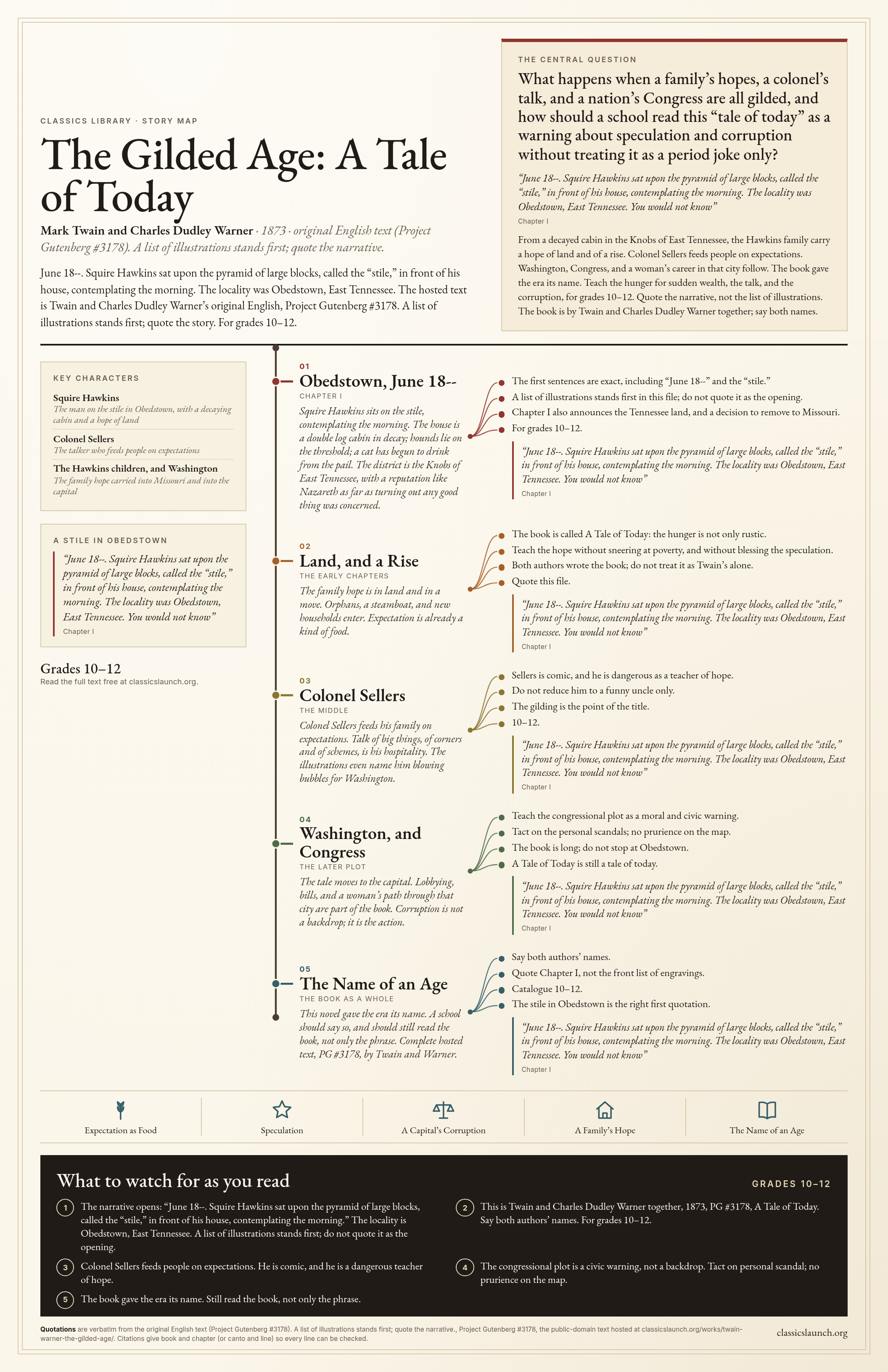
The Gilded Age: A Tale of Today: A Story Map
The PDF is one tabloid page (11 × 17 in). On letter paper, choose “Fit to page.”
June 18--. Squire Hawkins sat upon the pyramid of large blocks, called the “stile,” in front of his house, contemplating the morning. The locality was Obedstown, East Tennessee. The hosted text is Twain and Charles Dudley Warner’s original English, Project Gutenberg #3178. A list of illustrations stands first; quote the story. For grades 10–12.
The central question
What happens when a family’s hopes, a colonel’s talk, and a nation’s Congress are all gilded, and how should a school read this “tale of today” as a warning about speculation and corruption without treating it as a period joke only?
“June 18--. Squire Hawkins sat upon the pyramid of large blocks, called the “stile,” in front of his house, contemplating the morning. The locality was Obedstown, East Tennessee. You would not know”
From a decayed cabin in the Knobs of East Tennessee, the Hawkins family carry a hope of land and of a rise. Colonel Sellers feeds people on expectations. Washington, Congress, and a woman’s career in that city follow. The book gave the era its name. Teach the hunger for sudden wealth, the talk, and the corruption, for grades 10–12. Quote the narrative, not the list of illustrations. The book is by Twain and Charles Dudley Warner together; say both names.
- 01
Obedstown, June 18--
Chapter I
Squire Hawkins sits on the stile, contemplating the morning. The house is a double log cabin in decay; hounds lie on the threshold; a cat has begun to drink from the pail. The district is the Knobs of East Tennessee, with a reputation like Nazareth as far as turning out any good thing was concerned.
- The first sentences are exact, including “June 18--” and the “stile.”
- A list of illustrations stands first in this file; do not quote it as the opening.
- Chapter I also announces the Tennessee land, and a decision to remove to Missouri.
- For grades 10–12.
“June 18--. Squire Hawkins sat upon the pyramid of large blocks, called the “stile,” in front of his house, contemplating the morning. The locality was Obedstown, East Tennessee. You would not know”
- 02
Land, and a Rise
The early chapters
The family hope is in land and in a move. Orphans, a steamboat, and new households enter. Expectation is already a kind of food.
- The book is called A Tale of Today: the hunger is not only rustic.
- Teach the hope without sneering at poverty, and without blessing the speculation.
- Both authors wrote the book; do not treat it as Twain’s alone.
- Quote this file.
“June 18--. Squire Hawkins sat upon the pyramid of large blocks, called the “stile,” in front of his house, contemplating the morning. The locality was Obedstown, East Tennessee. You would not know”
- 03
Colonel Sellers
The middle
Colonel Sellers feeds his family on expectations. Talk of big things, of corners and of schemes, is his hospitality. The illustrations even name him blowing bubbles for Washington.
- Sellers is comic, and he is dangerous as a teacher of hope.
- Do not reduce him to a funny uncle only.
- The gilding is the point of the title.
- 10–12.
“June 18--. Squire Hawkins sat upon the pyramid of large blocks, called the “stile,” in front of his house, contemplating the morning. The locality was Obedstown, East Tennessee. You would not know”
- 04
Washington, and Congress
The later plot
The tale moves to the capital. Lobbying, bills, and a woman’s path through that city are part of the book. Corruption is not a backdrop; it is the action.
- Teach the congressional plot as a moral and civic warning.
- Tact on the personal scandals; no prurience on the map.
- The book is long; do not stop at Obedstown.
- A Tale of Today is still a tale of today.
“June 18--. Squire Hawkins sat upon the pyramid of large blocks, called the “stile,” in front of his house, contemplating the morning. The locality was Obedstown, East Tennessee. You would not know”
- 05
The Name of an Age
The book as a whole
This novel gave the era its name. A school should say so, and should still read the book, not only the phrase. Complete hosted text, PG #3178, by Twain and Warner.
- Say both authors’ names.
- Quote Chapter I, not the front list of engravings.
- Catalogue 10–12.
- The stile in Obedstown is the right first quotation.
“June 18--. Squire Hawkins sat upon the pyramid of large blocks, called the “stile,” in front of his house, contemplating the morning. The locality was Obedstown, East Tennessee. You would not know”
- Expectation as Food
- Speculation
- A Capital’s Corruption
- A Family’s Hope
- The Name of an Age
What to watch for as you read
Grades 10–12- The narrative opens: “June 18--. Squire Hawkins sat upon the pyramid of large blocks, called the “stile,” in front of his house, contemplating the morning.” The locality is Obedstown, East Tennessee. A list of illustrations stands first; do not quote it as the opening.
- This is Twain and Charles Dudley Warner together, 1873, PG #3178, A Tale of Today. Say both authors’ names. For grades 10–12.
- Colonel Sellers feeds people on expectations. He is comic, and he is a dangerous teacher of hope.
- The congressional plot is a civic warning, not a backdrop. Tact on personal scandal; no prurience on the map.
- The book gave the era its name. Still read the book, not only the phrase.
Every quotation is word for word from the original English text (Project Gutenberg #3178). A list of illustrations stands first; quote the narrative. hosted in this library and is checked against that text each time the site is built. Citations give book and chapter (or canto and line).