Story maps · Grades 9–12
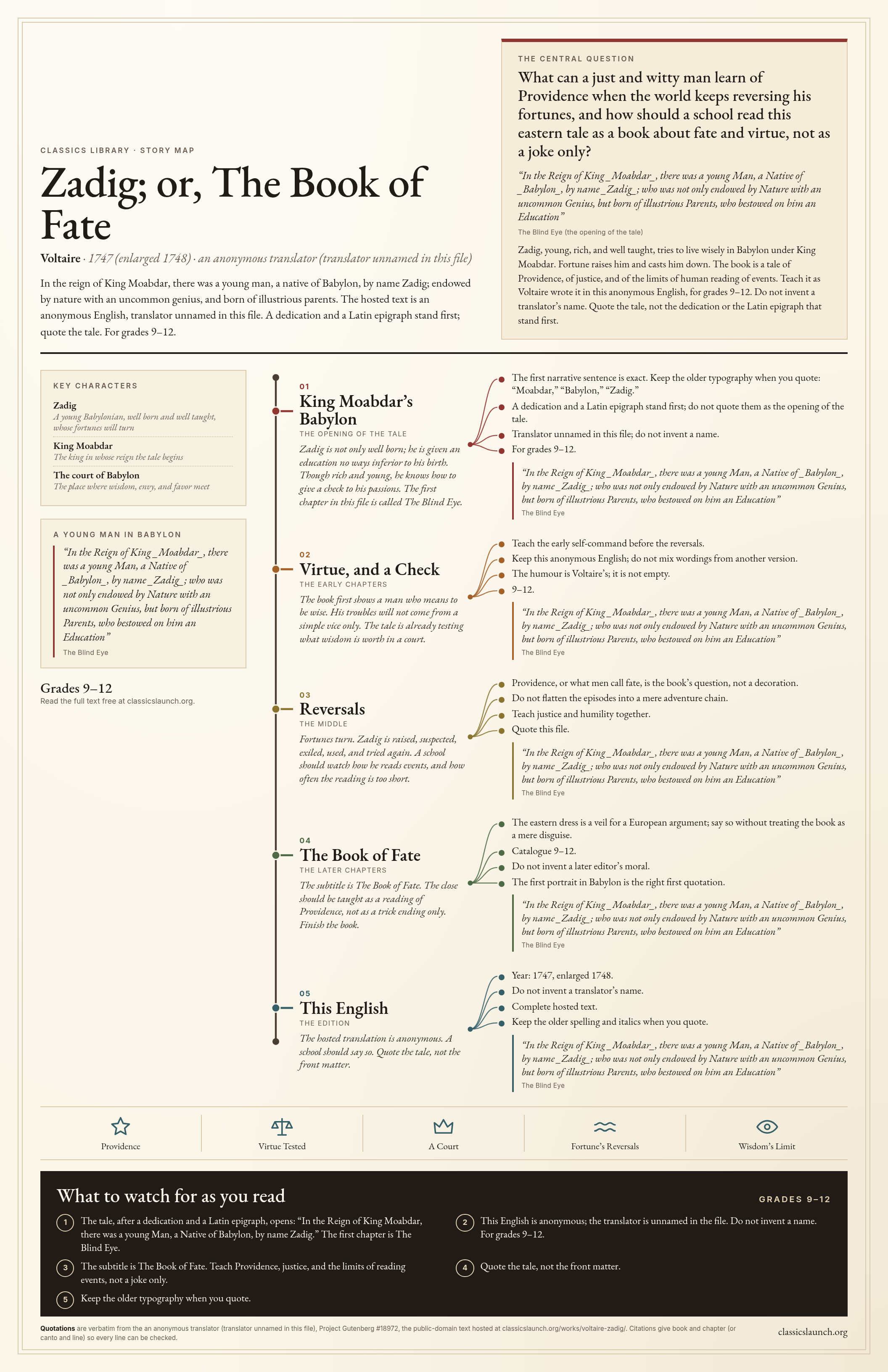
Zadig; or, The Book of Fate: A Story Map
The PDF is one tabloid page (11 × 17 in). On letter paper, choose “Fit to page.”
In the reign of King Moabdar, there was a young man, a native of Babylon, by name Zadig; endowed by nature with an uncommon genius, and born of illustrious parents. The hosted text is an anonymous English, translator unnamed in this file. A dedication and a Latin epigraph stand first; quote the tale. For grades 9–12.
The central question
What can a just and witty man learn of Providence when the world keeps reversing his fortunes, and how should a school read this eastern tale as a book about fate and virtue, not as a joke only?
“In the Reign of King _Moabdar_, there was a young Man, a Native of _Babylon_, by name _Zadig_; who was not only endowed by Nature with an uncommon Genius, but born of illustrious Parents, who bestowed on him an Education”
Zadig, young, rich, and well taught, tries to live wisely in Babylon under King Moabdar. Fortune raises him and casts him down. The book is a tale of Providence, of justice, and of the limits of human reading of events. Teach it as Voltaire wrote it in this anonymous English, for grades 9–12. Do not invent a translator’s name. Quote the tale, not the dedication or the Latin epigraph that stand first.
- 01
King Moabdar’s Babylon
The opening of the tale
Zadig is not only well born; he is given an education no ways inferior to his birth. Though rich and young, he knows how to give a check to his passions. The first chapter in this file is called The Blind Eye.
- The first narrative sentence is exact. Keep the older typography when you quote: “Moabdar,” “Babylon,” “Zadig.”
- A dedication and a Latin epigraph stand first; do not quote them as the opening of the tale.
- Translator unnamed in this file; do not invent a name.
- For grades 9–12.
“In the Reign of King _Moabdar_, there was a young Man, a Native of _Babylon_, by name _Zadig_; who was not only endowed by Nature with an uncommon Genius, but born of illustrious Parents, who bestowed on him an Education”
- 02
Virtue, and a Check
The early chapters
The book first shows a man who means to be wise. His troubles will not come from a simple vice only. The tale is already testing what wisdom is worth in a court.
- Teach the early self-command before the reversals.
- Keep this anonymous English; do not mix wordings from another version.
- The humour is Voltaire’s; it is not empty.
- 9–12.
“In the Reign of King _Moabdar_, there was a young Man, a Native of _Babylon_, by name _Zadig_; who was not only endowed by Nature with an uncommon Genius, but born of illustrious Parents, who bestowed on him an Education”
- 03
Reversals
The middle
Fortunes turn. Zadig is raised, suspected, exiled, used, and tried again. A school should watch how he reads events, and how often the reading is too short.
- Providence, or what men call fate, is the book’s question, not a decoration.
- Do not flatten the episodes into a mere adventure chain.
- Teach justice and humility together.
- Quote this file.
“In the Reign of King _Moabdar_, there was a young Man, a Native of _Babylon_, by name _Zadig_; who was not only endowed by Nature with an uncommon Genius, but born of illustrious Parents, who bestowed on him an Education”
- 04
The Book of Fate
The later chapters
The subtitle is The Book of Fate. The close should be taught as a reading of Providence, not as a trick ending only. Finish the book.
- The eastern dress is a veil for a European argument; say so without treating the book as a mere disguise.
- Catalogue 9–12.
- Do not invent a later editor’s moral.
- The first portrait in Babylon is the right first quotation.
“In the Reign of King _Moabdar_, there was a young Man, a Native of _Babylon_, by name _Zadig_; who was not only endowed by Nature with an uncommon Genius, but born of illustrious Parents, who bestowed on him an Education”
- 05
This English
The edition
The hosted translation is anonymous. A school should say so. Quote the tale, not the front matter.
- Year: 1747, enlarged 1748.
- Do not invent a translator’s name.
- Complete hosted text.
- Keep the older spelling and italics when you quote.
“In the Reign of King _Moabdar_, there was a young Man, a Native of _Babylon_, by name _Zadig_; who was not only endowed by Nature with an uncommon Genius, but born of illustrious Parents, who bestowed on him an Education”
- Providence
- Virtue Tested
- A Court
- Fortune’s Reversals
- Wisdom’s Limit
What to watch for as you read
Grades 9–12- The tale, after a dedication and a Latin epigraph, opens: “In the Reign of King Moabdar, there was a young Man, a Native of Babylon, by name Zadig.” The first chapter is The Blind Eye.
- This English is anonymous; the translator is unnamed in the file. Do not invent a name. For grades 9–12.
- The subtitle is The Book of Fate. Teach Providence, justice, and the limits of reading events, not a joke only.
- Quote the tale, not the front matter.
- Keep the older typography when you quote.
Every quotation is word for word from the an anonymous translator (translator unnamed in this file) hosted in this library and is checked against that text each time the site is built. Citations give book and chapter (or canto and line).