Story maps · Grades 9–12
The Castle of Otranto: A Story Map
The PDF is one tabloid page (11 × 17 in). On letter paper, choose “Fit to page.”
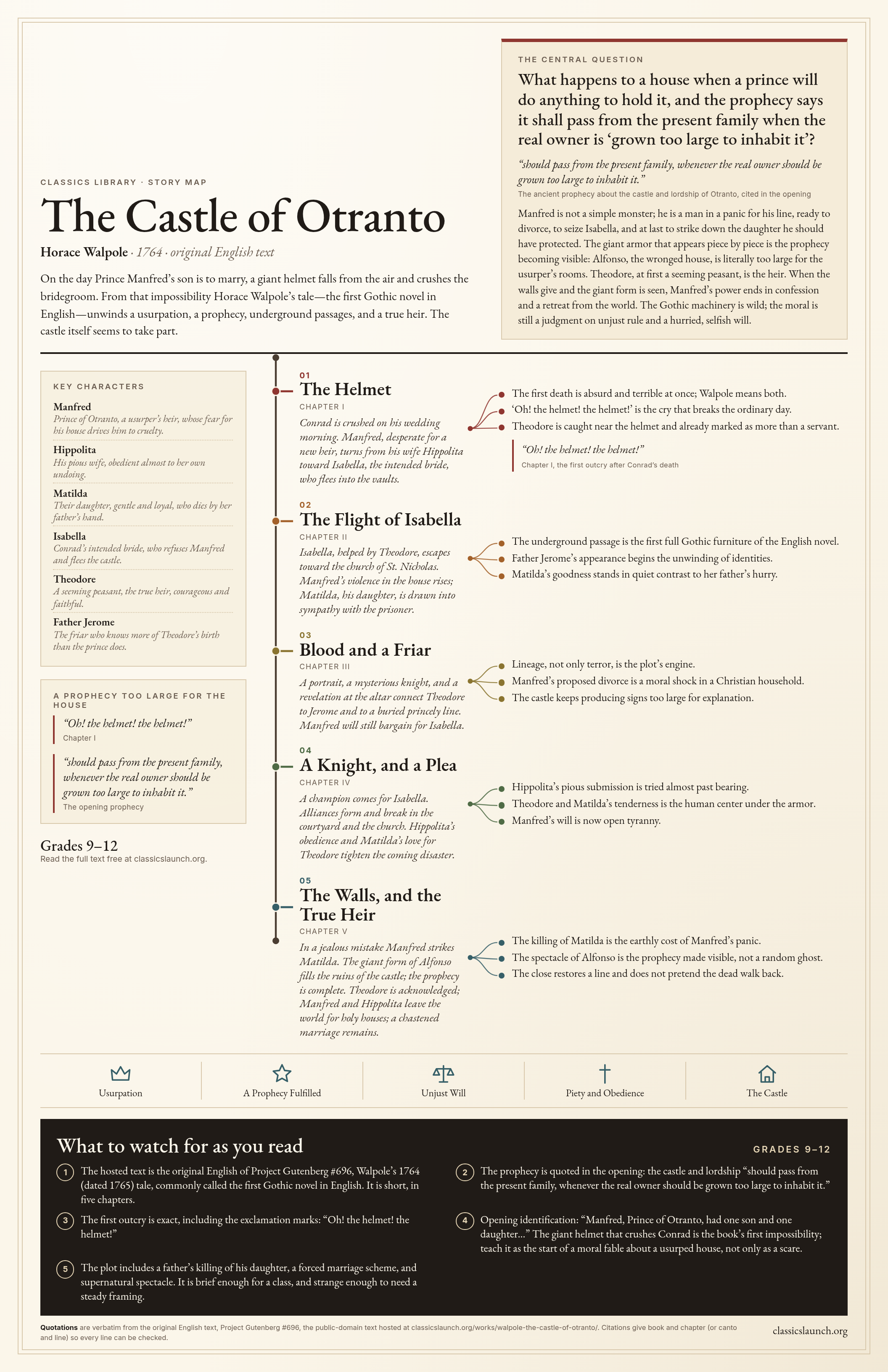
On the day Prince Manfred’s son is to marry, a giant helmet falls from the air and crushes the bridegroom. From that impossibility Horace Walpole’s tale—the first Gothic novel in English—unwinds a usurpation, a prophecy, underground passages, and a true heir. The castle itself seems to take part.
The central question
What happens to a house when a prince will do anything to hold it, and the prophecy says it shall pass from the present family when the real owner is ‘grown too large to inhabit it’?
“should pass from the present family, whenever the real owner should be grown too large to inhabit it.”
Manfred is not a simple monster; he is a man in a panic for his line, ready to divorce, to seize Isabella, and at last to strike down the daughter he should have protected. The giant armor that appears piece by piece is the prophecy becoming visible: Alfonso, the wronged house, is literally too large for the usurper’s rooms. Theodore, at first a seeming peasant, is the heir. When the walls give and the giant form is seen, Manfred’s power ends in confession and a retreat from the world. The Gothic machinery is wild; the moral is still a judgment on unjust rule and a hurried, selfish will.
- 01
The Helmet
Chapter I
Conrad is crushed on his wedding morning. Manfred, desperate for a new heir, turns from his wife Hippolita toward Isabella, the intended bride, who flees into the vaults.
- The first death is absurd and terrible at once; Walpole means both.
- ‘Oh! the helmet! the helmet!’ is the cry that breaks the ordinary day.
- Theodore is caught near the helmet and already marked as more than a servant.
“Oh! the helmet! the helmet!”
- 02
The Flight of Isabella
Chapter II
Isabella, helped by Theodore, escapes toward the church of St. Nicholas. Manfred’s violence in the house rises; Matilda, his daughter, is drawn into sympathy with the prisoner.
- The underground passage is the first full Gothic furniture of the English novel.
- Father Jerome’s appearance begins the unwinding of identities.
- Matilda’s goodness stands in quiet contrast to her father’s hurry.
- 03
Blood and a Friar
Chapter III
A portrait, a mysterious knight, and a revelation at the altar connect Theodore to Jerome and to a buried princely line. Manfred will still bargain for Isabella.
- Lineage, not only terror, is the plot’s engine.
- Manfred’s proposed divorce is a moral shock in a Christian household.
- The castle keeps producing signs too large for explanation.
- 04
A Knight, and a Plea
Chapter IV
A champion comes for Isabella. Alliances form and break in the courtyard and the church. Hippolita’s obedience and Matilda’s love for Theodore tighten the coming disaster.
- Hippolita’s pious submission is tried almost past bearing.
- Theodore and Matilda’s tenderness is the human center under the armor.
- Manfred’s will is now open tyranny.
- 05
The Walls, and the True Heir
Chapter V
In a jealous mistake Manfred strikes Matilda. The giant form of Alfonso fills the ruins of the castle; the prophecy is complete. Theodore is acknowledged; Manfred and Hippolita leave the world for holy houses; a chastened marriage remains.
- The killing of Matilda is the earthly cost of Manfred’s panic.
- The spectacle of Alfonso is the prophecy made visible, not a random ghost.
- The close restores a line and does not pretend the dead walk back.
- Usurpation
- A Prophecy Fulfilled
- Unjust Will
- Piety and Obedience
- The Castle
What to watch for as you read
Grades 9–12- The hosted text is the original English of Project Gutenberg #696, Walpole’s 1764 (dated 1765) tale, commonly called the first Gothic novel in English. It is short, in five chapters.
- The prophecy is quoted in the opening: the castle and lordship “should pass from the present family, whenever the real owner should be grown too large to inhabit it.”
- The first outcry is exact, including the exclamation marks: “Oh! the helmet! the helmet!”
- Opening identification: “Manfred, Prince of Otranto, had one son and one daughter…” The giant helmet that crushes Conrad is the book’s first impossibility; teach it as the start of a moral fable about a usurped house, not only as a scare.
- The plot includes a father’s killing of his daughter, a forced marriage scheme, and supernatural spectacle. It is brief enough for a class, and strange enough to need a steady framing.
Every quotation is word for word from the original English text hosted in this library and is checked against that text each time the site is built. Citations give book and chapter (or canto and line).