Story maps · Grades 11–12
Washington Square: A Story Map
The PDF is one tabloid page (11 × 17 in). On letter paper, choose “Fit to page.”
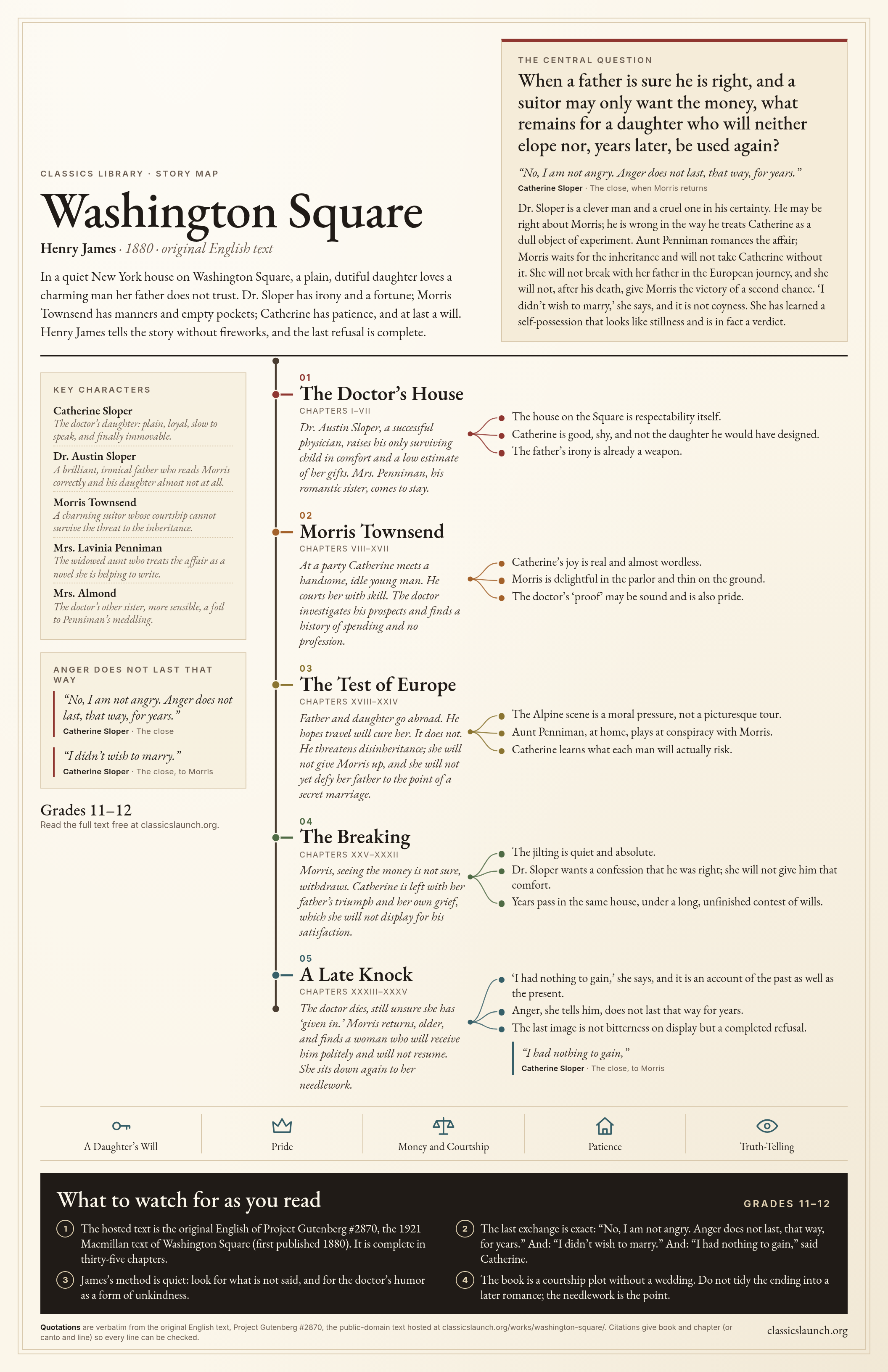
In a quiet New York house on Washington Square, a plain, dutiful daughter loves a charming man her father does not trust. Dr. Sloper has irony and a fortune; Morris Townsend has manners and empty pockets; Catherine has patience, and at last a will. Henry James tells the story without fireworks, and the last refusal is complete.
The central question
When a father is sure he is right, and a suitor may only want the money, what remains for a daughter who will neither elope nor, years later, be used again?
“No, I am not angry. Anger does not last, that way, for years.”
Dr. Sloper is a clever man and a cruel one in his certainty. He may be right about Morris; he is wrong in the way he treats Catherine as a dull object of experiment. Aunt Penniman romances the affair; Morris waits for the inheritance and will not take Catherine without it. She will not break with her father in the European journey, and she will not, after his death, give Morris the victory of a second chance. ‘I didn’t wish to marry,’ she says, and it is not coyness. She has learned a self-possession that looks like stillness and is in fact a verdict.
- 01
The Doctor’s House
Chapters I–VII
Dr. Austin Sloper, a successful physician, raises his only surviving child in comfort and a low estimate of her gifts. Mrs. Penniman, his romantic sister, comes to stay.
- The house on the Square is respectability itself.
- Catherine is good, shy, and not the daughter he would have designed.
- The father’s irony is already a weapon.
- 02
Morris Townsend
Chapters VIII–XVII
At a party Catherine meets a handsome, idle young man. He courts her with skill. The doctor investigates his prospects and finds a history of spending and no profession.
- Catherine’s joy is real and almost wordless.
- Morris is delightful in the parlor and thin on the ground.
- The doctor’s ‘proof’ may be sound and is also pride.
- 03
The Test of Europe
Chapters XVIII–XXIV
Father and daughter go abroad. He hopes travel will cure her. It does not. He threatens disinheritance; she will not give Morris up, and she will not yet defy her father to the point of a secret marriage.
- The Alpine scene is a moral pressure, not a picturesque tour.
- Aunt Penniman, at home, plays at conspiracy with Morris.
- Catherine learns what each man will actually risk.
- 04
The Breaking
Chapters XXV–XXXII
Morris, seeing the money is not sure, withdraws. Catherine is left with her father’s triumph and her own grief, which she will not display for his satisfaction.
- The jilting is quiet and absolute.
- Dr. Sloper wants a confession that he was right; she will not give him that comfort.
- Years pass in the same house, under a long, unfinished contest of wills.
- 05
A Late Knock
Chapters XXXIII–XXXV
The doctor dies, still unsure she has ‘given in.’ Morris returns, older, and finds a woman who will receive him politely and will not resume. She sits down again to her needlework.
- ‘I had nothing to gain,’ she says, and it is an account of the past as well as the present.
- Anger, she tells him, does not last that way for years.
- The last image is not bitterness on display but a completed refusal.
“I had nothing to gain,”
- A Daughter’s Will
- Pride
- Money and Courtship
- Patience
- Truth-Telling
What to watch for as you read
Grades 11–12- The hosted text is the original English of Project Gutenberg #2870, the 1921 Macmillan text of Washington Square (first published 1880). It is complete in thirty-five chapters.
- The last exchange is exact: “No, I am not angry. Anger does not last, that way, for years.” And: “I didn’t wish to marry.” And: “I had nothing to gain,” said Catherine.
- James’s method is quiet: look for what is not said, and for the doctor’s humor as a form of unkindness.
- The book is a courtship plot without a wedding. Do not tidy the ending into a later romance; the needlework is the point.
Every quotation is word for word from the original English text hosted in this library and is checked against that text each time the site is built. Citations give book and chapter (or canto and line).