Story maps · Grades 10–12
The House of Mirth: A Story Map
The PDF is one tabloid page (11 × 17 in). On letter paper, choose “Fit to page.”
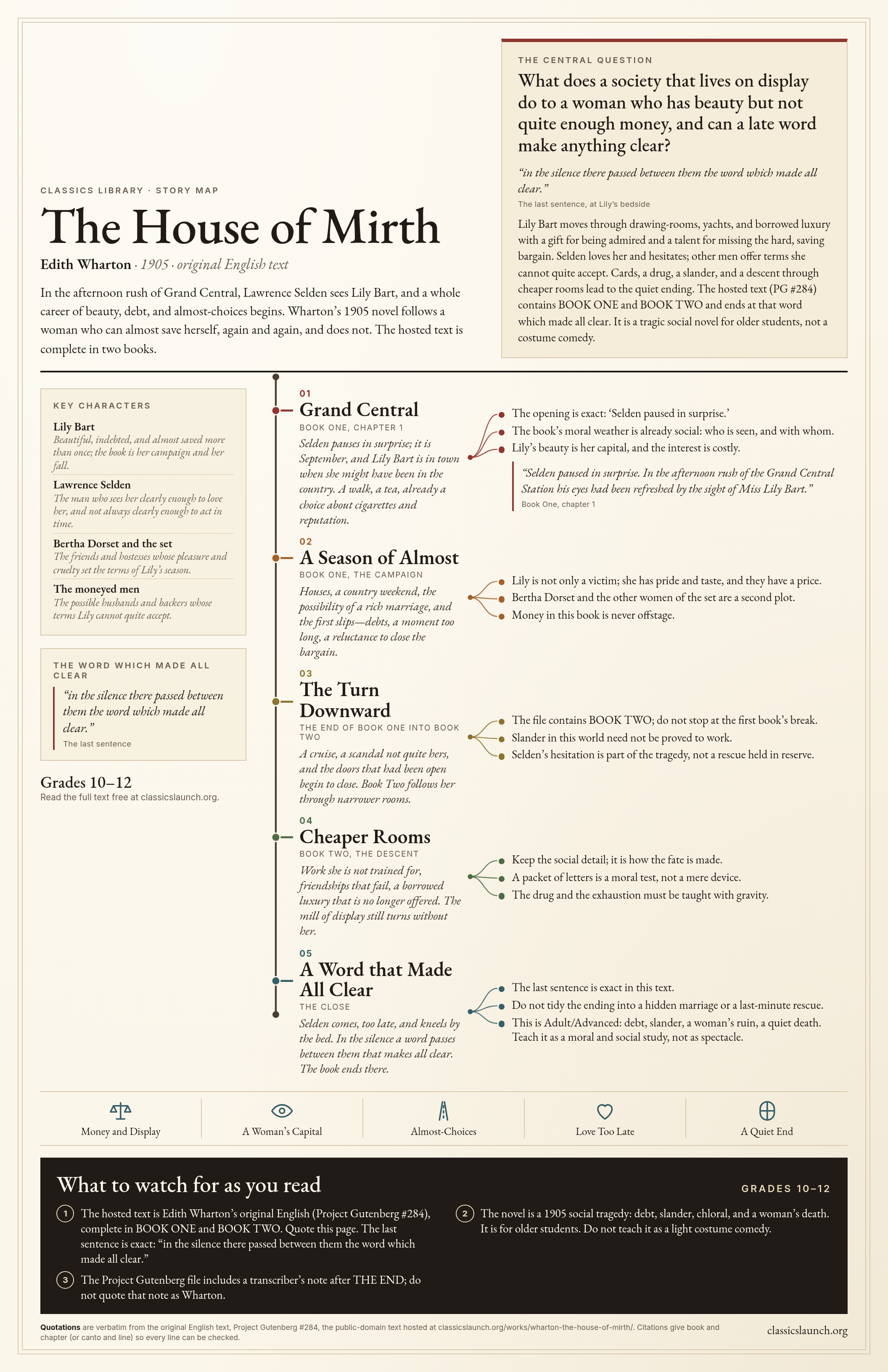
In the afternoon rush of Grand Central, Lawrence Selden sees Lily Bart, and a whole career of beauty, debt, and almost-choices begins. Wharton’s 1905 novel follows a woman who can almost save herself, again and again, and does not. The hosted text is complete in two books.
The central question
What does a society that lives on display do to a woman who has beauty but not quite enough money, and can a late word make anything clear?
“in the silence there passed between them the word which made all clear.”
Lily Bart moves through drawing-rooms, yachts, and borrowed luxury with a gift for being admired and a talent for missing the hard, saving bargain. Selden loves her and hesitates; other men offer terms she cannot quite accept. Cards, a drug, a slander, and a descent through cheaper rooms lead to the quiet ending. The hosted text (PG #284) contains BOOK ONE and BOOK TWO and ends at that word which made all clear. It is a tragic social novel for older students, not a costume comedy.
- 01
Grand Central
Book One, chapter 1
Selden pauses in surprise; it is September, and Lily Bart is in town when she might have been in the country. A walk, a tea, already a choice about cigarettes and reputation.
- The opening is exact: ‘Selden paused in surprise.’
- The book’s moral weather is already social: who is seen, and with whom.
- Lily’s beauty is her capital, and the interest is costly.
“Selden paused in surprise. In the afternoon rush of the Grand Central Station his eyes had been refreshed by the sight of Miss Lily Bart.”
- 02
A Season of Almost
Book One, the campaign
Houses, a country weekend, the possibility of a rich marriage, and the first slips—debts, a moment too long, a reluctance to close the bargain.
- Lily is not only a victim; she has pride and taste, and they have a price.
- Bertha Dorset and the other women of the set are a second plot.
- Money in this book is never offstage.
- 03
The Turn Downward
The end of Book One into Book Two
A cruise, a scandal not quite hers, and the doors that had been open begin to close. Book Two follows her through narrower rooms.
- The file contains BOOK TWO; do not stop at the first book’s break.
- Slander in this world need not be proved to work.
- Selden’s hesitation is part of the tragedy, not a rescue held in reserve.
- 04
Cheaper Rooms
Book Two, the descent
Work she is not trained for, friendships that fail, a borrowed luxury that is no longer offered. The mill of display still turns without her.
- Keep the social detail; it is how the fate is made.
- A packet of letters is a moral test, not a mere device.
- The drug and the exhaustion must be taught with gravity.
- 05
A Word that Made All Clear
The close
Selden comes, too late, and kneels by the bed. In the silence a word passes between them that makes all clear. The book ends there.
- The last sentence is exact in this text.
- Do not tidy the ending into a hidden marriage or a last-minute rescue.
- This is Adult/Advanced: debt, slander, a woman’s ruin, a quiet death. Teach it as a moral and social study, not as spectacle.
- Money and Display
- A Woman’s Capital
- Almost-Choices
- Love Too Late
- A Quiet End
What to watch for as you read
Grades 10–12- The hosted text is Edith Wharton’s original English (Project Gutenberg #284), complete in BOOK ONE and BOOK TWO. Quote this page. The last sentence is exact: “in the silence there passed between them the word which made all clear.”
- The novel is a 1905 social tragedy: debt, slander, chloral, and a woman’s death. It is for older students. Do not teach it as a light costume comedy.
- The Project Gutenberg file includes a transcriber’s note after THE END; do not quote that note as Wharton.
Every quotation is word for word from the original English text hosted in this library and is checked against that text each time the site is built. Citations give book and chapter (or canto and line).