Story maps · Grades 9–12
When the Sleeper Wakes: A Story Map
The PDF is one tabloid page (11 × 17 in). On letter paper, choose “Fit to page.”
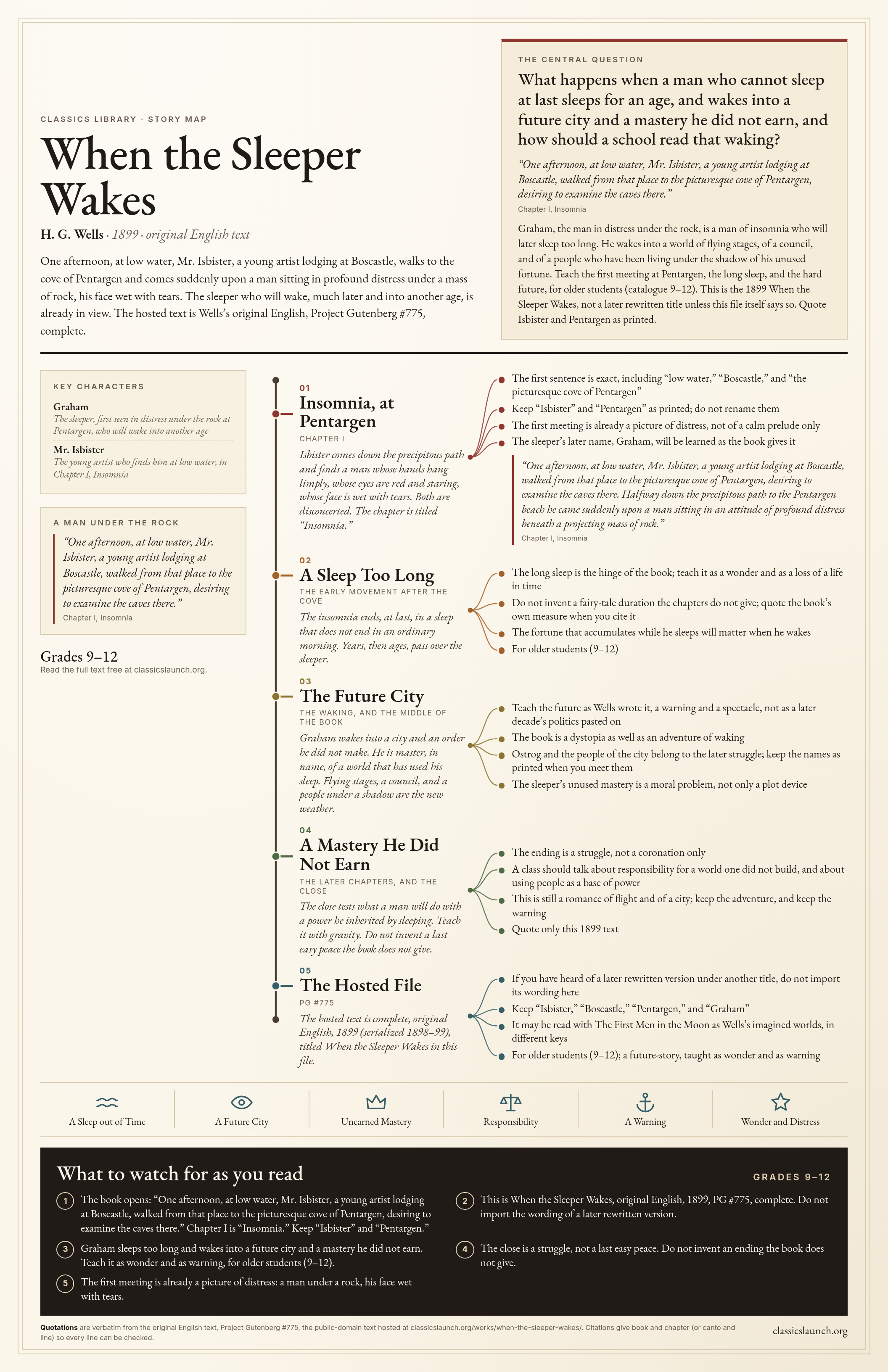
One afternoon, at low water, Mr. Isbister, a young artist lodging at Boscastle, walks to the cove of Pentargen and comes suddenly upon a man sitting in profound distress under a mass of rock, his face wet with tears. The sleeper who will wake, much later and into another age, is already in view. The hosted text is Wells’s original English, Project Gutenberg #775, complete.
The central question
What happens when a man who cannot sleep at last sleeps for an age, and wakes into a future city and a mastery he did not earn, and how should a school read that waking?
“One afternoon, at low water, Mr. Isbister, a young artist lodging at Boscastle, walked from that place to the picturesque cove of Pentargen, desiring to examine the caves there.”
Graham, the man in distress under the rock, is a man of insomnia who will later sleep too long. He wakes into a world of flying stages, of a council, and of a people who have been living under the shadow of his unused fortune. Teach the first meeting at Pentargen, the long sleep, and the hard future, for older students (catalogue 9–12). This is the 1899 When the Sleeper Wakes, not a later rewritten title unless this file itself says so. Quote Isbister and Pentargen as printed.
- 01
Insomnia, at Pentargen
Chapter I
Isbister comes down the precipitous path and finds a man whose hands hang limply, whose eyes are red and staring, whose face is wet with tears. Both are disconcerted. The chapter is titled “Insomnia.”
- The first sentence is exact, including “low water,” “Boscastle,” and “the picturesque cove of Pentargen”
- Keep “Isbister” and “Pentargen” as printed; do not rename them
- The first meeting is already a picture of distress, not of a calm prelude only
- The sleeper’s later name, Graham, will be learned as the book gives it
“One afternoon, at low water, Mr. Isbister, a young artist lodging at Boscastle, walked from that place to the picturesque cove of Pentargen, desiring to examine the caves there. Halfway down the precipitous path to the Pentargen beach he came suddenly upon a man sitting in an attitude of profound distress beneath a projecting mass of rock.”
- 02
A Sleep Too Long
The early movement after the cove
The insomnia ends, at last, in a sleep that does not end in an ordinary morning. Years, then ages, pass over the sleeper.
- The long sleep is the hinge of the book; teach it as a wonder and as a loss of a life in time
- Do not invent a fairy-tale duration the chapters do not give; quote the book’s own measure when you cite it
- The fortune that accumulates while he sleeps will matter when he wakes
- For older students (9–12)
- 03
The Future City
The waking, and the middle of the book
Graham wakes into a city and an order he did not make. He is master, in name, of a world that has used his sleep. Flying stages, a council, and a people under a shadow are the new weather.
- Teach the future as Wells wrote it, a warning and a spectacle, not as a later decade’s politics pasted on
- The book is a dystopia as well as an adventure of waking
- Ostrog and the people of the city belong to the later struggle; keep the names as printed when you meet them
- The sleeper’s unused mastery is a moral problem, not only a plot device
- 04
A Mastery He Did Not Earn
The later chapters, and the close
The close tests what a man will do with a power he inherited by sleeping. Teach it with gravity. Do not invent a last easy peace the book does not give.
- The ending is a struggle, not a coronation only
- A class should talk about responsibility for a world one did not build, and about using people as a base of power
- This is still a romance of flight and of a city; keep the adventure, and keep the warning
- Quote only this 1899 text
- 05
The Hosted File
PG #775
The hosted text is complete, original English, 1899 (serialized 1898–99), titled When the Sleeper Wakes in this file.
- If you have heard of a later rewritten version under another title, do not import its wording here
- Keep “Isbister,” “Boscastle,” “Pentargen,” and “Graham”
- It may be read with The First Men in the Moon as Wells’s imagined worlds, in different keys
- For older students (9–12); a future-story, taught as wonder and as warning
- A Sleep out of Time
- A Future City
- Unearned Mastery
- Responsibility
- A Warning
- Wonder and Distress
What to watch for as you read
Grades 9–12- The book opens: “One afternoon, at low water, Mr. Isbister, a young artist lodging at Boscastle, walked from that place to the picturesque cove of Pentargen, desiring to examine the caves there.” Chapter I is “Insomnia.” Keep “Isbister” and “Pentargen.”
- This is When the Sleeper Wakes, original English, 1899, PG #775, complete. Do not import the wording of a later rewritten version.
- Graham sleeps too long and wakes into a future city and a mastery he did not earn. Teach it as wonder and as warning, for older students (9–12).
- The close is a struggle, not a last easy peace. Do not invent an ending the book does not give.
- The first meeting is already a picture of distress: a man under a rock, his face wet with tears.
Every quotation is word for word from the original English text hosted in this library and is checked against that text each time the site is built. Citations give book and chapter (or canto and line).