Story maps · Grades 6–8
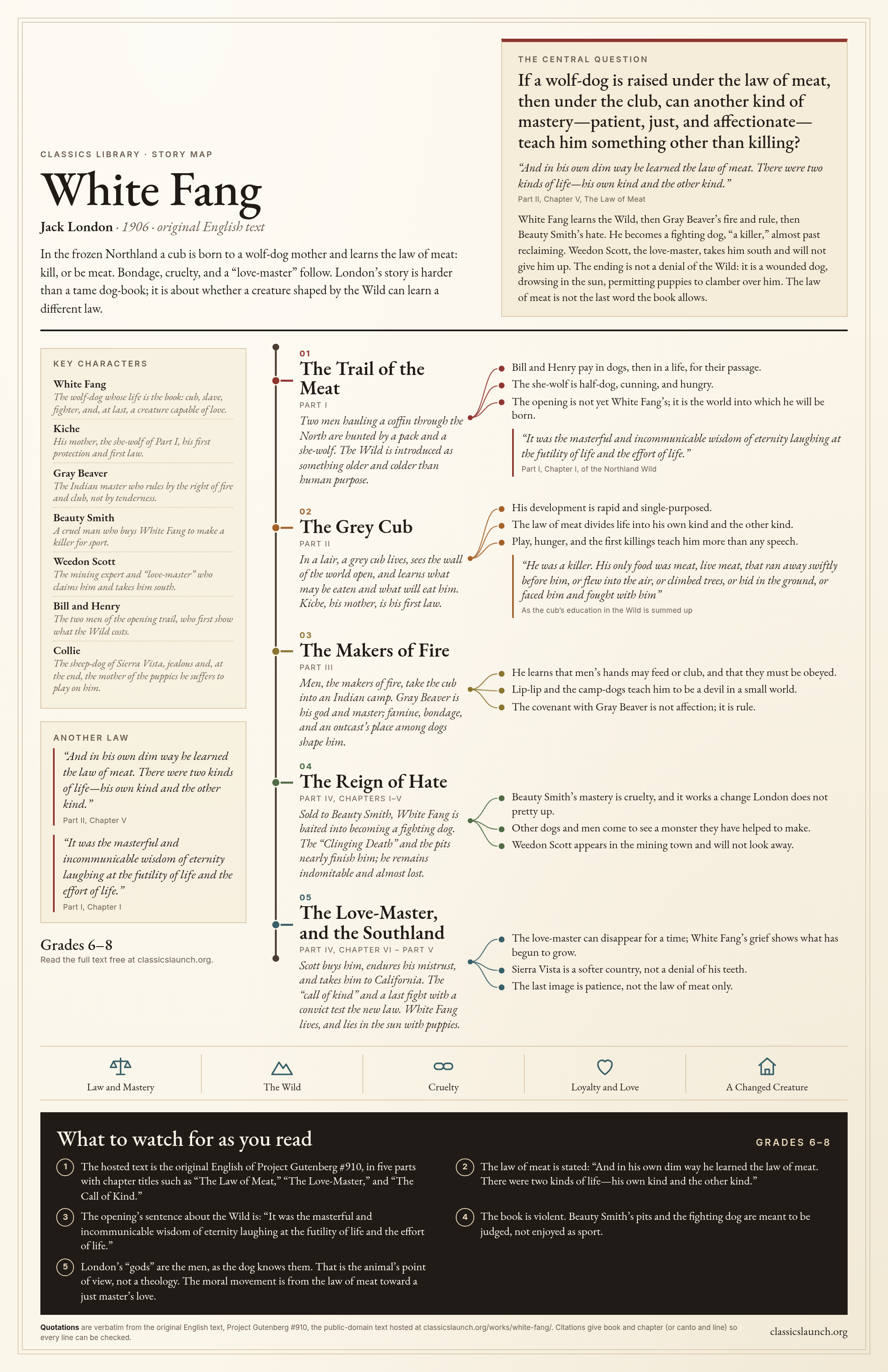
White Fang: A Story Map
The PDF is one tabloid page (11 × 17 in). On letter paper, choose “Fit to page.”
In the frozen Northland a cub is born to a wolf-dog mother and learns the law of meat: kill, or be meat. Bondage, cruelty, and a “love-master” follow. London’s story is harder than a tame dog-book; it is about whether a creature shaped by the Wild can learn a different law.
The central question
If a wolf-dog is raised under the law of meat, then under the club, can another kind of mastery—patient, just, and affectionate—teach him something other than killing?
“And in his own dim way he learned the law of meat. There were two kinds of life—his own kind and the other kind.”
White Fang learns the Wild, then Gray Beaver’s fire and rule, then Beauty Smith’s hate. He becomes a fighting dog, “a killer,” almost past reclaiming. Weedon Scott, the love-master, takes him south and will not give him up. The ending is not a denial of the Wild: it is a wounded dog, drowsing in the sun, permitting puppies to clamber over him. The law of meat is not the last word the book allows.
- 01
The Trail of the Meat
Part I
Two men hauling a coffin through the North are hunted by a pack and a she-wolf. The Wild is introduced as something older and colder than human purpose.
- Bill and Henry pay in dogs, then in a life, for their passage.
- The she-wolf is half-dog, cunning, and hungry.
- The opening is not yet White Fang’s; it is the world into which he will be born.
“It was the masterful and incommunicable wisdom of eternity laughing at the futility of life and the effort of life.”
- 02
The Grey Cub
Part II
In a lair, a grey cub lives, sees the wall of the world open, and learns what may be eaten and what will eat him. Kiche, his mother, is his first law.
- His development is rapid and single-purposed.
- The law of meat divides life into his own kind and the other kind.
- Play, hunger, and the first killings teach him more than any speech.
“He was a killer. His only food was meat, live meat, that ran away swiftly before him, or flew into the air, or climbed trees, or hid in the ground, or faced him and fought with him”
- 03
The Makers of Fire
Part III
Men, the makers of fire, take the cub into an Indian camp. Gray Beaver is his god and master; famine, bondage, and an outcast’s place among dogs shape him.
- He learns that men’s hands may feed or club, and that they must be obeyed.
- Lip-lip and the camp-dogs teach him to be a devil in a small world.
- The covenant with Gray Beaver is not affection; it is rule.
- 04
The Reign of Hate
Part IV, Chapters I–V
Sold to Beauty Smith, White Fang is baited into becoming a fighting dog. The “Clinging Death” and the pits nearly finish him; he remains indomitable and almost lost.
- Beauty Smith’s mastery is cruelty, and it works a change London does not pretty up.
- Other dogs and men come to see a monster they have helped to make.
- Weedon Scott appears in the mining town and will not look away.
- 05
The Love-Master, and the Southland
Part IV, Chapter VI – Part V
Scott buys him, endures his mistrust, and takes him to California. The “call of kind” and a last fight with a convict test the new law. White Fang lives, and lies in the sun with puppies.
- The love-master can disappear for a time; White Fang’s grief shows what has begun to grow.
- Sierra Vista is a softer country, not a denial of his teeth.
- The last image is patience, not the law of meat only.
- Law and Mastery
- The Wild
- Cruelty
- Loyalty and Love
- A Changed Creature
What to watch for as you read
Grades 6–8- The hosted text is the original English of Project Gutenberg #910, in five parts with chapter titles such as “The Law of Meat,” “The Love-Master,” and “The Call of Kind.”
- The law of meat is stated: “And in his own dim way he learned the law of meat. There were two kinds of life—his own kind and the other kind.”
- The opening’s sentence about the Wild is: “It was the masterful and incommunicable wisdom of eternity laughing at the futility of life and the effort of life.”
- The book is violent. Beauty Smith’s pits and the fighting dog are meant to be judged, not enjoyed as sport.
- London’s “gods” are the men, as the dog knows them. That is the animal’s point of view, not a theology. The moral movement is from the law of meat toward a just master’s love.
Every quotation is word for word from the original English text hosted in this library and is checked against that text each time the site is built. Citations give book and chapter (or canto and line).