Story maps · Grades 9–12
White Nights: A Story Map
The PDF is one tabloid page (11 × 17 in). On letter paper, choose “Fit to page.”
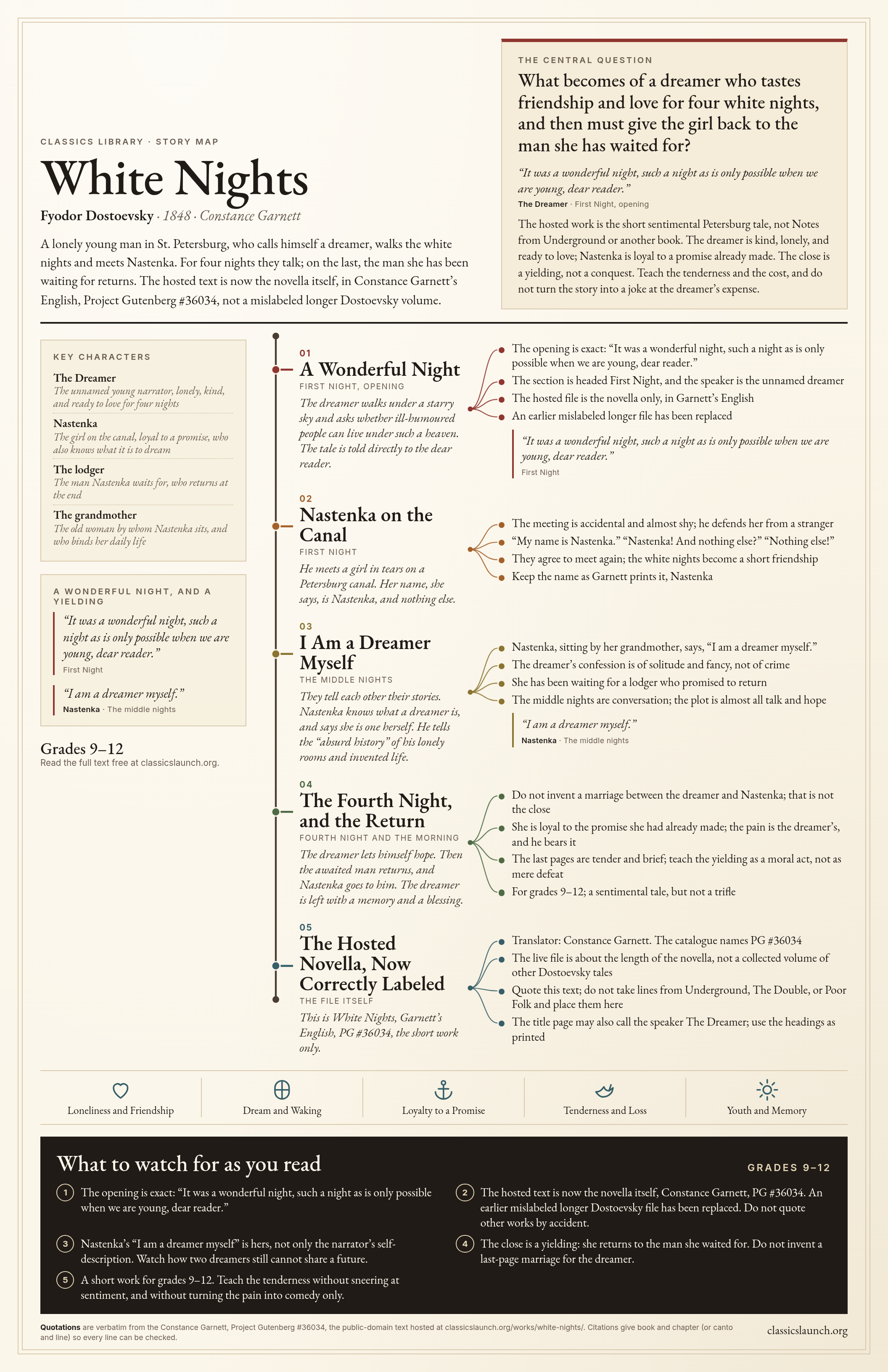
A lonely young man in St. Petersburg, who calls himself a dreamer, walks the white nights and meets Nastenka. For four nights they talk; on the last, the man she has been waiting for returns. The hosted text is now the novella itself, in Constance Garnett’s English, Project Gutenberg #36034, not a mislabeled longer Dostoevsky volume.
The central question
What becomes of a dreamer who tastes friendship and love for four white nights, and then must give the girl back to the man she has waited for?
“It was a wonderful night, such a night as is only possible when we are young, dear reader.”
The hosted work is the short sentimental Petersburg tale, not Notes from Underground or another book. The dreamer is kind, lonely, and ready to love; Nastenka is loyal to a promise already made. The close is a yielding, not a conquest. Teach the tenderness and the cost, and do not turn the story into a joke at the dreamer’s expense.
- 01
A Wonderful Night
First Night, opening
The dreamer walks under a starry sky and asks whether ill-humoured people can live under such a heaven. The tale is told directly to the dear reader.
- The opening is exact: “It was a wonderful night, such a night as is only possible when we are young, dear reader.”
- The section is headed First Night, and the speaker is the unnamed dreamer
- The hosted file is the novella only, in Garnett’s English
- An earlier mislabeled longer file has been replaced
“It was a wonderful night, such a night as is only possible when we are young, dear reader.”
- 02
Nastenka on the Canal
First Night
He meets a girl in tears on a Petersburg canal. Her name, she says, is Nastenka, and nothing else.
- The meeting is accidental and almost shy; he defends her from a stranger
- “My name is Nastenka.” “Nastenka! And nothing else?” “Nothing else!”
- They agree to meet again; the white nights become a short friendship
- Keep the name as Garnett prints it, Nastenka
- 03
I Am a Dreamer Myself
The middle nights
They tell each other their stories. Nastenka knows what a dreamer is, and says she is one herself. He tells the “absurd history” of his lonely rooms and invented life.
- Nastenka, sitting by her grandmother, says, “I am a dreamer myself.”
- The dreamer’s confession is of solitude and fancy, not of crime
- She has been waiting for a lodger who promised to return
- The middle nights are conversation; the plot is almost all talk and hope
“I am a dreamer myself.”
- 04
The Fourth Night, and the Return
Fourth Night and the morning
The dreamer lets himself hope. Then the awaited man returns, and Nastenka goes to him. The dreamer is left with a memory and a blessing.
- Do not invent a marriage between the dreamer and Nastenka; that is not the close
- She is loyal to the promise she had already made; the pain is the dreamer’s, and he bears it
- The last pages are tender and brief; teach the yielding as a moral act, not as mere defeat
- For grades 9–12; a sentimental tale, but not a trifle
- 05
The Hosted Novella, Now Correctly Labeled
The file itself
This is White Nights, Garnett’s English, PG #36034, the short work only.
- Translator: Constance Garnett. The catalogue names PG #36034
- The live file is about the length of the novella, not a collected volume of other Dostoevsky tales
- Quote this text; do not take lines from Underground, The Double, or Poor Folk and place them here
- The title page may also call the speaker The Dreamer; use the headings as printed
- Loneliness and Friendship
- Dream and Waking
- Loyalty to a Promise
- Tenderness and Loss
- Youth and Memory
What to watch for as you read
Grades 9–12- The opening is exact: “It was a wonderful night, such a night as is only possible when we are young, dear reader.”
- The hosted text is now the novella itself, Constance Garnett, PG #36034. An earlier mislabeled longer Dostoevsky file has been replaced. Do not quote other works by accident.
- Nastenka’s “I am a dreamer myself” is hers, not only the narrator’s self-description. Watch how two dreamers still cannot share a future.
- The close is a yielding: she returns to the man she waited for. Do not invent a last-page marriage for the dreamer.
- A short work for grades 9–12. Teach the tenderness without sneering at sentiment, and without turning the pain into comedy only.
Every quotation is word for word from the Constance Garnett hosted in this library and is checked against that text each time the site is built. Citations give book and chapter (or canto and line).