Story maps · Grades 11–12
To the Lighthouse: A Story Map
The PDF is one tabloid page (11 × 17 in). On letter paper, choose “Fit to page.”
On an island in the Hebrides, Mrs. Ramsay promises her son that they will go to the lighthouse if it is fine tomorrow. The visit is delayed by weather, by time, and by death. Years later, the remaining household makes the crossing, and Lily Briscoe, finishing a picture, has her vision. The hosted text is the complete 1927 novel, public domain in the United States.
The central question
What holds a family and a day’s promise together when time, death, and the work of art have all had their say, and the boat has at last gone to the lighthouse?
“Yes, of course, if it's fine tomorrow," said Mrs. Ramsay. "But you'll have to be up with the lark," she added.”
The book is in three movements: The Window, Time Passes, and The Lighthouse. Mrs. Ramsay’s promise to James opens the work; her death is recorded, briefly, in the middle movement; the later crossing and Lily’s picture close it. Teach the moral weight of a promise, of marriage, of grief, and of a finished work. Do not flatten the novel into a mere stream of impressions.
- 01
If It’s Fine Tomorrow
The Window, opening
Mrs. Ramsay tells James that they will go to the lighthouse if it is fine. The words convey an extraordinary joy, as if the expedition were already settled.
- The novel opens, after the heading THE WINDOW, with Mrs. Ramsay’s sentence, exact in this text, including “you'll have to be up with the lark”
- Mr. Ramsay will say that it will not be fine; the child’s anger at the father begins here
- The house is full of guests: Lily Briscoe, Charles Tansley, the children, the friends
- The first movement is one long day and evening, ending in a dinner and a marriage promised between two of the young
“Yes, of course, if it's fine tomorrow," said Mrs. Ramsay. "But you'll have to be up with the lark," she added.”
- 02
The Window
The first movement
Mrs. Ramsay knits, comforts, arranges, and holds the household in a shape. Mr. Ramsay strides on the terrace, needing sympathy. Lily begins a painting she cannot yet finish.
- The marriage of Mr. and Mrs. Ramsay is a real bond, with real friction; teach both
- Lily’s picture, and her doubt whether women can paint, belong to this movement
- The dinner is the first movement’s formal close, a brief order made around a table
- James’s desire for the lighthouse is not a small wish only; it is how love and disappointment enter the book
- 03
Time Passes
The second movement
Years go over the house. Deaths are recorded in brackets, almost as if in passing. The house decays, and is at last put in order again.
- Mrs. Ramsay’s death is told briefly, in the manner of this movement; teach it with gravity, not as a trick
- Other losses in the family are recorded in the same spare way
- The empty house, the air, the sea, and the charwoman’s work occupy the middle of the book
- For older students (11–12); grief is the point, not spectacle
- 04
The Crossing
The Lighthouse, the voyage
Mr. Ramsay, James, and Cam at last go out in the boat. The old quarrel between father and son is still alive, and is in some measure laid to rest before they land.
- The expedition Mrs. Ramsay promised is made years later, without her
- James and Cam have their own reckoning with their father on the water
- Lily, on the lawn, watches the boat and works at the picture
- Do not treat the landing as a simple happy ending; it is a fulfillment and a loss together
- 05
I Have Had My Vision
The last page
Lily looks at the canvas, draws a line, and is done. “I have had my vision.”
- The last sentence of her thought is exact: “I have had my vision.”
- Just before, of the landing, she has also said, “It is finished.”
- The hosted text is the complete 1927 novel, from the Project Gutenberg Australia file, public domain in the US (published 1927)
- Quote Woolf’s wording; do not tidy her punctuation or her section numbers
“I have had my vision.”
- Promise and Delay
- Time and Grief
- Marriage and Family
- The Work of Art
- Father and Child
- Vision
What to watch for as you read
Grades 11–12- The opening is exact: “Yes, of course, if it's fine tomorrow,” said Mrs. Ramsay. “But you'll have to be up with the lark,” she added. James’s joy at those words is how the book begins.
- The last thought is Lily’s: “I have had my vision.” Just before, she has said of the landing, “It is finished.” Do not invent a speech for Mrs. Ramsay at the close; she is already gone.
- The middle movement records deaths briefly, in brackets. Teach them with gravity. The method is spare; the loss is not.
- The hosted text is the complete 1927 novel, public domain in the United States, from the Project Gutenberg Australia source named in the catalogue. It is original English, not a retelling.
- For older students (11–12). The book is difficult in method and serious in grief; it is also about a promise kept late, and about work finished at last.
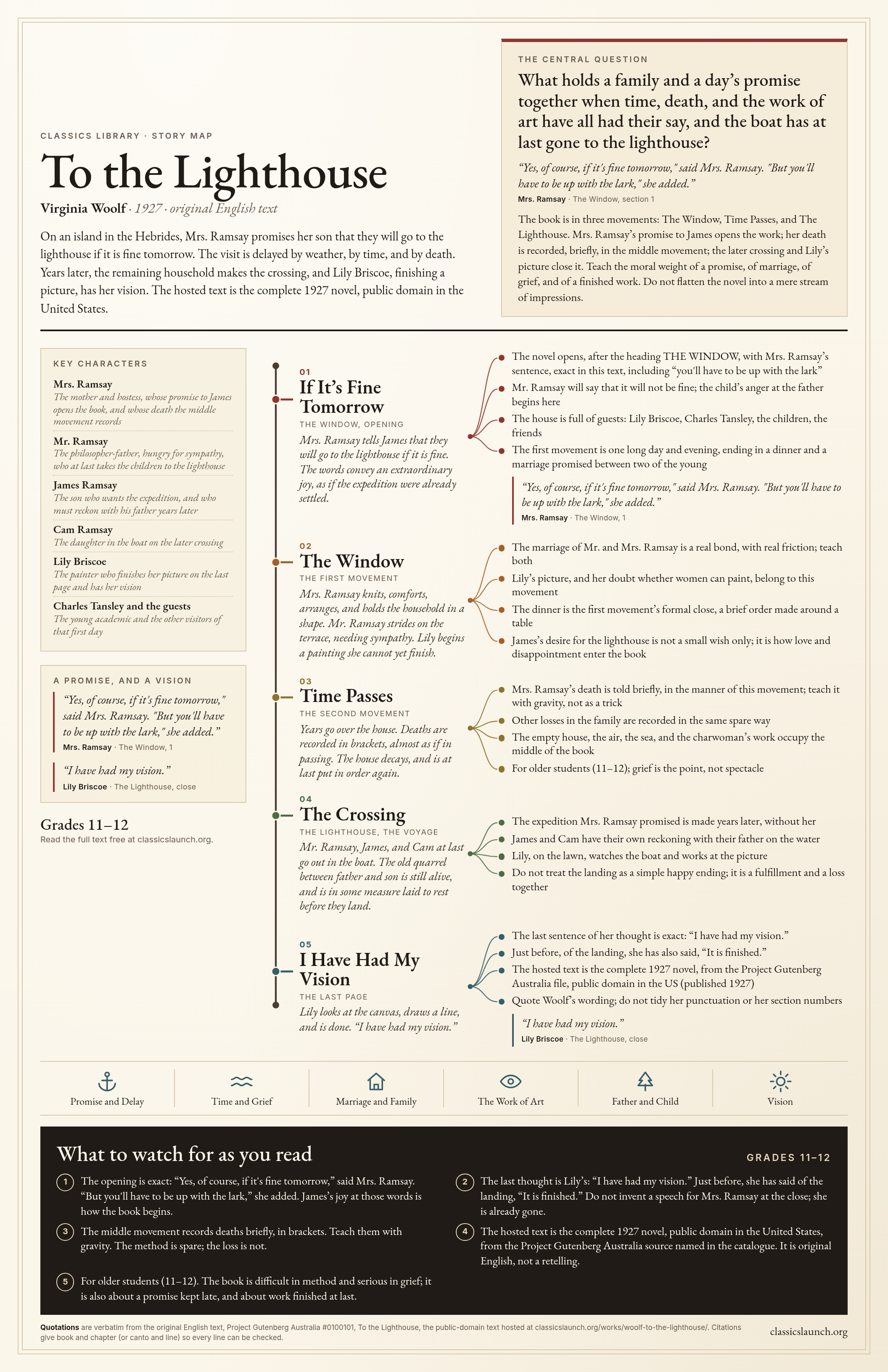
Every quotation is word for word from the original English text hosted in this library and is checked against that text each time the site is built. Citations give book and chapter (or canto and line).