Story maps · Grades 9–12
The Thorn: A Story Map
The PDF is one tabloid page (11 × 17 in). On letter paper, choose “Fit to page.”
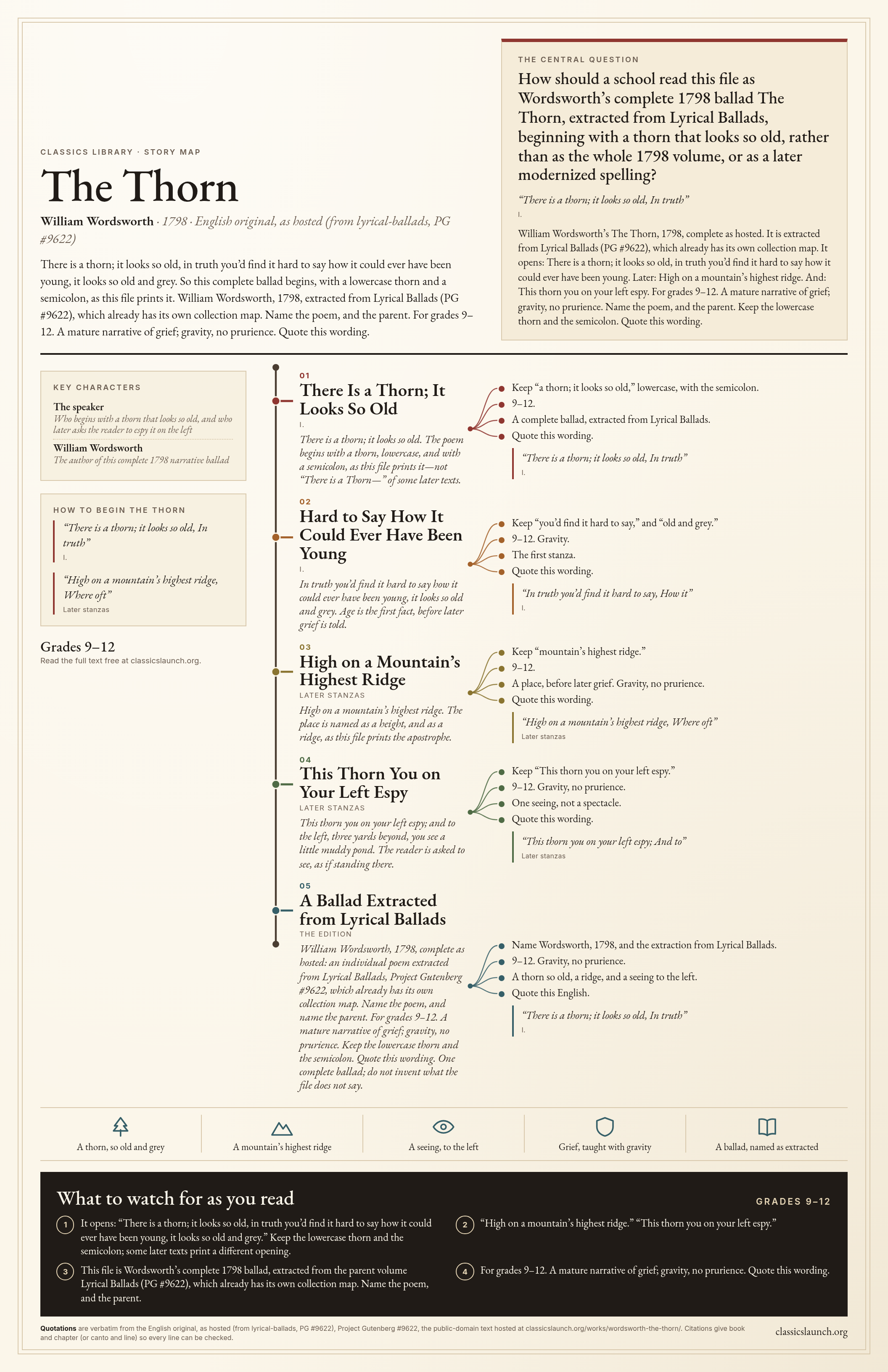
There is a thorn; it looks so old, in truth you’d find it hard to say how it could ever have been young, it looks so old and grey. So this complete ballad begins, with a lowercase thorn and a semicolon, as this file prints it. William Wordsworth, 1798, extracted from Lyrical Ballads (PG #9622), which already has its own collection map. Name the poem, and the parent. For grades 9–12. A mature narrative of grief; gravity, no prurience. Quote this wording.
The central question
How should a school read this file as Wordsworth’s complete 1798 ballad The Thorn, extracted from Lyrical Ballads, beginning with a thorn that looks so old, rather than as the whole 1798 volume, or as a later modernized spelling?
“There is a thorn; it looks so old, In truth”
William Wordsworth’s The Thorn, 1798, complete as hosted. It is extracted from Lyrical Ballads (PG #9622), which already has its own collection map. It opens: There is a thorn; it looks so old, in truth you’d find it hard to say how it could ever have been young. Later: High on a mountain’s highest ridge. And: This thorn you on your left espy. For grades 9–12. A mature narrative of grief; gravity, no prurience. Name the poem, and the parent. Keep the lowercase thorn and the semicolon. Quote this wording.
- 01
There Is a Thorn; It Looks So Old
I.
There is a thorn; it looks so old. The poem begins with a thorn, lowercase, and with a semicolon, as this file prints it—not “There is a Thorn—” of some later texts.
- Keep “a thorn; it looks so old,” lowercase, with the semicolon.
- 9–12.
- A complete ballad, extracted from Lyrical Ballads.
- Quote this wording.
“There is a thorn; it looks so old, In truth”
- 02
Hard to Say How It Could Ever Have Been Young
I.
In truth you’d find it hard to say how it could ever have been young, it looks so old and grey. Age is the first fact, before later grief is told.
- Keep “you’d find it hard to say,” and “old and grey.”
- 9–12. Gravity.
- The first stanza.
- Quote this wording.
“In truth you’d find it hard to say, How it”
- 03
High on a Mountain’s Highest Ridge
Later stanzas
High on a mountain’s highest ridge. The place is named as a height, and as a ridge, as this file prints the apostrophe.
- Keep “mountain’s highest ridge.”
- 9–12.
- A place, before later grief. Gravity, no prurience.
- Quote this wording.
“High on a mountain’s highest ridge, Where oft”
- 04
This Thorn You on Your Left Espy
Later stanzas
This thorn you on your left espy; and to the left, three yards beyond, you see a little muddy pond. The reader is asked to see, as if standing there.
- Keep “This thorn you on your left espy.”
- 9–12. Gravity, no prurience.
- One seeing, not a spectacle.
- Quote this wording.
“This thorn you on your left espy; And to”
- 05
A Ballad Extracted from Lyrical Ballads
The edition
William Wordsworth, 1798, complete as hosted: an individual poem extracted from Lyrical Ballads, Project Gutenberg #9622, which already has its own collection map. Name the poem, and name the parent. For grades 9–12. A mature narrative of grief; gravity, no prurience. Keep the lowercase thorn and the semicolon. Quote this wording. One complete ballad; do not invent what the file does not say.
- Name Wordsworth, 1798, and the extraction from Lyrical Ballads.
- 9–12. Gravity, no prurience.
- A thorn so old, a ridge, and a seeing to the left.
- Quote this English.
“There is a thorn; it looks so old, In truth”
- A thorn, so old and grey
- A mountain’s highest ridge
- A seeing, to the left
- Grief, taught with gravity
- A ballad, named as extracted
What to watch for as you read
Grades 9–12- It opens: “There is a thorn; it looks so old, in truth you’d find it hard to say how it could ever have been young, it looks so old and grey.” Keep the lowercase thorn and the semicolon; some later texts print a different opening.
- “High on a mountain’s highest ridge.” “This thorn you on your left espy.”
- This file is Wordsworth’s complete 1798 ballad, extracted from the parent volume Lyrical Ballads (PG #9622), which already has its own collection map. Name the poem, and the parent.
- For grades 9–12. A mature narrative of grief; gravity, no prurience. Quote this wording.
Every quotation is word for word from the English original, as hosted (from lyrical-ballads, PG #9622) hosted in this library and is checked against that text each time the site is built. Citations give book and chapter (or canto and line).